An Irish Legend

Most of his stories are based in small towns and villages of 1950s Ireland. He writes about the underdog: small men and hard-done-by women. He has a deep concern for sexual exiles. His writing is true to that time in history because he normalizes silence, evasion and ambiguity. His fiction reads like truth. It reminds me of the time we lived in Northern Ireland. Almost every day I was flummoxed by the response I got on asking a colleague, how they were.

“Not too bad.”

I was never sure what that meant. Were they well? Or not as well as before? Or not as unwell as before? Not as well as they could be? Bad, but not too bad? I soon came to accept that as normal. In time I came to understand it as a safe answer – not giving away too much. It was historical.

William Trevor was a genius at talking about the unknown known, of knowing and not knowing at the same time. A cognitive disjunction. A common social ailment.

Yes. Mary Louise is in a loveless marriage to an older man and everyone in their small town knows but they pretend like they don’t.

Yes. Everyone knows that Elmer is becoming an alcoholic, but they act like they don’t.

I lately read ‘Two Lives: Reading Turgenev & My House in Umbria’ – a book with two artful novellas by Trevor. Reading Turgenev was shortlisted for the Booker Prize in its time. My House in Umbria was made into a film in 2003, available on YouTube. I haven’t watched it but apparently Maggie Smith is brilliant and the end has been changed for Hollywood.

For me, the protagonists of both these stories exemplify how hidden and unacknowledged grief can escort one to the thin red line between sanity and insanity. Both women are poorly understood even by people who claim to love them, their coping labelled as unacceptable, erratic and bonkers. Judged, condemned and outcast for simply managing their losses. Punished for somehow managing their loss. And finally, put away.
Joyland

Islam forbids suicide. It calls it a grave sin or ‘haraam’. It is viewed as taking away the gifts of life given by God. The Qu’ran says, trust God, have faith in the mercy of God and do not destroy life.

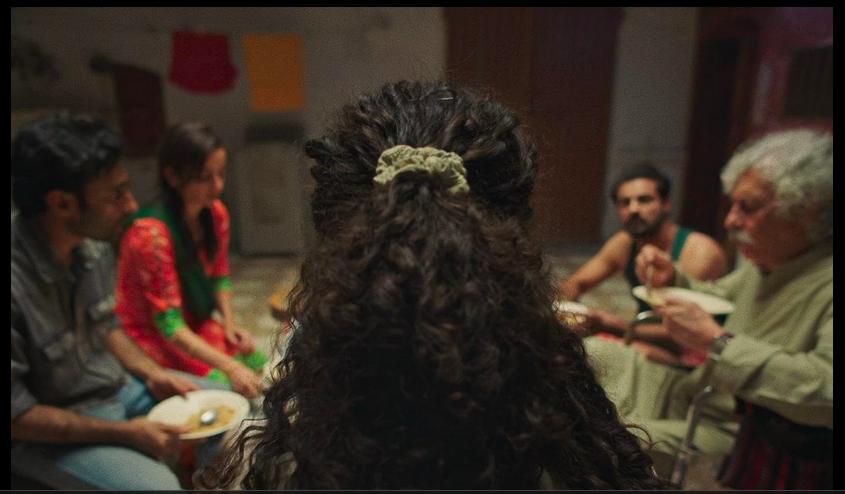
Joyland is a bold film, the first Pakistani feature to be premiered at Cannes in 2022.

It is about being alone in a crowd of expectations, being punished for having secret desires and accidentally making them seen. It is about someone else having to pay the price for our impulsive indiscretions, about how the bucket of shame topples itself on our heads as soon as we allow our innermost wants to be visible. It talks about how others can forcibly live their dreams through us, how our roles in society hold us firmly in one place and make us invisible as individuals, how we don’t have permission to be confused and are not allowed the time and space to think and talk things through, how life can be cluttered and noisy.  It’s about knowing you want to ‘run away’ but not knowing what that means or looks like. It’s about having to figure all this out, all by yourself.

It’s about treasuring moments of joy when they arise.

They could be hidden in the kitchen, on the Ferris wheel or inside the pages of an old book.

The innocence of others

How I envy the lives of those, who have never been touched by suicide. What must be the quality of their minds? Their being must be so clean, un-spattered with blood. How I miss the old me of the world ‘before’, however ignorant and self-absorbed I was. My smile used to reach my eyes. It conveyed something real and complete about me. Now my eyes thirst to see that one sweet face. My smile is a faded and false version of its former self. A nicety that makes futile attempts to cover up for a heart that bleeds all the time.

When I look at photographs of women’s faces, I can tell the ones who have lost big chunks of their hearts. Their eyes are miles away from their smiles. Searching. Hungry for that part of their story which disappeared. I know that hunger. I envy all the other eyes, that sparkle.

Oh yes. I make up condolences for myself. Isn’t it a blessing that he didn’t have to go through the treachery of the lock-downs, he doesn’t have to worry about getting on the property ladder or about nations at war or about the appalling state of world leadership or about the rising fuel prices or about increasing world poverty or about some woman breaking his heart, about offending someone by asking a simple question. And climate change. He doesn’t need to deal with all this nonsense ever. Lucky bastard.

I turned to the kid’s section at our local library to rediscover the lost child in me and found ‘Charlotte’s web’ by E B White. I loved Fern, the little girl who could understand animal sentiments and conversations. I met Wilbur, who was ‘some pig’, terrific, radiant and humble and Templeton, the annoying rat. Charlotte, the spider, was adorable, a kind and benevolent friend. That’s the world I want to live in.

I think I’ll be visiting the children’s section of the library more often. This Easter, we shall watch all three Kung Fu Panda films, in preparation for the fourth one coming soon. Maybe we can fit in some Madagascar too 😉