Human rights issue – Families Matter

Hundreds of times, in waiting rooms outside Intensive Care Units I have looked into the eyes of sons and daughters, spouses and partners of patients, held their hands and said, “We did all we could. I am so sorry for your loss.”

When Saagar died, no one looked into my eyes and said that to me. They had not done all they could for him. The hospital carried out a sham investigation, a futile exercise in ‘being seen’ to be doing the right thing.

The GMC found everything to be hunky dory. The doctors ‘looking after’ Saagar had done their jobs to perfection. Just too bad the patient was dead. They did not deem Saagar’s case worthy of an investigation. GMC’s role in its own words:

We work to protect patient safety and support medical education and practice across the UK.”

The Coroner’s report shone some light on the holes in Saagar’s care. It clearly pointed out the things that South London and Maudsley (SLaM) Hospital got wrong.

  1. There was a general failure to identify the diagnosis on the discharge summary from the Home Treatment Team to the GP.
  2. There was a general failure to communicate thoroughly enough with the parents about the relapse symptoms, what to watch out for and where to go for help in the future.

Last June, I wrote to the CEO of SLaM, requesting an update on the changes that had been made in his organisation in response to the Coroner’s findings above. He said someone would get back to me and I heard nothing. This June, I sent him a reminder and again he said someone would get back to me and I am still waiting.

What are my rights as a parent? Is this too much to ask?

What were Saagar’s rights as a young man with a mental illness?

Are our lives not as important as anyone else’s? Black or white or brown? With Cancer or Diabetes? Or Bipolar Disorder?

Everyone deserves to be heard and seen. With respect.

It’s not charity. It’s a human rights issue.

Ref: Learning from deaths: Guidance for NHS trusts on working with bereaved families and carers

Could I?

She ran around chasing her multiple ‘to-do’ lists the whole time. She managed to tick things off it with fare speed. Yet her chores never ended. She didn’t allow herself the slightest slip-up. She slowed down for nothing or no one. Despite running herself down she kept carrying on. Yet she thought she wasn’t quite hitting the mark. There was so much more to do. She lived so much in the future that she could never see the landscape of her own heart or anyone else’s. She didn’t know that if your own cup is empty, you can’t fill someone else’s.

She thought she had everything under control. She didn’t ask anyone for help or advice. Even if they offered it, she seldom took it. She did her own thing. Deep down she knew that she didn’t know best but had no idea how to admit it. She took herself way too seriously. She bull-dozed her way around the marshland of her life and crushed a poor little soul every now and then. She didn’t know how to apologise even when she was truly sorry.

She took herself off to far-away places as and when she fancied, oblivious of the impact it would have on those left behind. She just wanted to fly high, be happy, be free. She made it look like she had it all figured out when in fact, she was lost. She had no names for her feelings. Somewhere along the way she had learnt that it was ok to be a martyr and a bully and she managed to play both those roles to perfection. She didn’t know that it wasn’t ‘hard work’ but kindness that made a life good.

She had been unfulfilled and ignorant in so many ways for so many years but she had no clue. She was under the impression that she was successful. There was so much that she did not know. But none of it was her fault.

Could I forgive her?

She was the mother of my son before Day 0.

Could I accept her? Even love her? Embrace her? Could I?

Our own voices

Paramedics and trainee paramedics rotate through our Department of Anaesthesia to learn to manage airways safely. A few weeks ago, I had a young man in his mid-thirties, a trainee paramedic with me, learning about airway management. Out of curiosity I asked him, “What is the most annoying part of your job?” He was straight-up, “When people inflict injuries on themselves, I think it’s such a waste of time. It takes away from others with real problems, who really need our attention.” I just smiled. I wasn’t surprised. I know full well that paramedics do a great job of looking after all kinds of people in all kinds of trouble. But attitudes can only be changed through education.

A professor of Psychiatry tweeted today “Twice in the last week I’ve been told of cruel comments by health staff to people who had self-harmed. I really believe this is unusual now but it shows there is something deep-rooted that we have to eradicate.” A classic example of ignorance within medicine of attitudes within medicine.

No training of first responders is complete till someone with lived experience of a mental illness has spoken with them, be it a police academy, social workers, fire fighters, nursing or medical students or ambulance crew. Lived experience includes suicide attempt survivors, others who have experienced a suicidal crisis and those who have lost a loved one to suicide. Sharing by these individuals can be a powerful agent for challenging prejudice and generating hope for people at risk. It enriches the participant’s understanding of how people with these serious disorders cope with their symptoms, recover and lead productive lives with hope, meaning and dignity. The program also empowers those who are faced with mental illness and provides living proof that recovery is an ongoing reality. Presenters gain confidence and self-esteem while serving as role models for the community.

Disproportionate focus on research and clinical expertise too frequently fails to see the person at the centre of a crisis as well as their loved ones who ride the wave of terror of suicidal behaviour. This needs to change and with urgency.

Lived Experience is an underutilised and underappreciated resource in the UK.

Roses in the ocean, a charity in Australia is an excellent example of harnessing this invaluable resource and making a huge difference.

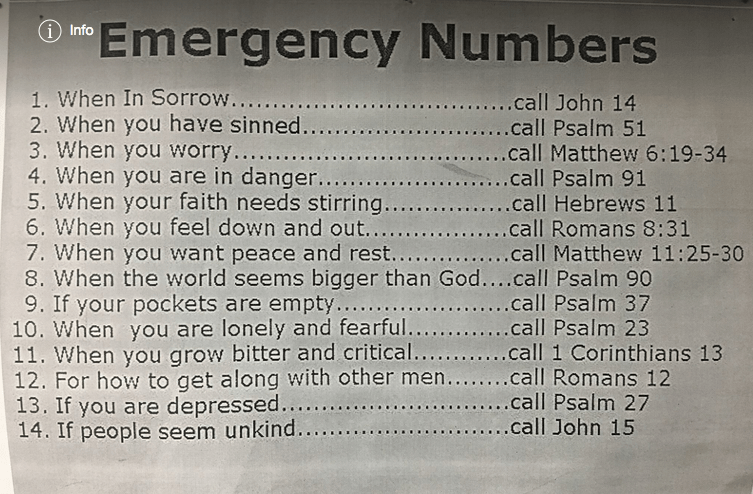
Emergency Numbers

Earlier this year, at a Medical school in North India I spoke to staff and students about the stigma and ignorance around Mental Health. At the end of the lecture one of the senior faculty members asked me a question, “Is it helpful for people with a mental illness to be a part of a religious community?”

‘Yes’, I said. ‘Most certainly. Just like it is helpful for someone with Diabetes to be part of a religious community. It might also be a good idea for them to see a doctor.’

Earlier that day Si and I had taken a walk around the hospital and found this list of ‘Emergency Numbers’ prominently displayed on a notice board in the medical library for medical students, nursing students, dentists and doctors.

Need I say any more?  

PS: It is important for every student in every educational organisation to have ready access to reliable and knowledgeable resources if they feel the need to discuss their thoughts and feelings or are concerned about a friend.

Come October

3/10/2019. 6 am: I am excited. At the airport, waiting to board my flight to Washington Dulles. Change to another flight to Manchester and then a taxi ride to Concord, New Hampshire. This is the first leg of my travels as a Churchill Fellow. I have checked in and am having a cup of tea. I have just come across this post from a young woman on Facebook:

“According to my local crisis team, I was ‘too articulate’ to be feeling suicidal.
As a writer, and someone who works in languages, I am a naturally very articulate person. Because I could speak so clearly about my thoughts and feelings, I was discharged from the crisis team as I didn’t fit the bill of someone suicidal, or indeed, of being mentally unwell enough to need their support despite evidence to the contrary.

The Papyrus text line allowed me to articulate how I felt (you don’t have any choice really when you’re using the text service, you have to ‘say’ it how it is!!), and that was delved into so much deeper with thoughtful questions, suggestions and recommendations that allowed me to get through a real low point and see that there was hope. At no stage did they reply with ‘sorry, you’re too articulate to be feeling the way you claim’.

Non-judgemental, kind, compassionate, a REAL life saver, especially in the current climate of NHS mental health cuts.”

Judgement. The ultimate wall. Even a positive judgement can be harmful. A missed opportunity. A lost life. Who fills the gaping holes created by ‘unfit for purpose’ services, NHS cuts and ignored carers?

Charities. Families. Friends.

The needs of young people are different. They need an active, positive and creative interaction to make sense of how they feel. They need to be heard and understood. They need to know in their hearts that they are deeply loved and cared for just the way they are. They need to know that things get better. Educating families is crucial.

4/10/2019

Today’s gem: Mayo Clinic video for parents. All parents of adolescents should see this.