Day 764

paratrooper

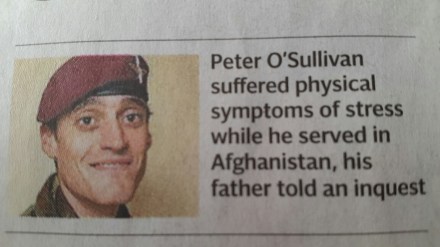
He served for 10 years in the Parachute Regiment. He had witnessed and been a part of ‘very severe military activity’ in Afghanistan as a result of his service in the elite Pathfinder Platoon. He left the army in 2010 and started to work in close protection in Iraq. In 2012 he married a Thai woman who commented that 2 years later he ‘wasn’t good’.

He sought help from the Combat Stress charity (http://www.combatstress.org.uk/) in December. A nurse referred him to a Consultant Psychiatrist as she felt he might have PTSD. His father noticed that Pete had started to have a tic and facial problems and that was a clear indication that he was suffering from deep psychological trauma. The psychiatric appointment was available for a date 4 months away, in April. Faced with this long wait, Pete went back to Iraq for 2 months. He returned home briefly before flying to Vietnam for a kite-surfing course. Pete never went on the course and sadly ended his life in Vietnam in February.

The Coroner heard that drugs were found in Pete’s blood and ruled there was insufficient evidence for either suicide or accidental death. His family are hoping that the authorities will recognise Pete’s death as a direct result of PTSD resulting from his service. They want his name to be included at the National Memorial Arboretum.

Another tragic loss of a young life, not getting timely help despite asking for it. Another family lost, not knowing exactly how to help their young man. Another suicide not registered as such, adding to the underestimation of the national scandal that it is. Another charity, offering more assistance than the NHS. Another child not coming home for Christmas.

Preventable? Yes.

RIP Pete. 


Day 736

In the NHS, staff morale is at an all time low.

Non-UK staff have been insulted by the Secretary of State and Prime Minister and made to feel that their work is not appreciated and their presence neither wanted nor likely to be tolerated in the not too distant future. Considering that at least one-third of the NHS staff has its origins outside of the UK, this does not bode well for the future.

Our medical students are threatened with financial handcuffs to tie them to the NHS for four years as if they hadn’t already paid tuition fees and won’t be going on to pay punitive taxes for the rest of their careers. Junior doctors are being subjected to an unnecessary new contract which is unsafe and unfair, that they voted against and that discriminates against women, less than full time workers and those who wish to improve themselves as doctors by undertaking research or further training.

The salaries have been falling since 2003. Meanwhile, hovering in the background, there have been two years of national negotiations about a potential new and toxic consultant contract. The press continues to make doctors look lazy and loaded. Fewer school kids are applying for places in medical schools than ever before. More junior doctors are looking for jobs abroad than ever before.

The UK environment for doctors is not attractive.


Day 725

Another story.
Another young man.
Another family.
Another mother.
Same themes. Same gaps. Same cover-ups.

“Y went to University, experiencing life away from home for the first time. Although only a 40-minute train journey away, he lived in halls of residence, sharing a flat with four other students. I saw him at least once every fortnight and although I knew he was upset at the break up of his first serious relationship, there were no signs that he was struggling to cope with his studies or not enjoying university life. He appeared to be the same quirky teenager who made friends easily and faced challenges full on.

One Sunday he failed to come home for lunch with the family. Frantic, I drove to his halls where an ambulance and police car were parked and I was given the news that our beloved son was gone. It was another 24 hours before we discovered he had completed suicide. Nothing could have prepared me or our family.

Five months later we attended an inquest into his death where an open verdict was recorded, and the Coroner claimed that everything possible had been done by health care professionals to support Y following a university doctor diagnosing him with depression and prescribing anti-depressants. He had been referred for counselling and his university tutor was informed.

At the inquest, the GP had legal representation. A representative of the university’s counselling service gave evidence on behalf of the counsellor; a statement was read out from a doctor who had admitted Y to hospital following two incidents of self-harm, and another statement was read from the university tutor in whom Y had confided.

As a family, we sat completely dumbfounded that all of these people knew that our child was suffering from mental health issues. Not one of them had contacted any of us, or identified us as a ‘safety contact’, yet felt the need to be legally and professionally protected in court.

Just one month after starting university and following the break-up with his girlfriend, Y made his first suicide attempt. We were not informed. The reason we were given was that he was an adult and all of the professionals involved had a duty to respect his confidentiality. The counsellor’s representative commented that it was ‘possible’ that it ‘may have been suggested’ that Y talk to me about his situation, but she could not confirm that this was the case.

Had Lawrence been involved in any sort of accident then I would have been contacted immediately, but because his admission was a mental health issue the veil of confidentiality came down and prioritised clinical staff welfare rather than that of my son.

Did we as a family – or me, specifically, as his mother – fail him? We failed to see his suffering, but when he was around us he was the usual Y we all knew and loved.

Did the university fail him? Yes, they should have informed his emergency contact/next of kin that he had expressed suicidal thoughts.

Did the clinicians fail him? Yes, by averting culpability and absolving themselves within a care system culture that protects its own and isolates the patient from their family – the people closest to them and those who would have provided the love, care and protection that could have saved a young life.

As a family we felt that the ‘professionals’ closed ranks to protect themselves. In the weeks leading up to that awful day, and the months before the inquest, their self-protective instincts mattered more than the duty of care they had towards protecting our son Y, a caring, funny, intelligent young man with a whole lifetime of adventures in front of him.”

NO CONFIDENTIALITY WHEN IT COMES TO SUICIDE.

In Jan 2014, an official document was published – “Consensus statement on information sharing” (https://www.gov.uk/government/uploads/system/uploads/attachment_data/file/271792/Consensus_statement_on_information_sharing.pdf)

“The statement applies to adults in England. Information can be shared where it is in the public interest to do so. In practice, this means that practitioners should disclose information to an appropriate person or authority if this is necessary to protect the child or young person from risk of death or serious harm. A decision can be made to share such information with the family and friends, and normally would be.”

Who’s left to deal with the loss for the rest of their lives? The people who never knew it was happening. The people who would have gone to any lengths to avert the tragedy. The people who had a right to be informed.

10th of october 2014 was a friday, the beginning of my last weekend with my darling son, the last italian meal we shared. All that is left now is a broken heart holding many beautiful memories on one hand and reliving the nightmare over and over again on the other.



Day 723

“Random thoughts”, he said, looking perplexed. “I keep getting these random thoughts.”
“Thoughts of what exactly?” I would ask.
“Just random….”
I didn’t know how to explore any further.

He confided in at least 3 men he trusted about his suicidal thoughts and none of them knew what to do.
Not surprising.
He specifically told them not to tell me about it. He even shared his plan with one of them. But he did not know what to do.
Not his fault.
No one is taught what to do in a situation like that.

How would you feel if some one came up to you and said they were seriously considering ending it all?
Overwhelmed? Panicked?
Calm and confident knowing exactly what to do as if you were being asked to do CPR?
What would you do?
Break into a sweat?
Think they are kidding?
‘Fix it’ for them?
Call 999?
Take them to A&E?
Ask them to see their GP?
Connect them to the Samaritans?
Tell them to get over it because life is beautiful?

Yesterday I watched a video of a skilful conversation between a suicidal person and a person in a position to help. It was a caring and respectful exchange designed to model an evidence based framework which has been developed over 30 years by LivingWorks whose mission is to create a life-affirming suicide-safer world (https://www.livingworks.net/programs/asist/). It made me cry floods of tears as I was reminded why the poor bugger didn’t have a hope in hell. Even his doctor didn’t know CPR or what would be CPR for him. The video was a part of the ASIST Course (Applied Suicide Intervention Skills Training). Regardless of prior experience LivingWorks enable ordinary people to provide suicide first aid. They have training programmes lasting from 90 minutes to 2 days. Shown by major studies to significantly reduce suicidality, LivingWorks courses teach effective intervention skills while helping to reduce stigma and raise awareness.

While speaking with the trainers of ASIST it emerged that the most difficult group to train is GPs as they can never make time. The last General Practice who contacted them wanted them to come at lunch time for half an hour and provide training and lunch for all staff members in that time.

Top priority. Eh?


Day 720

Back in London, I notice the filthy water of the Thames, the inescapable stenches of various kinds emanating from nooks and corners on the streets, the stress of the daily commute and the demanding work environment. Patients demanding to be treated like ‘customers’ who are always right and managers trying to get results unachievable with the realities and limitations on ground. Me, finding myself stuck in the middle of the two. One patient, who was denied a separate room that she demanded for no valid reason said that this is the National Health Service but their ‘customer service’ is very poor.

Many nurses and doctors feel demotivated and exhausted by constant firefighting and not having the time to actually do the work they want to, taking care of patients. This leads to earlier burnout and sideways movement of highly trained staff away from frontline work to more lucrative and glossy management roles.

Stress is the biggest killer of modern times. One of the definitions of stress is, not living up to one’s own expectations. With fewer job prospects, growing number of ‘zero hour’ contracts, rising property prices, longer working hours and rising living costs, it is not surprising that young people find themselves not achieving as much as they are capable of.

The latest figures published by the Office for National Statistics highlight that young suicide in the UK is at its highest for the past 10 years. In 2015 1,659 young people under 35 years took their own lives; an increase of 103 more than in 2014 and 58 above the previous highest recorded figure (1,631 in 2011).

Suicide is the biggest killer of young people in the UK and tragically the figures continue to rise. It is a national crisis yet far from prominent on the government’s agenda.