CHIME

132 billion pounds = money saved for the UK by unpaid carers.

6.5 million = number of carers in the UK.

6000 = number of people who become carers every day.

1 in 8 adults are unpaid carers for a family member or friend.

Carers UK call them ‘The Second NHS’.

Yet, do we or the Health Service truly value them? Listen to them? Include them? Give them a voice? Understand their concerns? Treat them as an ally? Respect their abilities and contributions? Answer their questions? Educate them? Empower them? Support them? Partner with them as well as we could? Sadly not.

In my experience and that of many other families of individuals with a mental illness, the power imbalance between the health care providers and the service users does not allow for an equitable relationship. Hence, denying the patient the best chances of recovery. There is national and local evidence that proves that carer engagement saves lives.
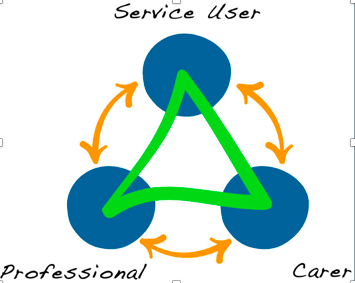
Triangulation of services is essential for best outcomes for patients and professionals. Risk averse practices may help reduce risk in the short term but may increase risk in the long term. A recovery approach to risk and development of a “life worth living” may have longer lasting benefits through rebuilding relationships, increasing service-users skills and confidence in collaboration with carers.

Norfolk and Suffolk Foundation Trust (NSFT) have developed a program called “Stepping Back Safely” up-skilling staff, carers and service-users. It is based on five main drivers of Recovery: CHIME

  • Connection
  • Hope
  • Identity
  • Meaning
  • Empowerment

NSFT are offering free training in Stepping back Safely in July 2021 on-line. Having heard many stories where a life could have been saved only if there was a meaningful and effective communication between the three parts of the Triangle of Care, I think this training is most relevant and essential. I shall be taking it as I am sure it will deepen my understanding of the subject. If you or anyone you know might like a point of contact, here it is: catherine.phillips@nsft.nhs.uk

Changing the Conversation.

First versus second.

Medical versus human.

Symptoms versus experiences.

Problem-based versus Trauma-informed.

Here is an example of language, describing the same thing in two different ways.

First:

“I was 15 when I started to suffer with mental illness. I went to see a psychiatrist who told me that I had something called Schizophrenia. For a couple of years my symptoms got really bad and people were afraid I was going to hurt myself so I was hospitalised. They stabilised me on meds and shock treatments and sent me home. For a long time, I didn’t get sick again.

Later, as an adult, I started to get symptomatic again. I got pretty psychotic and once again got put in hospital. They told me there that I was really sick and should go on disability. For a long time, I was pretty sick but then started to be able to manage my symptoms.”

Second:

“I was 15 when I started feeling different than others and really alone. For a couple of years after that, I would do things in pretty extreme ways. They made sense to me based on what I was thinking and feeling but I guess it was scary for others who didn’t really understand what I was thinking and feeling. I got put in a hospital. There I really lost hope and beliefs about being a ‘regular’ person. They put me on a lot of medication that made me sleepy all the time. After I left, I threw out all the meds and put my intensity into music.

Years later, coming out of a difficult marriage I started to have similar kinds of experiences as the ones I had as a kid. I had really strong feelings and felt pretty separate from others. I got put back in the hospital again. I was told I had a major mental illness and that I should go on disability. Though I did that for a while, I realised that I was just going along with their beliefs rather than looking at how I’d come to think in certain ways. Little by little, I figured out what to do with my intensity and I’ve been really growing ever since.”

Each one of us is simply at a different place in our growth and development. Using language that is personal and descriptive of our experiences enables shared understanding. It forces us to think of ourselves and others more broadly as human beings, free of labels and assumptions.

Reference:

Intentional Peer Support: https://www.intentionalpeersupport.org/?v=79cba1185463

Blue Rose

She was the colour of almonds. Her smile so bright, it made the sun shine. Her hair waist-length, wavy and a very dark brown, like a heavy veil down her back. Her petite frame, shy, smelt of sandalwood. She was only 19.

Her friends had rebellious red, pink and green highlights in their hair. Some had happy multi-coloured beads and braids woven in. Others had playful ribbons platted in, like flower-girls at hippie weddings. She sat on her aquamarine blue sofa with her laptop, peering through colour-charts. She wanted her hair dip-dyed. She hadn’t picked a colour yet.

It was going to cost a bit but her mum had agreed to pay for it. She often did.

When alone in her room, unable to sleep at 2 am, Rose had looked up Helium and what it does. She didn’t know why. It was an involuntary act. It was nonsensical. Her body and mind were no longer of her.

Her hair appointment was in a couple of hours. She had to decide now. It was important she got this right. It was an expensive decision. The staid Royal blue or the scintillating Moroccan Turquoise? Silky peacock blue or the majestic sapphire? She wanted a straight horizontal line to run right across the dark sheet of her hair. The bottom one-third of the length a startling shade of blue, like a designer curtain.

She played classical music on the violin. Her ears didn’t particularly savour the Blues. They jarred her. She didn’t have a taste for blueberries. She preferred the ‘rasp’ variety with big dollops of double cream. Her wardrobe was a smattering of whites, pinks and reds. No blues there either, except the denim jeans and shorts. She was a proper girlie-girl. Blue skies made her spirits soar. But they left blue stains on her heart. She hid them like children hide pretty pebbles in corners of drawers. Her smile kept feeding the sun through the blueness.

She hand-wrote letters to the people she shared the house with, in blue ink. To her mother she said how wonderful a mum she was and she should take better care of herself. To her sister she expressed her appreciation for her companionship, friendship and laughter. Her little brother never left her side. She never turned down his invitation to play any kind of silly game with him. The dogs were all hers. They didn’t know they weighed as much as her. She had to sit down when they clambered all over her saying ‘we love you’.

The blue stains on her heart were expanding like drops of ink drip-dripping on a white blotting paper. She knew it was happening but didn’t know what it was. It’s creepiness had no name. It made her want to escape. It compelled her thoughts to convince her that her deepest desire was to implode. She had no say in the matter. It made her hands look up Helium on the internet. It kept her eyes wide open at night. It made her tummy churn, her legs restless and her head hurt. She now had 2 hearts and she moved between them. One blue. The other not. One wanting out. The other wanting blue hair.

“I am finding this difficult Mum.”

‘We need to leave in about 20 minutes for the hair-dressers my darling.’

“Yes. I am thinking about it … looking up the options on the internet.”

‘Good idea. We can take your laptop with us. I am sure the hair-dressers will have some ideas for you. Don’t worry.’

“I have some ideas but haven’t decided yet.”

‘Take your time. No rush.’

Midnight blue was the final choice. She was happy.

Over the next year that wretched blue embedded deeper into her heart and from there, leached into every cell of her body. Then it burst out, released itself and merged back into the midnight, the sky, the ocean.

That was 5 years ago. Till this day, her mother’s mind twists into painful knots when she remembers that day. How could her lovely Rose have wanted to live with blue hair and at the same time, to not live at all? At nineteen! How?

No one knows. Sometimes it’s like that.

———————————–

A video for every parent: https://www.youtube.com/watch?v=3BByqa7bhto

Human rights issue – Families Matter

Hundreds of times, in waiting rooms outside Intensive Care Units I have looked into the eyes of sons and daughters, spouses and partners of patients, held their hands and said, “We did all we could. I am so sorry for your loss.”

When Saagar died, no one looked into my eyes and said that to me. They had not done all they could for him. The hospital carried out a sham investigation, a futile exercise in ‘being seen’ to be doing the right thing.

The GMC found everything to be hunky dory. The doctors ‘looking after’ Saagar had done their jobs to perfection. Just too bad the patient was dead. They did not deem Saagar’s case worthy of an investigation. GMC’s role in its own words:

We work to protect patient safety and support medical education and practice across the UK.”

The Coroner’s report shone some light on the holes in Saagar’s care. It clearly pointed out the things that South London and Maudsley (SLaM) Hospital got wrong.

  1. There was a general failure to identify the diagnosis on the discharge summary from the Home Treatment Team to the GP.
  2. There was a general failure to communicate thoroughly enough with the parents about the relapse symptoms, what to watch out for and where to go for help in the future.

Last June, I wrote to the CEO of SLaM, requesting an update on the changes that had been made in his organisation in response to the Coroner’s findings above. He said someone would get back to me and I heard nothing. This June, I sent him a reminder and again he said someone would get back to me and I am still waiting.

What are my rights as a parent? Is this too much to ask?

What were Saagar’s rights as a young man with a mental illness?

Are our lives not as important as anyone else’s? Black or white or brown? With Cancer or Diabetes? Or Bipolar Disorder?

Everyone deserves to be heard and seen. With respect.

It’s not charity. It’s a human rights issue.

Ref: Learning from deaths: Guidance for NHS trusts on working with bereaved families and carers

India – talking Mental Health.

Asian countries account for more than 60% of world suicides.

According to the WHO, in the year 2016, suicide was the most common cause of death in the 15-39 age bracket in India, the highest in the South-East Asian region. India’s own official statistics, which map the number and causes of suicides in the country, have not been made public for the last three years, hindering suicide prevention strategies and efforts to implement the WHO’s recommendations in this regard.

In 2014, the WHO released a report with a series of recommendations for successful suicide prevention. It proposed a public health model for suicide prevention, consisting of four steps:

  • Surveillance
  • Identification of risks and protective factors
  • Development & evaluation of interventions
  • Implementation

India has not progressed beyond the first step. Lack of political will, social stigma and inadequate mental health awareness in the general and medical communities contribute to the continuous rise in the death rate of young people by suicide in India.

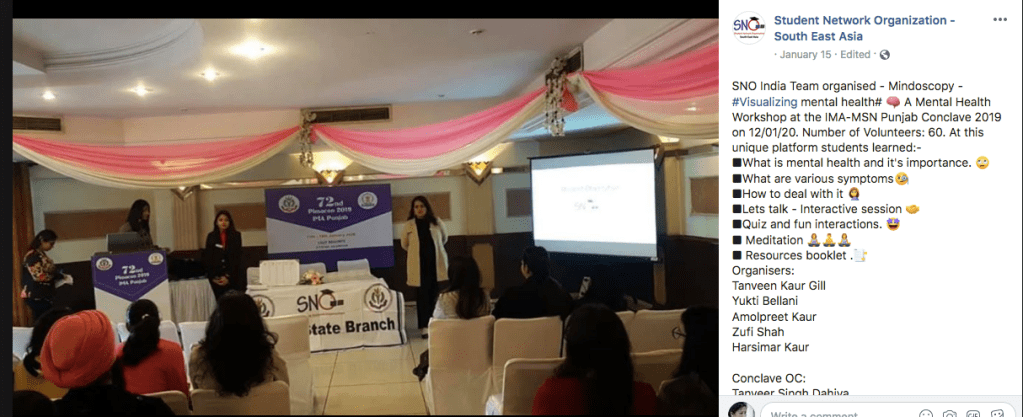
A Junior Doctors World Congress was held at my alma mater, Christian Medical College Ludhiana in April 2019. Si and I ran a Mental Health Workshop that was attended by 75 medical students from India and the wider South and South East Asia region. 

Motivated by this event, some students have established community mental health support networks and mentorship programmes at their respective institutions.  I am impressed with their passion to make a difference.

Here is an example:

Early March I was back in Delhi and was honoured to be invited by Shruti Verma Singh, the founder of a Youtube channel, Zen-Brain.com. She is determined to increase the emotional awareness in India and does it gently, through a series of interviews. We met one afternoon to talk about Saagar. I hope her work will help wake up the government, break social stigma and drive understanding and compassion.