Day 248

Governments and organisations hide behind big words. For instance ‘Restructuring’ means some people are going to lose their jobs, ‘Quantitative Easing’ means printing money and giving it to the banks, ‘Benefits Reform’ means taking away more state support from the poor and ‘Austerity’ means capitalism for the poor and socialism for corporations and the rich.

‘Modified departmental schedule’ means new time-table. ‘Enhanced positive learning environment’ means talking warmly while teaching. ‘Capacity planning’ is deciding how much a particular computer or system can handle.

These phrases are everywhere around us. They have no face, no humanity. They are completely impersonal and extremely self-important. They don’t speak to me. They are like a poor camouflage. Not only do they try desperately to hide something but also offend and insult. They distract and alienate people from real issues.

The real problem with the NHS is that it has too many managers and not enough people on the frontline doing what needs done. Lots and lots of people are employed and paid exceptionally high salaries to invent and create this eye-watering jargon.

Some CEOs of NHS Trusts are paid more than the prime-minister of this country.

In my experience as a consultant in the NHS I have seen many fabulous nurses and physiotherapists lost to the managerial route because sadly, that is the only way they can further their careers and make a decent living.

Without a revolution in thought and politics, there is no way to stop this terrible destruction of a potentially wonderful service.

It would be great if more managers thought of their work as ‘service’ and not business. Make it about people, not numbers.
Day 246

“More Mentally Ill Persons Are in Jails and Prisons Than Hospitals” is the title of a survey that was published in the USA in 2010. It states that America’s jails and prisons have become its new mental hospitals, housing 3 times more seriously ill patients (3 million) than hospitals.

Almost 1 in 4 of inmates live with serious mental illness and their conditions are often under-treated or not treated at all. Harsh conditions, isolation and noise can “push them over the edge” into acute psychosis. An estimated 70,000 prisoners suffer from psychosis on any given day. Many of the sickest patients are not able to make any sense of orders screamed out at them. Here is a video that shows how inhuman the treatment of these inmates is. It is difficult to watch and I would not recommend it if you have the slightest worry of it potentially traumatising you.

A sheriff in 1973 said, “a good deal of mental illness is now being interpreted as criminality.” That seems to be the case even today, more than 4 decades later.

7 out of 10 youths in the juvenile justice system also experience mental health disorders, with 2 out of 10 experiencing disorders so severe that their ability to function is significantly impaired.

“The bedlam which ensued each time I walked out into one of those units, the number of people who were screaming, who were begging for help, for attention, the number of people who appeared to be disturbed, the existence, again, of people who were smeared with faeces, the intensity of the noise as people began to shout and ask, ‘Please come over here. Please talk to me. Please help me.’ It was shattering. And as I discussed this atmosphere with the people who worked here, I was told that this was an everyday occurrence, that there was nothing at all unusual about what I was seeing.” (Dr. Craig Haney, quoted in Elsner, Alan (2006). Gates of Injustice: The Crisis in America’s Prisons)

The situation in the UK is not very different as is apparent from the ‘Too little too late” report, an independent review of the unmet mental health need in prisons.

The lack of understanding of mental illness is rampant in all areas of life.  How is it that we have advanced so little since the days of the infamous mental hospitals of the Victorian and pre-Victorian eras?

Day 238

“Why don’t you do a crossword or something for the next 5 hours?” said the woman who answered the phone to a mental health patient in crisis. The call was made to Emergency services in the wee hours of the morning and the Mental Health Crisis team would come on 5 hours later. This is an excerpt from a CQC (Care Quality Commission) report on Emergency staff attitudes to patients in mental health crisis.

Here are some more observations:

  • Judgemental and unsympathetic attitudes of staff towards patients with injuries inflicted on themselves.
  • Unsafe, unfair and completely unacceptable level of care.
  • “Quite shocking”
  • Only one in seven (14%) of the patients surveyed said the care they received provided the right response and helped to resolve their mental health crisis.
  • Police and ambulance services were much better at helping them than the key types of NHS teams.
  • Increasing difficulty getting patients undergoing a crisis into hospital because of an acute shortage of beds.
  • Helpline staff were hanging up on mentally ill patients because they were seen as ‘difficult’ callers.
  • They constantly have to explain their circumstances to a chain of professionals because notes cannot be accessed out of hours.

They concluded, “It is clear that there is still a long way to go to make sure everyone is treated compassionately in the right place and at the right time.”

Yes. True. Yet we have been accepting this unacceptable behaviour for decades.
Nothing will change as long as public perceptions don’t.
As long as we, the people, continue to tolerate these intolerably intolerant attitudes, things will stay the same.
Awareness in everyone’s hearts and minds is the answer.
Education. Education. Education.

Day 231

SBK

Communication gaps between teams, poor risk assessment, inadequate training for doctors and carers, poor discharge planning, absent safety planning, failure of proactive follow-up, no consultation with and support to families – these are the most commonly occurring themes from inquest reports on suicides for the last 15 years.

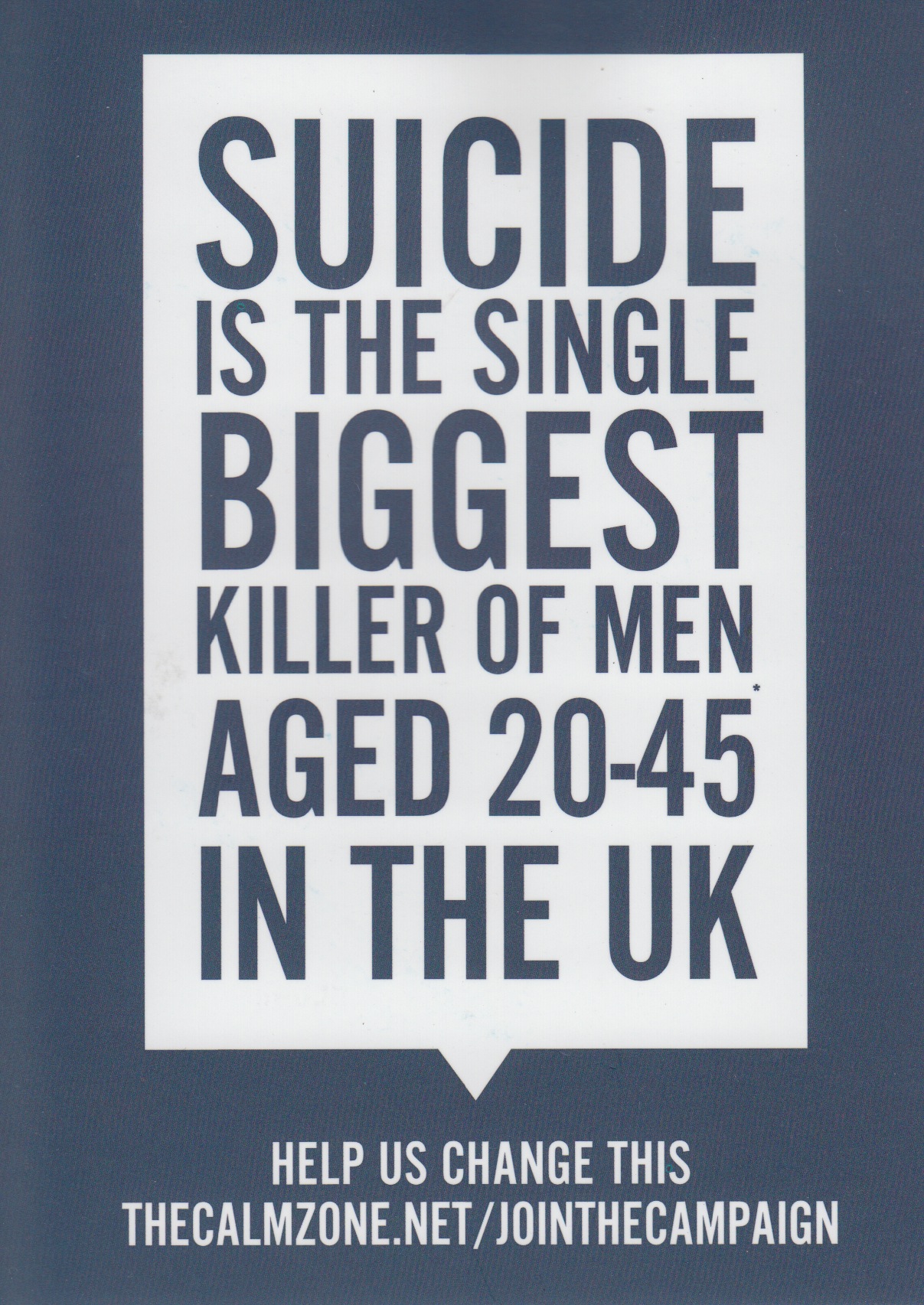
Yet, the story repeats itself again and again and yet again. Why is the rate of suicides amongst men rising when we have known for a long time what needs to be done? In 1982 the rate was 21.5 and by 2012 it was up to 25.9 every 100,000.

While mortality from serious ailments such as cancer, heart disease and AIDS has fallen dramatically over the last 30 years, that from suicide in men has risen. This is happening in our society because we allow it to happen. We as a collective consciousness need to find an honest answer for these questions within ourselves : What value does a person from low socio-economic background hold for us? What value does someone with mental illness hold for us? How much time and attention are we willing to give to people who are so utterly without hope that they end their own lives?

“You make a mistake only once”, I used to say to him. “If you do the same thing a second time it is your unwillingness to learn.” We as humans don’t learn anything till something is at stake. Do we have anything of value at stake here?

It appears 8 months was not long enough for the investigators of our case to prepare a report on what happened during the 10 week period of his illness. Hence the Coroner’s inquest has been delayed until further notice. We were informed today, 5 days before the day. Very disappointing!

The Chief Medical Officer then, Sir Liam Donaldson speaking at the launch of the World Alliance for Patient Safety in Washington DC in 2004 summed up the challenges of patient safety in this way: “To err is human, to cover up is unforgivable, and to fail to learn is inexcusable.”

Words, words and more words.

Day 228

All day today 55 years old Charles Kennedy has been on the news – a prominent political figure found dead at his residence yesterday. He struggled with alcohol, his father passed away earlier this year and he lost his parliamentary seat of 32 years in the recent elections. Police are treating his death as ‘not suspicious’.
Interesting description. Isn’t it? I, on the other hand, am very suspicious.
My thoughts and prayers are with his family. For them the nightmare begins.

From the documents that have been sent to me for the inquest, it is revealed that my son’s depression score on PHQ-9 was the highest possible, ie. 27/27, sixteen days prior to Day 0. It indicates severe depression. It doesn’t get any worse. Yet, no alarm bells rang for anyone and he was sent home on the same medication and no escalation of care, despite it being requested. On the follow-up visit 2 weeks late, the test was not repeated. Wonder why?

PHQ-9 score ≥10 had a sensitivity of 88% and a specificity of 88% for major depression and it is a validated tool for monitoring depression.

Eli Robins and colleagues at Washington university studied 134 suicides and came to this conclusion: “If we had found that suicide was an impulsive, unpremeditated act without rather well defined clinical limits, then the problems of its prevention would present insurmountable difficulties using presently available clinical criteria. The high rate of communication of suicidal ideas indicates that in the majority of cases it is a premeditated act of which the person gives ample warning.”

Identification through proper assessment of suicide risk must precede any attempt to treat psychiatric illness. Asking the patient directly about suicidal thoughts or plans is an essential part of history taking. Other major risk factors that need to be evaluated are: the presence of severe anxiety or agitation; the type and severity of psychiatric illness, the extent of hopelessness; presence of severe sleep disturbance, current alcohol or drug abuse, ease of access to lethal means, lack of access to good medical and psychological treatments (!), a recent setback, family history, close proximity to a first episode of depression, mania or schizophrenia and recent release from a psychiatric hospital.

Once identified, acutely suicidal patients need hospitalisation as a protective measure and for further evaluation. It does not prevent all suicides but definitely saves lives.

Hospital beds are like gold dust. Patients verbally and clearly proclaiming suicidal intent are sent home due to lack of beds. ‘Length of stay’ is another criterion for assessing how well a hospital is doing. So, even if they do manage to find a bed, patients are discharged earlier than they should be. There is tremendous pressure on the system and the carers at home.

There is almost nothing doctors can do about major stresses in patient’s lives as they are difficult to predict and govern but there are things that can be done to influence the underlying biological vulnerabilities to suicide. The proper management of mental illnesses, especially those closely linked to suicidal behavior, is vital.