Day 782

For a long time I didn’t understand why Saagar couldn’t speak to me about his suicidal thoughts. I felt terrible about myself – untrustworthy. In short, Bad Mum. I thought we were close. When he took his own life, I felt betrayed and shunned like an outsider. He must have known that I cared for him deeply even if I didn’t always know how to show it. I am sure he felt the vastness of our love as much as I did. It glued us together and carried us as one through thick and thin. It was the most solid part of my life, unwavering, undying and unfaltering.

What stopped him? Why couldn’t he? In the early months it nearly killed me, the utter and complete sense of failure as a parent. How alone must he have felt! Was he embarrassed? Ashamed? Confused? Did he feel trapped? Why couldn’t I see it? Was it out of concern for me that he didn’t share? Did he know that I would probably freak out if he did? Could he feel my pain as I watched him suffer? Could he see how lost and powerless I felt? Was his silence his way of being kind to me? Did he really believe that I would be better off without him? Did he even know the meaning of what he was doing?

All these unanswerable haunting questions coming back uninvited! But now, I can understand. 

ps: If you are concerned about anyone close to you, please call PAPYRUS for help and advice. I wish I knew of them when Saagar was ill. (https://www.papyrus-uk.org/)

Ref: http://www.speakingofsuicide.com/2013/05/29/parents-and-teens/


Day 778

Bereavement by suicide is a risk factor for suicide.

A study published in The British Journal of General Practise in August 2016 found that among GPs there is a low level of confidence in dealing with suicide and an unpreparedness to face parents bereaved by suicide. Some GPs described guilt surrounding the suicide and a reluctance to initiate contact with the bereaved parents. They talked of their duty to care for the bereaved patients but admitted difficulties in knowing what to do, particularly in the perceived absence of other services. They also reflected on the impact of the suicide on themselves and described a lack of support or supervision.

2 weeks after Saagar’s death I went to see our GP. I just wanted to see him as there had been no communication between us since Saagar’s last consultation, which was 2 days before his death. He asked me if I was sleeping well. Through a non-stop stream of tears I said I wasn’t. He gave me a prescription for sleeping tablets to last me 3 months. Just perfect for someone who was para-suicidal. Time up. Consultation over.

A few weeks hence I consulted a homeopath. She asked me how I felt. She listened. She created a safe space for me to share from the heart. She wanted to know how I was coping and what support systems I had in place. She acknowledged my tears. She held me like a baby. She taught me techniques that would help me release anger out of my system. At the very end she gave me some medicines for healing. She knew exactly what needed to be done. Having time with her was a blessing.

This is how Wikipedia defines ‘Alternative medicine’: practices claimed to have the healing effects of medicine but are disproven, unproven, impossible to prove, or only harmful.

Lately, there is a trend towards slating alternative medicine as quackery. This is worrying as it assumes superiority of Allopathy over all other disciplines for every possible condition. However, this is not the case. The pharmaceutical industry has something to do with this propaganda just as the automobile industry had a huge influence on cutting back train services in the UK. As far as evidence is concerned, Randomised Controlled Trials are often not do-able or appropriate for many medical interventions within Allopathy.

Holistic care is only possible if we acknowledge the strengths and weaknesses of different disciplines and use them in conjunction with each other.

Ref: http://bjgp.org/content/early/2016/08/15/bjgp16X686605

Day 764

paratrooper

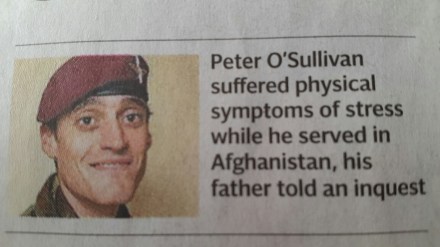
He served for 10 years in the Parachute Regiment. He had witnessed and been a part of ‘very severe military activity’ in Afghanistan as a result of his service in the elite Pathfinder Platoon. He left the army in 2010 and started to work in close protection in Iraq. In 2012 he married a Thai woman who commented that 2 years later he ‘wasn’t good’.

He sought help from the Combat Stress charity (http://www.combatstress.org.uk/) in December. A nurse referred him to a Consultant Psychiatrist as she felt he might have PTSD. His father noticed that Pete had started to have a tic and facial problems and that was a clear indication that he was suffering from deep psychological trauma. The psychiatric appointment was available for a date 4 months away, in April. Faced with this long wait, Pete went back to Iraq for 2 months. He returned home briefly before flying to Vietnam for a kite-surfing course. Pete never went on the course and sadly ended his life in Vietnam in February.

The Coroner heard that drugs were found in Pete’s blood and ruled there was insufficient evidence for either suicide or accidental death. His family are hoping that the authorities will recognise Pete’s death as a direct result of PTSD resulting from his service. They want his name to be included at the National Memorial Arboretum.

Another tragic loss of a young life, not getting timely help despite asking for it. Another family lost, not knowing exactly how to help their young man. Another suicide not registered as such, adding to the underestimation of the national scandal that it is. Another charity, offering more assistance than the NHS. Another child not coming home for Christmas.

Preventable? Yes.

RIP Pete. 


Day 760

cover-jpg-rendition-460-707

4500 men end their  lives every year in the UK, 3 times more than women. Many times more self harm and attempt suicide. The highest suicide rate in 2014 was for men aged 45-49.

‘Building Modern Men’ is a series of articles published by Huffington post to mark the International Men’s Day (19th Nov). It covers a wide range of topics from male role models to inability to swim. (http://projects.huffingtonpost.co.uk/building-modern-men/) A Masculinity Audit carried out by Huff Post and CALM,looking into the causes of male suicide  found that :

  • Four out of ten males feel they lack the qualities and abilities that partners look for in a man

  • 61% of all respondents agree that men are stereotyped in the media

  • Four in ten male respondents strongly agreed that ‘women have unrealistic expectations of men’

(Ref: http://www.huffingtonpost.co.uk/entry/mens-mental-health-building-modern-men_uk_58206805e4b0c2e24ab022fb?utm_hp_ref=uk)

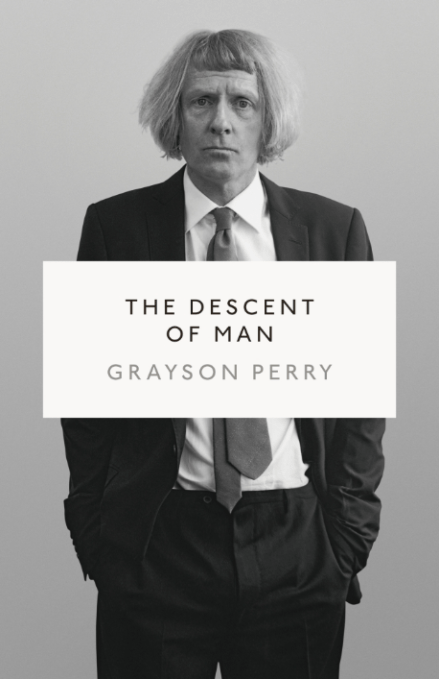
‘For many, masculinity is a fatal burden’ says Grayson Perry on why old-school masculinity is man’s greatest enemy. The 56 years old transvestite artist has always seen masculinity as a choice. He has questioned his gender identity since the age of 12. He believes that his transvestism permits him a greater distance and sharper insight into the layers of manhood that he talks about in his new book ‘The Descent of Man’.
He believes that the traditional approach of ‘stiff upper lip’ is completely out dated. It renders men emotionally illiterate and unable to form healthy relationships. It leaves them very fragile yet unwilling to express their vulnerability, a lethal combination when it comes to mental health. The inflexibility of traditional masculinity doesn’t fit in the present times of change and diversity. That masculinity comes from an age of heavy industry and farming and it doesn’t work anymore.

‘We need to think of masculinity like a piece of equipment. Some men, like soldiers, need to use it all the time, others might need it at the weekend and others not at all.’

Day 759

“My daughter, Frances, developed severe clinical depression when she was in her second year at university, aged 20. She started to self harm, cutting her arms and 3 months later attempted to take her own life by taking an overdose of paracetamol. She was taken to the general hospital in Derby and was released to us 3 days later with no follow up treatment of any kind. The depression continued and we were constantly terrified that she would attempt to take her own life again. She moved backwards and forwards between Derby and home for several months, still clearly very unwell, and was eventually admitted to a psychiatric ward in Addenbrookes hospital in Cambridge (fortunately now closed down) where she only stayed 5 days as she was badly bullied by a psychiatric nurse and forbidden to access either food or drink unless she went to the dining area, which her catatonic depression and severe distress prevented her from doing.

After leaving the hospital, she was offered no further treatment and was not even assigned a CPN. We continued struggling for 3 more years, desperately trying to get the appropriate help for my daughter to survive and cope with the debilitating depression. In 2006 Frances became very severely depressed again and came home after splitting up with her boyfriend, leaving her extremely fragile and deeply depressed. My husband checked the memory on our computer and found out that Frances was actively researching suicide sites. I called our G.P practice and begged for an appointment for her with our G.P, who had been very understanding when we were able to access her. I had complained numerous times that it was often impossible to get an appointment with our G.P as one of the women on reception always insisted that Frances should see whoever was available and she repeatedly refused to give her access to our G.P. On that fateful day, 6 June, 2007, access was once again denied and Frances was given an appointment with another doctor. I went with Frances, as she was catatonic at this stage, and begged the G.P to refer her to hospital. I stressed, repeatedly, that Frances had already made a serious attempt to take her own life and was currently researching suicide sites on our computer. Despite my entreaties, the G.P insisted that Frances should have a prescription for a halved dose of anti depressant, prior to changing it to another one, and sent her away with a leaflet on counselling. Only 5 days later on 12 June 2007, Frances attempted to hang herself. She survived after 6 months in hospital and was left with a severe brain injury, unable to do anything for herself and requiring 24/7 care at a huge cost to Social Care and the NHS.

Frances lived a life with very little quality for a further 9 years and died this year of breast cancer.

I have actively campaigned for many years to improve mental health provision, especially for young people, who are most at risk. I have helped Papyrus and the Samaritans with media work and research and also campaigned for Headway. Over the past 9 years, I have listened to countless parents telling me their story and I have learned that my daughters experience with a G.P, just before attempting or completing suicide is sadly very common. All doctors, and particularly G.P’s, should have a mandatory day’s training on suicide awareness. The training for doctors is long and rigorous, but currently has nothing with regard to suicide prevention. As G.Ps are the gatekeepers of the nation’s health, and are usually the first point of health care access, it is particularly essential that this training becomes mandatory.”

Just one days training in suicide awareness for all doctors could potentially save thousands of lives every year. Teachers, too, would benefit from this training and young people in secondary schools should be taught about mental health, how to protect themselves and to feel able to confide in a trusted adult if they self harm and or have suicidal thoughts. As a teacher, myself, I am well aware of the considerable emphasis on physical health, taught as part of the PSHE curriculum, at primary and secondary schools, but there is nothing in the current national curriculum regarding safe- guarding mental health and so the stigma still remains. Many young men, in particular, suffer from severe and devastating depression, yet tell no-one except,their G.P that they have thoughts of self-harm and suicide. Their parents and families often say that they had no idea that their son or daughter was suicidal until it was too late.” – RW

Another lone voice in the dark joining up. Watch out for the big clang. It’s coming. It’s long overdue. We will be heard. I promise you Saagar. Things will have to change.