Day 723

“Random thoughts”, he said, looking perplexed. “I keep getting these random thoughts.”
“Thoughts of what exactly?” I would ask.
“Just random….”
I didn’t know how to explore any further.

He confided in at least 3 men he trusted about his suicidal thoughts and none of them knew what to do.
Not surprising.
He specifically told them not to tell me about it. He even shared his plan with one of them. But he did not know what to do.
Not his fault.
No one is taught what to do in a situation like that.

How would you feel if some one came up to you and said they were seriously considering ending it all?
Overwhelmed? Panicked?
Calm and confident knowing exactly what to do as if you were being asked to do CPR?
What would you do?
Break into a sweat?
Think they are kidding?
‘Fix it’ for them?
Call 999?
Take them to A&E?
Ask them to see their GP?
Connect them to the Samaritans?
Tell them to get over it because life is beautiful?

Yesterday I watched a video of a skilful conversation between a suicidal person and a person in a position to help. It was a caring and respectful exchange designed to model an evidence based framework which has been developed over 30 years by LivingWorks whose mission is to create a life-affirming suicide-safer world (https://www.livingworks.net/programs/asist/). It made me cry floods of tears as I was reminded why the poor bugger didn’t have a hope in hell. Even his doctor didn’t know CPR or what would be CPR for him. The video was a part of the ASIST Course (Applied Suicide Intervention Skills Training). Regardless of prior experience LivingWorks enable ordinary people to provide suicide first aid. They have training programmes lasting from 90 minutes to 2 days. Shown by major studies to significantly reduce suicidality, LivingWorks courses teach effective intervention skills while helping to reduce stigma and raise awareness.

While speaking with the trainers of ASIST it emerged that the most difficult group to train is GPs as they can never make time. The last General Practice who contacted them wanted them to come at lunch time for half an hour and provide training and lunch for all staff members in that time.

Top priority. Eh?


Day 722

Yes. Here’s an admission if there ever was one – I am a fan of the ‘Archers’ (a drama series on BBC Radio 4). Each time the theme tune comes on Si says, ”Let us pray.” I love Helen. She is a woman with a clear mind. Over the past few months I have been gripped by the twists and turns of the dramatic story of Helen and Rob Titchener. I have always had serious doubts about him. Not surprisingly, he did show his true colours and caused great suffering for Helen. It was interesting how insidiously, like a slithering serpent he created a severe degree of self-doubt and confusion in her mind and took control of all aspects of her life. They called it ‘mental abuse and coercive control’.

This made me look up some statistics around domestic abuse. I was shocked.

Domestic violence:

  • Will affect 1 in 4 women and 1 in 6 men in their lifetime.
  • Leads to, on average, two women being murdered each week and 30 men per year.
  • 3 women take their own lives every week to escape from domestic violence.
  • Almost 30 women attempt suicide per day for the same reason.
  • There is currently no ‘liability for suicide’ law under which an abusive partner can be prosecuted for the suicide of their victim.
  • Accounts for 16% of all violent crime (Source: Crime in England and Wales 04/05 report), however it is still the violent crime least likely to be reported to the police.
  • Has more repeat victims than any other crime (on average there will have been 35 assaults before a victim calls the police)
  • Is the single most quoted reason for becoming homeless (Shelter, 2002)
  • Is witnessed by 750,000 children per year.

The charity ‘Refuge’ is campaigning for a new ‘liability for suicide’ law that would hold perpetrators of domestic violence responsible for behaviour that drives their victims to suicide. ‘Taking Lives’ is a documentary film which tells the story of ‘Gurda’ who took her own life after suffering years of violent abuse at the hands of her husband. Her brother Nav has been actively campaigning for this law to be enforced. After Gurda’s death, instead of being punished, her husband was awarded financial benefits of the mortgage being paid off and all the insurance money.

Source: (http://www.refuge.org.uk/what-we-do/campaigns/takinglives/)

Here are some of the myths associated with Domestic violence:

MYTH: Alcohol and drugs make men violent.
MYTH: It only happens in poor families on council estates.

MYTH: More women would leave if the abuse was that bad.
MYTH: Abusers grow up in violent homes.
MYTH: Some women like violence.
MYTH: Women ask for it. They deserve what they get.
MYTH: Abusive men have a mental illness. They can’t help what they do.
MYTH: He only hit her because he was under stress.

MYTH: He loses his temper sometimes, that’s all.
MYTH: Domestic violence is a private matter, you shouldn’t get involved.

Once again most of the work in this field is being done by charities like LWA (Living Without Abuse), Refuge, Shelter and Women’s aid. The government needs to do more.

Day 721

james-20-400x325

“Befriending has saved thousands of lives in Britain. My job now is to organise it all over the world, until suicide becomes unimportant as a cause of death.”
– Chad Varah, Founder of Samaritans.

He made his debut as a vicar by burying a 14 year old girl who’d killed herself when her periods started because she thought she had a sexually transmitted disease. That had a profound effect on him.

In 1953 he set up Samaritans. Ten years later there were 41 branches of Samaritans in the UK and Ireland. Just three years later there were 6,537 Samaritans volunteers based in 80 branches and calls to Samaritans have continued to go up every year. The number of branches is now at 202.

It all started in 1953. Chad strongly believed that those in crisis should have access to a number they could call at any time. He coped with callers with the help of his secretary for some weeks in November 1953 but then useless amateurs began offering to help. He bounced off the ones he didn’t like and graciously allowed the ones he found agreeable to run errands for him and keep the clients amused while waiting to be ushered in to his presence.

It soon became evident that they were doing the clients more good than he was. Everybody needed befriending, only a minority needed his counselling or referral to a psychiatrist. By 2nd February 1954 he called these amateurs together and said, “Over to you Samaritans. Never again shall I pick up the emergency phone, nor be the one to say ‘Come in and have a coffee’ when a client taps at the door. I shall select you and supervise you and discipline you and sack you if necessary, and see the clients who need something more than your befriending, and I shall make the decisions you are not competent to make. But you are the life-savers, and one day everyone will recognise what suicidal people need.”

Isn’t it a great pity that suicide had not yet become an ‘unimportant’ cause of death!
Sadly that day has not yet arrived when everyone recognises what suicidal people need.

Day 720

Back in London, I notice the filthy water of the Thames, the inescapable stenches of various kinds emanating from nooks and corners on the streets, the stress of the daily commute and the demanding work environment. Patients demanding to be treated like ‘customers’ who are always right and managers trying to get results unachievable with the realities and limitations on ground. Me, finding myself stuck in the middle of the two. One patient, who was denied a separate room that she demanded for no valid reason said that this is the National Health Service but their ‘customer service’ is very poor.

Many nurses and doctors feel demotivated and exhausted by constant firefighting and not having the time to actually do the work they want to, taking care of patients. This leads to earlier burnout and sideways movement of highly trained staff away from frontline work to more lucrative and glossy management roles.

Stress is the biggest killer of modern times. One of the definitions of stress is, not living up to one’s own expectations. With fewer job prospects, growing number of ‘zero hour’ contracts, rising property prices, longer working hours and rising living costs, it is not surprising that young people find themselves not achieving as much as they are capable of.

The latest figures published by the Office for National Statistics highlight that young suicide in the UK is at its highest for the past 10 years. In 2015 1,659 young people under 35 years took their own lives; an increase of 103 more than in 2014 and 58 above the previous highest recorded figure (1,631 in 2011).

Suicide is the biggest killer of young people in the UK and tragically the figures continue to rise. It is a national crisis yet far from prominent on the government’s agenda.


Day 717

Sunday lunch at the start of autumn on a warm day of blue skies and a warm sun, sitting under a wise old carob tree with supported branches and multiple dried brown beans hanging from a wide umbrella of dark green leaves with friends and strangers making introductions followed by conversations, smiles and laughter, references to this and that, occupations, travels and hobbies, daughters and mothers, food and wine, so on and so forth …. as if straight out of a film set infused with a sweet subtle smell of eucalyptus.

All of it completely meaningless, empty, futile, feckless, inane and pointless. Words, words and more words! Exhausting! I had to get up and walk away with my i-pad and take pictures of something. Anything.

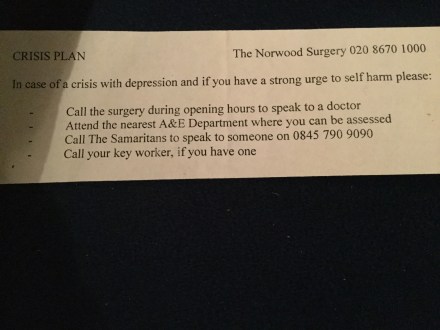
In 2 weeks time he will be dead. Around this time 2 years ago he was scoring max on his depression scores and he gave it in writing to his GP in the form of a PHQ-9 form but got no help. No escalation of care. No attention. No mention of ‘suicide’ to us and yet holding a firm belief that a safety plan was in place. Sent home with the suggestion, “It will get better. Give it time. Rome was not built in one day” and a piece of paper.

img_0279

It was early autumn then and it is early autumn now.
I lived in what I thought was our world then.
I live in a world of my own now. It sort of overlaps with this one in places but most of this one is irrelevant to me.

img_0270