Day 708

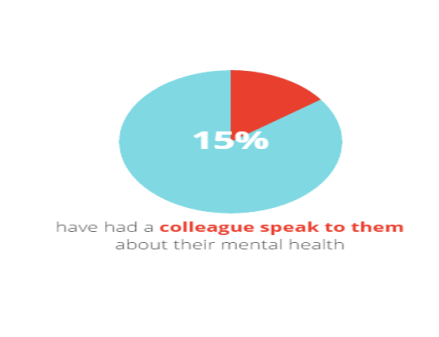
suicide_homicide_warA survey of 500 people revealed that a third of people didn’t feel comfortable at all talking to someone at work about mental health related issues and only 15% have had a colleague speak to them about their mental health.

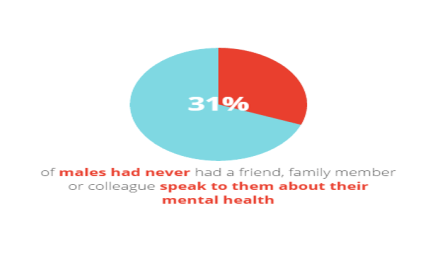
The survey also uncovered an interesting trend: nearly a third of all male respondents have never had a friend, family member or colleague speak to them about their mental health. Worryingly, this statistic rises to 42% for males aged 45 and over and increases yet again to 60% for males aged 54 and over.

( Source:  www.team24.co.uk/suicide-prevention-day )

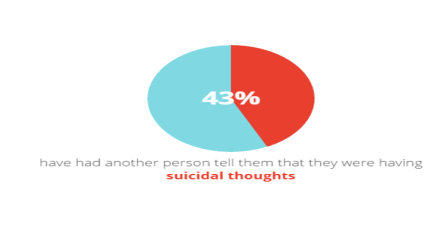
43_per_cent_suicidal_thoughts

33_per_cent_dont_feel_comfortable_talking

31_per_cent_males_never_speak_mental_health

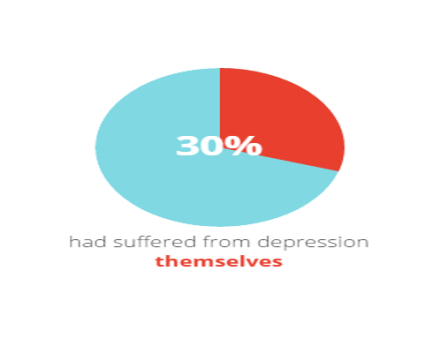
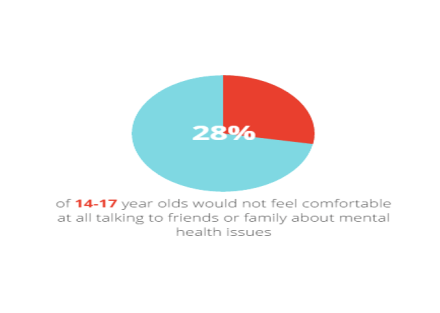
30_per_cent_suffered_depression28_per_cent_14_17_dont_feel_comfortable


15_per_cent_colleague_mental_health

“I would say that the vast majority of people who die by suicide, don’t necessarily want to be dead—they want to end their suffering and don’t know what else to do. We know from our clinical treatment research that suicidal suffering can be effectively treated. There is hope; suicidal states can be effectively treated and people can and do recover from suicidal suffering.”

David A. Jobes, Ph.D., ABPP. Professor of Psychology. Author of Managing Suicidal Risk

Prevention starts with a conversation.

Let’s start the conversation.

Day 707

While the government in England aims to reduce the rate of suicide by 10% in 5 years, an independent charity ‘Contact’ (http://www.contactni.com/) in Northern Ireland (NI) holds the vision of creating a society free of suicide. Its mission statement is – ‘Getting you through the most difficult times.’

Here are the salient features of its manifesto for this year:

  1. Zero Suicide is the only target to aim for, the ultimate expression of our commitment to patient safety. Driving suicide to zero must commence with health and justice care systems, affirming the conviction that, ‘no one should die alone, in despair, by suicide’.
  2. All learning achieved from saving lives in our care must be urgently applied to community and family settings. Continuity of care at crisis point must ensure critical real-time information sharing agreed by memorandum of understanding, investing in robust multi-agency relationships, applying 24/7 ‘air traffic control’, gold standard patient safety quality assurance for everyone in our care.
  3. No wrong door – every patient at risk of suicide must receive comprehensive clinical assessment and safety plan at first point of contact (including family/ loved ones, GP and crisis clinical support), testing safety plan relevance on every subsequent contact.
  4. No wrong door at times of crisis. Perfect crisis care requires 100% commitment to a ‘no blame’ culture, championed by accessible, visible and competent corporate leadership accountability – with immediate learning from honest mistakes celebrated as opportunities to achieve continuous service improvement excellence.
  5. Civic leadership must invest in competent, courageous suicide prevention championship, encouraging compassionate understanding while promoting courageous lived experience voices of hope and recovery.
  6. A regional Suicide Prevention Standing Conference to celebrate what works and drive the zero suicide challenge. If suicide is preventable, then NI health and justice systems have a unique opportunity and compelling obligation to provide world-class suicide prevention integrated care, from crisis-point, to stabilisation and recovery, with a renewed, ambitious, relentless resolve to drive the NI suicide death rate down, establishing NI as the safest-from-suicide region in the UK and Ireland within the next five years. Every suicide is preventable until the last moment of life.

Belfast was home for 7 years. Saagar was there from the ages of 5 to 12. He did a fantastic ‘norn-irish’ accent! I never thought I would be going back there to participate in a Suicide Prevention Conference but in November I am.

Day 701

img94joktmu72618

Today I attended a Mind-Body Interface Conference at the Royal College of Physicians. I have no idea why I enrolled for it. I am attracted to any event that might deepen my understanding of the magicians that work with the intricate workings of the mind. This was the first conference of my career where I did not know anyone at all. I had no idea what the trade stalls were talking about and I felt like an alien. Yet, in the breaks I had insightful conversations with a GP, a mental health nurse who is now a Resuscitation lead in his hospital and a child psychologist.

I learnt from the experts about the relationship of mental illness with cannabis, tobacco, functional neurological syndromes, diabetes, Obstructive Sleep Apnoea, Restless leg Syndrome, Insomnia. There was also a very descriptive talk on emergency management of Anorexia Nervosa. It was all very interesting but my intellectual mind and emotional mind were in constant battle with each other giving me a severe headache. It brought up more questions about Saagar. The idealistic solutions proposed by some gave me an insight into how far the theory is from the practical realities of life like poor funding and poor access to specialist services.

Being there made me really angry at GMC’s decision to not carry on with investigations into Saagar’s death in any detail. They seem to think everyone did their job properly. If that is the case, how did he die within weeks of his diagnosis?

In medicine it is a common teaching that when we treat someone, we should make decisions guided by what we would do if the patient was a dear one of ours. I wonder if the Examiners at the GMC apply that principle to themselves while taking decisions – how deeply would I investigate if this damaged/deceased young man was my child?

Day 700

When our GP heard of Saagar’s death, the first phone call he made was to the Medical Defence Union and they advised him not to call us. Despite having known us for more than 7 years and seeing Saagar every 2 weeks with us for the last few months of his life, he did not call us on his death.

A qualitative study of GPs’ experiences of dealing with parents bereaved by suicide by Emily Foggin et al was published last month in the British Journal of General Practise.

It acknowledged that bereavement by suicide is a risk factor for suicide but the needs of those bereaved by suicide have not been addressed and little is known about how GPs support these patients, and how they deal with this aspect of their work. 13 GPs in the UK were interviewed in a semi-structured format. It explored experiences of dealing with suicide and bereavement.

GPs disclosed low confidence in dealing with suicide and an unpreparedness to face parents bereaved by suicide. Some GPs described guilt surrounding the suicide, and a reluctance to initiate contact with the bereaved parents. GPs talked of their duty to care for the bereaved patients, but admitted difficulties in knowing what to do, particularly in the perceived absence of other services. GPs reflected on the impact of the suicide on themselves and described a lack of support or supervision.

It concluded that GPs need to feel confident and competent to support parents bereaved by suicide. Although this may be facilitated through training initiatives, and accessible services to refer parents to, GPs also require formal support and supervision, particularly around significant events such as suicide. Results from this qualitative study have informed the development of evidence-based suicide bereavement training for health professionals.

Ref : http://bjgp.org/content/early/2016/08/15/bjgp16X686605

This evening a vigil was held by SOBS (Survivors Of Bereavement by Suicide) at Hyde Park to remember those lost through suicide. Some of the people there had lost a brother 25 years ago or a sister 5 years ago or a friend 1 year ago and so on. Some of the families had not been able to speak about it for many years. Others had kept quiet as they were not sure if anyone would understand. But in that space, we sat together on the brownish-green grass with the pictures of our loved ones and lit candles in their memory and we opened our hearts. For about 2 hours we claimed that space and made it our own knowing full well that we are being listened to and perfectly well understood. What a rare gift that is!

When it comes to suicide, post-vention is pre-vention.


Day 698

“Take care of your feet” has been the resounding advice and part of best wishes from all my friends and colleagues over the past few days, on hearing of the upcoming long walk. Guess what. All that distance and not a single blister. Regular trainers. Nothing fancy. Regular hiking socks and lots of ‘compede’ in the bag but none on the feet. My feet just don’t blister. Must be my thick skin!

Before the walk, I didn’t think I could do it.
Before Saagar passed away, I didn’t know I could survive it.
After the walk, I know I can even though at times it seemed impossible to go on.
Nearly 2 years after Saagar, I know I can, even though at times it seems impossible to go on.

Both of these experiences, while not comparable, took me right outside my comfort zone and put me in a very vulnerable and painful place. And I am still here, learning new things about myself and the world around me everyday.

A young man from Scotland survived a serious suicide attempt in May 2015. He suffers with depression. He is now cycling around the world to raise awareness of mental health and suicide prevention. His journey will take him to 80 countries on 6 continents. He calls himself ‘The Tartan Explorer’  (http://tartanexplorer.com/) and his name is Josh Quigley. Good luck young man!

screen-shot-2016-09-13-at-23-03-27