Treatment versus Care

In her entry to this year’s BMA News Writing Competition, a consultant psychiatrist relates the experience of her postpartum psychosis and explains that, although grateful for her treatment, something was missing from the care she received.

images

The Human Factor

I am a consultant psychiatrist. Two years ago, I had a taste of my own medicine.

Three sleepless nights after the birth of my daughter, I became acutely ill. I slowly realised I couldn’t sleep — something strange was happening. Within six hours, I was experiencing a kaleidoscope of symptoms — elation, fear, heightened senses, delusions. I wanted to kill myself and my daughter.

Postpartum psychosis is a medical emergency and a consultant perinatal psychiatrist was at my house within the hour. I literally ran to her ward in my socks, my mum running behind, having forgotten her shoes too.

My first night was terrifying, but the staff were fantastic. As I rode an emotional rollercoaster, they reassured me, calmed me, gave me the sedation I desperately needed. Soon, I settled into a mild mania. Though at times it was very scary, I was fascinated. I noted with curiosity how my brain behaved. I felt great love for my daughter, and beneficence for my fellow man. I enjoyed all the activities the ward had to offer.

Five weeks later I was happily home. But what goes up, must come down. Gradually, I became unsettled, filled with self-doubt. I became convinced my baby was autistic. The anxiety became intense, and I considered suicide. My consultant coaxed me into hospital again. ‘It will only be two weeks,’ she promised. ‘I think you need to start lithium.’

You cannot breastfeed on lithium. One day I was connected with my baby, the next she fed from a bottle. My heart broke as my breasts filled to burst. It was a symbolic change, from wonderful to awful. She smelled wrong, artificial. I began a tiresome regimen of sterilising, preparing and cooling bottles, when all the while my baby yelled, to my great shame. As if in protest, she vomited spectacularly after every feed.

This time, the ward seemed an unfriendly place; swelteringly hot, noisy, tedious, excessively rule-bound. The other patients seemed uninteresting and depressing. My eldest son was bewildered: he wasn’t allowed on the ward. Why wasn’t mummy coming home? He became rejecting and oppositional. My heart broke some more.

I begged for leave but developed extreme insomnia and could not get well. I remember one night getting up, sitting down, and getting up again for seven hours, unable to decide whether to wake my baby for a change. A burly nurse was recruited to force me unceremoniously to move to a room near the nurses. I was told I would be sectioned if I tried to leave. An informal patient, I was allowed out for only half an hour each day.

I told my consultant I wasn’t depressed, her ward was the problem. ‘You’re depressed’ she repeated, implacably, and brought in a second-opinion doctor. I was desperate to leave as soon as I arrived, yet those two weeks became two months.

Having a mental illness is one of the most disturbing and frightening experiences one can ever have. The rug is truly pulled out from under your feet. Suddenly you are somehow lesser, rendered powerless. I was one of the lucky ones. I knew what was happening, and was more able than most to speak up for myself. I got treated very quickly. Many don’t.

My consultant was a former colleague of mine, a peer. She was kind but paternalistic, and my care became a battle of wills. She believed her plan was faultless and that her ward was entirely beneficial. She conducted her ward rounds like job interviews and treated me like an adolescent. I watched helplessly as she pathologised my normal behaviour and denied promises to get me to comply.

We were fragile mothers, but were often shamed like naughty children for not ‘doing the right thing’, sometimes berated across the ward for all to hear by opinionated nursery nurses with little sensitivity to our mental state. Mothering a screaming baby during an intense crisis of confidence was a tortuous task, yet it was rarely considered that our babies were exacerbating the problem. Scared and disturbed women were managed by intimidating rapid response teams.

I lost trust in them, I hid symptoms. One night I nearly killed myself but never told.

I now can understand how my patients feel when they say they no longer want to go back to ‘that place’. How lack of insight guides them away from reminders of restraint, coercion, scrutiny and endless questions. How it is difficult to trust people who don’t treat you as fully human.

Despite all the positives and the expertise in my care, an important element was missing. Care needs to be more than medication, therapies and keeping people safe. Now I’ve had a taste of my own medicine, I always ask: ‘What is this like for you, what do you really need to help you get well?’

We have further information on doctors’ well-being and our doctors for doctors services
Small talk saves lives.

It’s a dry winter morning. I am in my favourite red jumper and floral denims, on my way to the therapist. I have seen him for 3 years and I remain completely unfinished. My train will arrive at this platform, Platform number 1, West Norwood Station in 4 minutes. There are only 2 tracks and only 2 platforms here. The sun is in hiding and all trains are delayed, allegedly due to bad weather. Despite 2 people ahead of me in the queue there is enough time for me to get a cappuccino with one and a half sugars from the newly-opened kiosk, the Blackbird Bakery. The pair of sweet,  smiley girls behind the counter have a way of making things work while maintaining an environment of relaxed, chatty friendliness.

A toddler in a pram doesn’t want her half-eaten kitkat anymore. She wants to feed it to the birds. Her mum takes it from her and lovingly puts it in her own mouth. She gets a quizzical look from her daughter. She beams a gentle smile back on to her baby.

Just as the train pulls up behind me, my order is ready. In the here and now, the yellowness of the foliage on the ground and on trees is bright as stippled sunshine. My drink smells like the warmth of Brazil. Grateful for no rain, I turn around and step onto the train holding my hand-warming  and heart-warming treat.

I look for a forward-facing window seat with a table. The one I find seats an unclaimed blue knitted scarf, coiled up like a snake. An overweight elderly lady sits with a smile opposite me.

‘Is this your’s?’ I ask.
The train starts to move.
‘No.’ says she.
‘How are you?’
‘I am ok’, she says in a strong Spanish accent.
‘Doing anything nice today?’
‘Going to see a friend in Victoria. We don’t talk much. We meet once a week. We go for hot-chocolate.’
‘That’s nice.’
She looks down at a picture of 3 pretty young women in her magazine.
‘I always wanted daughters but I got 2 sons and1 grandson. No girls.’
‘Boys are lovely too.’
‘Yes. But I would have liked a girl.’
I smile.
West Norwood station is well behind us by now.
Saagar, my son comes alive in my mind.
Platform 1 was where he spent his last couple of hours. That was 3 years ago. He was more than I could have dreamt of. All I wanted was him, his happiness. Nothing else.

He was there for at least two whole hours. No one spoke with him. Small talk saves lives. For every life lost on the railway, 6 are saved by those around them. Only if someone had interrupted his train of thoughts. Only if someone had trusted their instincts enough, to act. Only if someone had cared enough to ask if he was ok. Only if everyone had the basic tools of suicide prevention, just like they do for choking and drowning. Who knows?

Now, all I want is for him to come back to me.

Free on-line training for all, in Suicide prevention, launched by the Zero Suicide Alliance. 20 minutes of life-saving skills : https://www.relias.co.uk/zero-suicide-alliance/form.


Three years of nothing

IMG_5170

One morning as I set off to work on my bike, my neighbour bundled up her chatty 6 years old son in her car and drove him to school. In the evening when I got back home, huffing and puffing, she was there again, putting the bins out with her son. I unlocked our front door and walked in with the biggest lump in my throat.

A few months ago, a notice arrived from the Council saying that the rubbish collection day would change from Tuesdays to Fridays. My first thought was, “Must let Saagar know.” It’s not the fancy things, but silly, mundane, ordinary, everyday things that make up the essential fabric of life.

Yesterday was three years since we spent a whole day together, going to the GP, then to the green-grocer and bank, then for a walk and then for an afternoon nap. When he was upstairs in his room, I phoned my brother in India and shared my sadness and helplessness about Saagar’s illness. He said he would come over as soon as his Visa came through, most likely within the next couple of days. I felt re-assured. I cooked a nice meal. We ate and watched TV together. We kissed good-night and went to bed.

3 years ago, today was the last time I drove him to the gym and back. He didn’t spend much time there. I noticed but didn’t make much of it. I asked him if he met any of his friends in the gym. He said no. He did his best to carry on. Today was the last time I gave him a cuddle and kissed him good night.

Last week I happened to walk past the GP surgery where Saagar was treated (or not). It has closed. The GP has retired. A barrage of mixed feelings emerged out of nowhere. It felt good to read that sign. Yet, it marked the end of a career, a vocation. God knows how many people found help and comfort there. God knows how many got lost. God knows how many such practices still exist where GPs work single-handedly and in isolation, hiring locums on occasion.

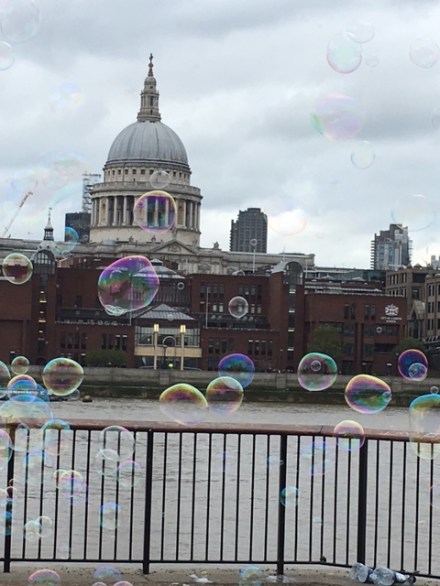
Walking along the Thames a few days ago, a stream of bubbles glided across my field of vision with the majestic, unshakable St Paul’s cathedral standing solidly in the background. The bubbles captured all the colours of the rainbow hidden in the autumn sun. The breeze sculpted subtle shifts in the shapes of the bubbles as they floated along the river. They danced and smiled as they moved with the wind. They added immense beauty to the world even though they lasted less than a few seconds.

Billions of people have lived and died before Saagar and I. Hopefully, billions will live and die after us. We are like bubbles in the ocean of life, capturing all the colourful emotions and being the best we can for as long as we are here, however long or short.

Saagar’s best friend Hugo shares his thoughts and memories. He also sings a beautiful song for Saagar. We love you and miss you darling Saagar. May peace be upon you!


A life sentence.

The best part of being human is to be able to feel stuff. All kinds of stuff. The world seems to be forever in pursuit of happiness in more money, more holidays, more clothes, more children and so on. The elusive ‘happiness’ is put on hold until the ‘more’ arrives, soon to be followed by more ‘more’.

In a week, it will be 3 years since Saagar died. For days I have been feeling this day approaching like a huge oil tanker which is going to squash my dinky little boat. This inauspicious day should be removed from all calendars everywhere for all the years ahead. It should be obliterated, erased, deleted and destroyed.

I think back on this time three years ago, trying to understand how Saagar must have felt. I try to find words for the thoughts and feeling that he could not verbalise. I lament the fact that no one could read his body language. I admire him for coping with his state of mind with patience and dignity. I look at his face-book post from this night. It was a full moon. He said ‘big ass moooooon innit”. I marvel at his ability to appreciate beauty. I remember how funny he was. I get a smile on my face. I promise myself never to take one moment of those 20 years for granted. Each of them was a blessing. Yes. It’s true that this feels like a life-sentence sometimes. Yet, I know I am blessed.

Screen Shot 2017-10-08 at 23.46.06

“The so-called ‘psychotically depressed’ person who tries to kill herself doesn’t do so out of quote ‘hopelessness’ or any abstract conviction that life’s assets and debits do not square. And surely not because death seems suddenly appealing. The person in whom Its invisible agony reaches a certain unendurable level will kill herself the same way a trapped person will eventually jump from the window of a burning high-rise. Make no mistake about people who leap from burning windows. Their terror of falling from a great height is still just as great as it would be for you or me standing speculatively at the same window just checking out the view; i.e. the fear of falling remains a constant. The variable here is the other terror, the fire’s flames: when the flames get close enough, falling to death becomes the slightly less terrible of two terrors. It’s not desiring the fall; it’s terror of the flames. And yet nobody down on the sidewalk, looking up and yelling ‘Don’t!’ and ‘Hang on!’, can understand the jump. Not really. You’d have to have personally been trapped and felt flames to really understand a terror way beyond falling.”
― David Foster Wallace


If all the world’s a stage…it has props.

downloadIn the background stands a majestic Palladian structure in brick red. It’s nearly 400 years old. The artistic roof displays beautiful finials, turrets and cupolas. It’s easy to imagine the large atria and sweeping staircases on the inside. It appears as if this building emerges from an expansive lush green sea.

The cricket nets are placed to the right of this building. Many hours have been spent here, laughing, picnicking, practising, talking, spectating and playing. Multiple recordings of his bowling action have been made here, each scrutinised to the nth degree by him. Each one distinct to his discerning eyes but all identical, to my lay ones.

In the fore-ground sits a TV screen with ‘Friends’ playing. He likes Rachel. I think she plays the role of who she is in real life. Not much acting ability required for that. He doesn’t understand that. He thinks I don’t like her. I like Phoebe. We both love ‘Smelly cat’. He watches it when he is down. I see why. However feeble, it always brings a smile to his face as it does to mine now. However predictable, it doesn’t fail to amuse, to lighten the heart. The impression of a head is clearly formed on the red velvet cushion resting at the corner of a black leather sofa.

At centre-stage, a pink and silver drum-kit sits atop a hand woven black and white Moroccan rug.  2 goblet drums wait in the wings – a Djembe and a Darbuka. A set of initialled drum-sticks read ‘SN’. Big round black bags lean against the wall. They weigh half a tonne. They encase special cymbals – presently silent but given half a chance, fully capable to raising the roof of not just our house but also that of the neighbours.

A fake snake coils on the study table with its tail realistically hanging off the edge. It has been used successfully to blow the living day-lights out of people of all ages, shapes and forms, on many occasions. It took me 2 years to immunise myself against it.

An unwieldy ragged cricket bag with wheels at one end lazes against the wall. One entire shelf in the cup-board is dedicated to cricket gloves, balls and other paraphernalia.

The sun streams in from 2 big sky-lights and the space is lit like a sanctuary. A silver Apple Mac laptop lies gaping on the study table with funny cat-videos playing. It’s connected to the dome of Harman Kardon speakers which hide under the table.  An assortment of coins, head-phones and keys splash across the dark wood table top. A few coffee mugs are scattered around the room with various shades and degrees of dry brown coffee lining the insides.

Behind the door is an overflowing willow laundry basket. A pair of union-jack boxer shorts shine through. The space smells of an unkempt temple with a male caretaker –  hints of incense, musk and testosterone. From the door hook hangs a towelled maroon dressing gown.

All the props are here, tell-tale signs of a life. Where’s the main man? At a subtle level, his absence is only physical. His essence is present.

It’s in all the props, in the air around them, in the luminosity of the room, in everyone he touched, made jokes with, played music with, was kind to and loved. In the glow in my eyes, the light in my heart. In me.

His essence is here. I only need to close my eyes. This must be immortality.

“Do you not know that a man is not dead while his name is still spoken?”                              – Terry Pratchett

(Ref: A fully referenced, peer reviewed article published in an educational, medical  journal for GPs; a case study of a young man called SN to demonstrate the importance of Suicide prevention training and the role of human factors in patient safety: http://journals.sagepub.com/doi/full/10.1177/1755738017724183.)