Why do love and crying go together?

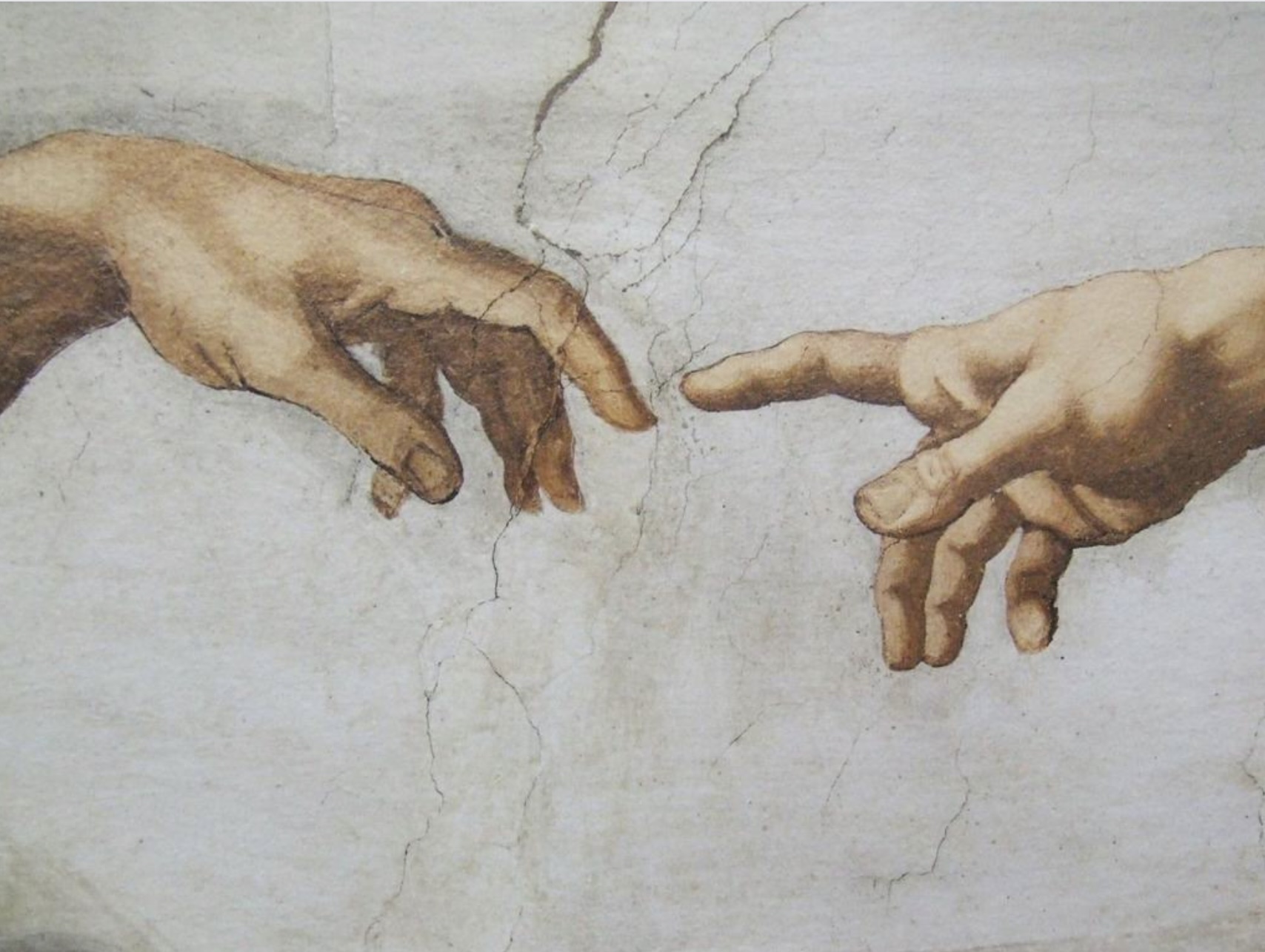
(From The Creation of Adam by Michelangelo)

At a recent wedding, halfway through his speech, the bride’s father was overcome with tears. He was so happy for his daughter that he couldn’t help but cry. It was a sparkling moment of a mixture of affection, achievement and perhaps relief. Even though it took him by surprise, it was perfectly normal and rather sweet.

At the hospital, I watched men and women cry with joy at the first sight of their newborn baby. It was joy to behold their love and terror of having this amazing miracle happen to them. I have taken many photos of those moist eyes brimming with love.

Babies cry to express their hunger or discomfort or pain. Adults also cry to express themselves but somehow, they don’t seem to have as much permission as kids. When we’re happy, we laugh and that’s okay. When we’re sad, we cry and that’s often not okay.

Jesus wept. (John 11:35)

When he visited the tomb of his friend, Lazarus, Jesus was moved to tears seeing the sorrow of those mourning his death. The verse comforts believers by showing them that Jesus had empathy for the grief, loss, and pain that humans endure. Despite knowing he was about to raise Lazarus, he felt for them in that moment. He had solidarity with the human heart.

The protective mechanisms built into our bodies are very subtle. The eyelids blink to ensure that the cornea remains moist, so we can continue to see clearly. It happens without us noticing. As soon as we put something in our mouths, our saliva starts to counter potential troublemakers in our food. When we change our position from sitting to standing, the biomechanics in the body readjust to ensure that we don’t fall over. A sense of balance in innate to us while standing and walking.

Crying also protects. It works as a pressure-release valve. When our emotions are intense and difficult to contain, crying helps to reestablish emotional equilibrium. It is a cue for connection with others as it is founded in our vulnerability as humans.

To stay with each other until the flood subsides.

To hold each other. Talk. Listen. Be present

That’s how we hold space for feelings, allowing them to be fully expressed.

That is how we experience divine love.

Resource:

CORe: Circle of Remembrance. A free online peer support group for bereaved parents, where crying is honoured.

New things.

They opened her sister’s tummy and took out a thing that looked like a red chili. Their mother was very worried, but the doctor said ‘all went well’. She was so relieved, she brought her a blue silk purse embroidered with beads and sequins. She had managed to buy a nearly new one for pennies at the village market from a heap of random goods piled up on the roadside.

New things never happened to Amita. She was the fifth of six kids. One girl. 3 boys. Her. One more boy. Most of her childhood was spent in boy’s clothes. When she was seven, she could finally wear her sister’s tattered old frocks. All she wanted was something new.

Amita started complaining of tummy aches that were so strong she had to miss school. She hardly ate anything and became scrawnier every week. She looked sallow. Her parents took her from one doctor to the next. They were exasperated. Finally, the fifth doctor said they would have to open her tummy and look inside. Amita’s dream was coming true. She smiled inwardly. Her operation was scheduled for Monday.

On Sunday night, in her hospital bed she remembered when her aunt had come to visit from Bangalore, she had brought one plastic doll for the girls to share. Its golden hair was pulled back in a tight ponytail. Her head was round with two very round brown eyes. When you lay her on her back, her eyelids closed over. Thick long black lashes touched her pink cheeks. On standing her up, the lids mechanically snapped open. Her elder sister claimed the doll all for herself. When no one was looking, Amita would hold the doll like a baby, rock it from side to side and stroke its cheeks.

On Monday morning, she was super-excited. As she was going off to sleep, the blue silk purse embroidered with beads and sequins danced in front of her eyes.

When she woke up, Amita had a huge red gash right down the middle of her tummy. It was so painful that she could hardly breathe but Amita didn’t care. She waited for her mum. When the visiting hour arrived, her mum brought her a gift – a red silk purse embroidered with beads and sequins. It was even more beautiful than the blue one. Amita felt victorious. She had a new thing, all for herself.  She could hardly wait to show it to the smiley nurse who routinely looked after her.

That night, Amita slept peacefully in her hospital bed, clutching on to her silk purse.

The next morning, the smiley nurse came in with a thermometer and placed the tip of it under Amita’s tongue with a smile. She then started writing her notes. Just then, Amita pulled out the purse from under her pillow and held it up for her to see, her eyes popping out but unable to speak.

“Oh! For me? How kind! Thank you.” said the nurse and received the purse with both her lovely hands.

                                                ****    ****    ****

Resource: This story is inspired by an anecdote from the book “Nonviolent Communication. A language of Life.‘ by Marshall B. Rosenberg. PhD. In Chapter 4, he addresses the heavy cost of unexpressed feelings about unmet needs.


An Irish Legend

Most of his stories are based in small towns and villages of 1950s Ireland. He writes about the underdog: small men and hard-done-by women. He has a deep concern for sexual exiles. His writing is true to that time in history because he normalizes silence, evasion and ambiguity. His fiction reads like truth. It reminds me of the time we lived in Northern Ireland. Almost every day I was flummoxed by the response I got on asking a colleague, how they were.

“Not too bad.”

I was never sure what that meant. Were they well? Or not as well as before? Or not as unwell as before? Not as well as they could be? Bad, but not too bad? I soon came to accept that as normal. In time I came to understand it as a safe answer – not giving away too much. It was historical.

William Trevor was a genius at talking about the unknown known, of knowing and not knowing at the same time. A cognitive disjunction. A common social ailment.

Yes. Mary Louise is in a loveless marriage to an older man and everyone in their small town knows but they pretend like they don’t.

Yes. Everyone knows that Elmer is becoming an alcoholic, but they act like they don’t.

I lately read ‘Two Lives: Reading Turgenev & My House in Umbria’ – a book with two artful novellas by Trevor. Reading Turgenev was shortlisted for the Booker Prize in its time. My House in Umbria was made into a film in 2003, available on YouTube. I haven’t watched it but apparently Maggie Smith is brilliant and the end has been changed for Hollywood.

For me, the protagonists of both these stories exemplify how hidden and unacknowledged grief can escort one to the thin red line between sanity and insanity. Both women are poorly understood even by people who claim to love them, their coping labelled as unacceptable, erratic and bonkers. Judged, condemned and outcast for simply managing their losses. Punished for somehow managing their loss. And finally, put away.

Everywhere.

A year or so after Saagar, one Saturday morning we were driving on the M4 to see Simon’s mum. As we tuned into BBC Radio 4, my ears were assaulted by the prefix, ’committed’. Neither the BBC, nor the psychiatrists knew better. They hadn’t learnt that crimes are ‘committed’. Not suicides. Suicides came from a desire to end insufferable emotional pain. Either these people didn’t know or they didn’t care enough to modify the words that habitually barfed out of their mouths. That prefix is so firmly embedded in the English language that it thoughtlessly rolls off our tongues. Suicide was a crime in the UK before 1961. It is still a ‘sin’ according to some good men and women of God. Hence, the default prefix, “committed”. That has to change. Like people who sadly die of cancer, people die of Depression and Schizophrenia and the like. They do not “commit” a crime.
Part of me was grateful they were talking about it, even if their language was wrong. I tried not to get too put off by that. I had not heard so many conversations about it before. Had something changed or had I not been listening all this time?
My mind could no longer handle long complicated, rambling books. It forgot names, lost plot lines and wandered off, out the window within minutes. Short and gentle texts, it could deal with but nothing that puts too much cognitive load. I asked a helpful librarian to recommend a couple of small books. She pulled out ‘The sense of an Ending’ by Julian Barnes and ‘The French Exit’ by Patrick deWitt. Both the stories had suicide at the center of it. I have read many books but couldn’t remember this theme arising so often.
I joined a short-story writing course at the Himalayan Writing Retreat. The award-winning author, Kritika Pandey, our teacher asked us to read ‘Why I decide to kill myself and other jokes’ by Douglas Glover beforehand. My heart pounded right through those sixteen pages. I was asked to pay attention to the technical details – the elliptical way in which the word ‘blue’ appears at periodic intervals, the sub-plot involving the dogs, the side-story of Hugo’s mum, the symbolism of the car – all of these were lost on me. I was inside the protagonist’s head, feeling her dread, her quandary and her hopelessness. It was in my face again.
The e-mail from the V&A was advertising an Alexander McQueen exhibition.
The film on TV tonight was ‘The Hours’.
The book that fell off the shelf and broke its spine today was ‘The First Forty-Nine stories’ by Earnest Hemingway.
This blasted thing that came out of nowhere, is now, everywhere.
Had my eyes and ears been shut for all these years?

Or, I wonder if, like many others I was not aware of my belief – this kind of thing only happens to others?

PS: The author, Earnest Hemingway and the fashion designer Alexander McQueen, both ended their own lives. ‘The Hours’ is a film based on a book by Michael Cunnigham with Virginia Woolf’s suicide at the center of it.

Cats

The Intensive Care Unit (ICU) at City Hospital, Belfast was a circus. Every day of the week a different clown (read Consultant) took charge of the ICU. What was right on a Monday was completely wrong on a Tuesday. The same action would be pronounced ‘perfect’ by one clown and ‘abhorrent’ by another. To make things even better, they didn’t talk to each other. The flunkies (read Junior doctors) were the in-betweeners that got lammed from both sides as their shifts crossed over time-territories. They were the pawns on the frontline that took over the running of the unit from one clown at the beginning of a shift and handed over to the other at the end of it. The flunkies dodged the arrows of conflict between the clowns – on the phones, in hospital corridors and at handovers. They were the ones that ran around all night looking after the sickest patients in the hospital, only to be lambasted the next morning. They were the buckets in which the bile of bitterness was collected, the one that the clowns didn’t have the gall to throw at each other.

In 2004, I was one of those flunkies. After about 8 months of this non-sense, I was done. I was loosing my sense of self, my confidence in making decisions and most importantly, the pride in my job. It was time to stop and take stock. After a nasty night shift, I was handing over the patients to the day team. At one point the Consultant said to me ‘you need your head examined’. That did it. I couldn’t bear to go home only to return to this hell-hole ten hours later. I walked into the Psychiatry Outpatient Department which was on the way to the car-park. There were two empty seats in the waiting area. I planted myself on one.
“Do you have an appointment?” one of the receptionists asked me.
“No. I don’t. I can wait for as long as it takes. I work here. If I am not seen today I may not come back tomorrow.” I didn’t fully comprehend what I was saying but it was my truth.

Dr Ingram was a handsome young psychiatrist with kind eyes and a small beer belly, well couched in his grey suit. He understood. He gave me 6 weeks off on grounds of ‘work-related-stress’ and started me on Fluoxetine. I was also seen five or six times by a therapist. She was a kind elderly lady who listened. She suggested getting a cat.

At the Antrim Animal rescue home an adorable black and white feline peered at Saagar’s dad and me from her cage. It was her eyes that got me – curious and twinkling, like a child. They said this little girl had been there for a month. Before that she’d had a rough life on the streets for a few months. Her right ear had a wedge missing from its edge. We decided to call her Bella. We were advised to keep her strictly indoors for at least 6 weeks, till she got familiarised with the smells of the house. She found her way to the tops of kitchen cabinets and radiator covers, squeezed behind sofas and underneath beds, inside shoes and suitcases. The only place she didn’t like was her brand new soft bed.

On our trip to the vet for a basic check-up, we were told that the she-cat was in fact a he-cat. After much discussion, Saagar’s dad’s choice of name came up tops. ‘Mr Bronx’, the old faithful. He soon became a source of great joy, comfort and hilarity for us. We had him playing with balls of wool, soft toys with bells and chasing the beam of a laser pen. He was pure joy but kept his distance. Slowly he let us stroke and cuddle him. His purring beneath the palms of my hand soothed my soul and made me feel deeply connected with this four-legged being. Within a month we were having full-fledged conversations.

The Fluoxetine made me feel like a zombie. No joy. No pain. No love.
It was dehumanising. At times it made me terribly restless but I stuck with it. It was proof that pills can’t make you happy. May be they take the edge off, but at a price. The best thing about that time was that I could rest. I was left alone. I had some control on my days and nights, which I had not had for years.

After 6 weeks, it was time to go back to work. I did. My schedule was reshuffled to ensure I didn’t spend much time working in ICU. It worked. I got back on my feet. Later I discovered that other junior doctors before me, had had similar unpleasant experiences, complaints had been made about the sad state of affairs at that hospital but nothing had changed on ground. It was an open secret, not spoken about while the abuse persisted and continued to break innocent young doctors down.

Nine years later, Saagar was home from University and I got a phone call from him at work. “Mamma, can we get a cat? I found one on Gumtree.”
That evening we went over to a tiny flat in Sydenham occupied by a black family of four – mum and three kids. On a window sill lounged another family of four, a grey mother-cat with her three grey kittens. Six weeks old. The kittens were being carried around the flat like rags by the kids. They didn’t care if they lifted them by their ears or tails or bellies.They released the sweet little things from various heights above the floor, cornered them and held them tight. They told us about what the cats ate. We picked the littlest one, a grey and white mini-punk. We got a bell, a bowl and some toys for him from the pet shop and brought him home in a cardboard box. He was christened ‘Milkshake’ by Saagar, who became his loving mum that summer.

The sedate Mr Bronx was too old and too calm for the punchy young Milkshake who developed an attitude very quickly, but they found a way to co-exist, keeping a safe distance from each other.

Not once did it occur to me that there might be a connection between the circumstances in which we got the first cat and then, the second.