The Wednesday Group.

Dear Saagar,

Ten is a strange one. Who knew an innocent, round, even number like this could inflict such pain on one. The last note I had from you was ten years ago. It turned each moment of each day into an unwanted debt, heavily owed to God-knows-who. Potential decades stretched out before me like a horizon-less dark desert. I wished they would disappear. Time became the enemy, unfolding in fits and starts in wiggly circular patterns, etching lines of blood and tears on the surface of mighty oceans.  

Now, this gone decade demands recognition. It wants to be acknowledged in some way, however small. It deserves a pat on the back for braving through such turmoil and finally becoming a friend.

Hugo, Azin, Phoebe and some other friends, yours and ours came over for a Sunday lunch in early August and brought their friends along. Many of them, musicians. Remember Corinne Bailey Rae? You bought me her CD, Girl put your records on one Christmas? Remember how I sang along to it in the kitchen while cooking? On Sunday, we sang that song together. The Dock of the Bay and Ain’t no sunshine and Stand by me too.

We cut a chocolate cake for everyone who turned thirty this year. We were together for five glorious hours. Tens of sun-flowers smiled in vases dotted around the room and the sun shone on us as we talked and laughed and sang, just like the old times.

You won’t believe this but I resigned from my job recently. I know. I was so proud of it. I got so much from it. It meant so much to me but I feel liberated. Now someone else can do that lovely job while I work with my unique gift. In a world increasingly obsessed with labels, I am happy to lighten myself and shed a few.  

Last weekend, Si and I hosted a retreat for eleven bereaved parents. It was The Wednesday Group of the Circle of Remembrance that had started meeting online in May 2022. For more than two years we met for an hour and a half online every fortnight, sharing the most personal of things. This was the first occasion for us to meet in person as a group. It was divine.

One brown butterfly alighted on the left side of Si’s chest and rested on his white shirt peacefully for quite a while as we all talked and laughed and sipped our teas and coffees.

After returning home, one mum wrote to say,

“…this weekend has reminded me of who I am and what I am capable of as I continue to navigate this life I never expected or wanted to have.” 

What could be better?

I am blessed. Thank you for being my son.

Your essence remains here, with us.

Love you my darling.

Mamma. xxx

(Please visit http://www.core-community.com and contact us to join our loving and understanding community or recommend it to anyone who might find peer support after child loss helpful.)
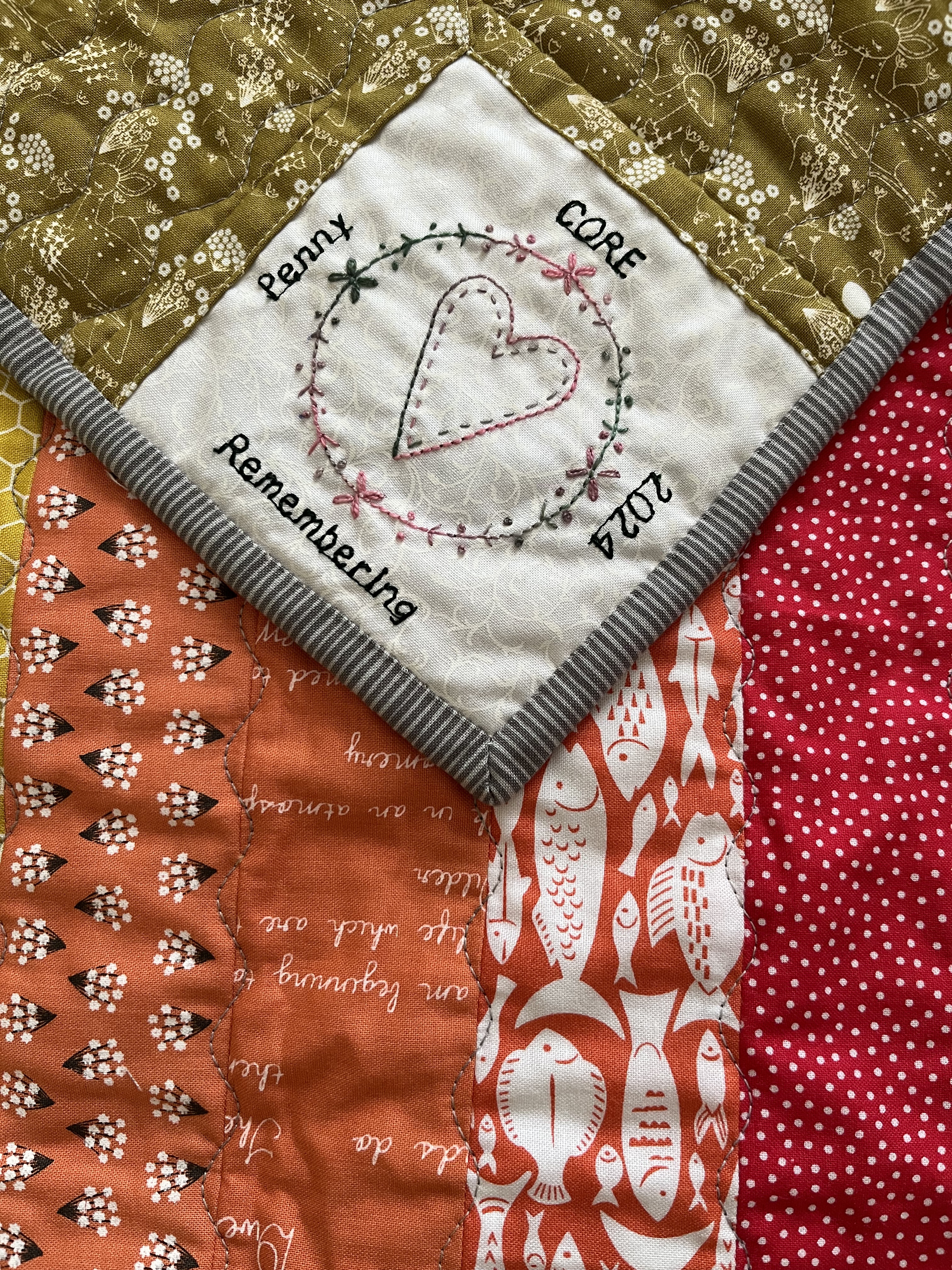
(A handmade patchwork wall-piece for the home of CORe)
It’s a story. It’s not a story.

Last weekend I was part of a team of volunteers. The Compassionate Friends hosted a summer retreat for parents who have lost a child to suicide or substance use. We expected seventy parents to arrive, some as couples, some by themselves. Many of us drove for many miles through road works and traffic jams. Some changed trains more than once and persevered through serious delays due to fatalities on the tracks on two successive days. Even though their own hearts ached, they traveled from all over the UK to Leeds.

The venue was a new one, Hinsley Hall. It was true to the pictures on its website – majestic. Having never worked there before, many of us arrived a day prior, to familiarise ourselves with the space and allocate rooms to activities depending on their size and suitability, getting to know the staff and setting out folders, notice boards and programes.

The job at hand was to belong to those who attended and have them belong to us. I went up to my room and drew the curtain. I gasped at the view. My window looked over a deep-green lawn with dark old trees and two parallel hedges with patches of yellow.

As the participants arrived through the gates, we welcomed and escorted them despite their visible anxiety and fatigue, a reluctance to acknowledge their eligibility to be here, attending this retreat. Slowly, cups of tea, coffee and glasses of water loosened the atmosphere.

At the Writing workshop, words like ‘disassembled’ and ‘brown silt’ were shared and felt. A bronze sculpture of a young woman in the courtyard, standing with her arms wide open was a constant encouragement to open our hearts.

Over the next couple of days, each of us felt seen, listened to, acknowledged and our grief felt witnessed. Friendships were born. There was much laughter and many tears flowing through truck-loads of memories. Grace was at work. It was allowing something within us to soften and relax.

At the end, one mum said she met some lovely people and found much comfort and connection. Another said, she met herself, this time with gentleness.

Being there, volunteering, was a good way to honour Saagar’s  life and mine.  What better way to spend our days than to hold our kids, ourselves and each other in a warm embrace?

I am here. He is here.

Long shadows

A few months after Day 0, at a SOBS (Survivors of Bereavement by Suicide) meeting at the All Saints near Euston, I met a father who said, “Eight years” when I asked him how long it had been since his son died. I looked at his face as if he was the most spectacular and wondrous impossibility of the world. Is it possible to live as long as that after the death of a child? He was proof. It was. I had never seen anyone who had been bereaved that long, standing and smiling and speaking sense.

Last Monday I joined the 3 dads on the last leg of their long walk to Westminster alongside many people who want the government to add suicide awareness and helpful resources to the school curriculum. We walked and talked in the rain. I said ‘Nearly eight years’ in response to how long has it been since my son passed. I got the same look from a young mum recently bereaved. She stopped and looked into my eyes through the thick rain drops. Past and future, face to face. “Gosh! Does it get any easier?” she asked. It does, I replied, holding her hands.

All these years I have tried to keep Saagar alive in every way I could – writing, public speaking, teaching Youth Mental Health First Aid courses, advocating for young people, working with various people, charities, NHS, Churchill Trust and other organisations, making films and so on.

I have read other people’s accounts of loss, hoping to lessen my pain and deepen my understanding. The latest book I read was ‘The Year of Magical Thinking’ by Joan Didion. She says:

I know why we try to keep the dead alive: we try to keep them alive in order to keep them with us.

I also know that if we are to live ourselves there comes a point at which we must relinquish the dead, let them go, keep them dead.

Let them become the photograph on the table.

Let them become the name on the Trust accounts.

Let go of them in the water.

Knowing this does not make it easier to let go of him in the water.”

Eight years! No time at all.

Time is the school in which we learn.

Time is the fire in which we burn.”

  • Delmore Schwartz.

Random stuff

After many years, things are being taken out of cup-boards and off shelves, turned inside out and properly looked at. Dusty books, clothes, folders, boxes and sachets. Some familiar fragrances are escaping and some old scenes are playing out on the screen of the mind. Bits of stuff slipping out of other stuff and falling to the ground with a clink. Some stuff that was believed to be misplaced is being placed. Some that was believed to be forgotten is being revisited.

Sample 1

A nappy pin. Special feature – A white safety cap to prevent accidental opening up while the baby has his cloth nappy on. Commonly used in India and other developing countries. Original owner: Baby Saagar.

Sample 2

A business card. Special feature – Simplicity. An invitation to music and joy. Original owner: Saagar.

Sample 3

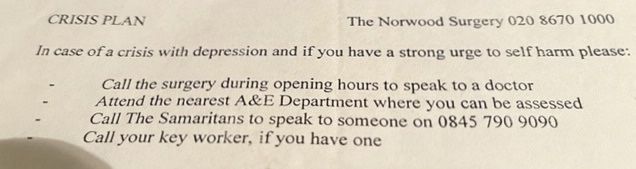
A Crisis Plan. Special features – Not worth two pennies. Highly ineffective. Not accompanied by a conversation. No detail. Not individualised. Not created in partnership with the patient. Not an alive document. Does not mention anything more than ‘self-harm’. Doesn’t tell us what ‘Crisis’ looks like. Doesn’t identify any helpful distractions, activities, friends or family. Doesn’t appear to know the patient, for example, a key fact – does this person have a key worker? Does not express any understanding or compassion.

Commonly used in developed countries.

Oops! The name of the GP surgery is visible. It doesn’t matter. It closed down years ago. We were it’s last few unlucky patients. Owner: Saagar Naresh (1994-2014).

(Resource: Safety Planning is essential to safety: https://stayingsafe.net/home)

Thank you for noticing.

She was listed for a minor surgical procedure on my list. I called out her name in the waiting area and escorted this pleasant, middle aged lady into a cubicle for her pre-anaesthetic check-up. We both sat down at right angles to each other. She had an unmissable racoon’s eye on the right side of her face. I looked again. Just to be sure. It was there in its fading pinky-blueness. She was in hospital for a totally unrelated reason but I ventured into asking, “What happened here?” pointing to the eye.

‘Oh. I had a run-in. Couple of weeks ago.’

“A run-in with what?”

‘You know … It’s okay. I don’t want to talk about it.’

“Have you spoken to anyone about it?”

‘Yes. I am okay. I really don’t wish to speak about it.’

“That’s fine. How are you doing today?”

We went ahead, staying focused on preparing her for the upcoming procedure.

I took a moment to call the Safeguarding department of the hospital. They said that it was normal for people suffering abuse, to not talk about it for a long time. They advised us to signpost her verbally. A written set of resources might make her more vulnerable, if discovered by the wrong set of hands.

Two women are killed by a partner or former partner every week in England and Wales.

One in five people suffering domestic violence will plan or attempt to take their own lives.

One in eight of all female suicides and attempts in the UK are due to domestic violence and abuse. This equates to 200 women taking their own lives and 10,000 attempting to do so due to domestic abuse every year in the UK. That’s nearly 30 women attempting to complete suicide every single day. 

Men endure domestic abuse too. This can include physical violence, as well as emotional and psychological bullying, sexual violence or financial control and abuse. 

It is living hell. An invisible prison. Isolating, with no one to confide in.

It takes great courage to speak. It’s often ignored. Many suffer in silence.

Survivors do come in contact with health and social services but disclosure is difficult.

If done right, it is life changing. Appropriate response is invaluable.

Front-line staff must recognise signs and highlight issues.

It is important to ask and act.

After her procedure, I went to see her in the Recovery room.

“Have a nice evening.” She said. “Thank you for noticing.”

Resources:

https://www.rcn.org.uk/clinical-topics/domestic-violence-and-abuse/general-resources-and-support