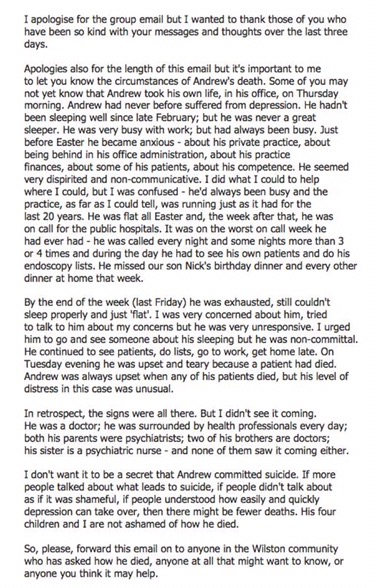
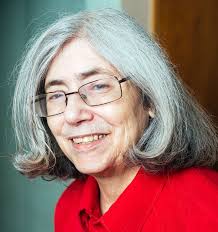
Day 952

A surgeon’s wife writes

img_1418

The Dark side of Doctoring is an insightful blog written by a surgeon.
The common themes that push doctors into dark despair are:

1.Loss of control.
2. Loss of support. 6am. Repeat.
3. Loss of meaning.

One would think that those who look after other people would know how to look after themselves and their colleagues. Not so at all.

Thank you Dr Eric Levi.


Day 951

download

Who? The young. 

1 in 6 people is an adolescent. More than 3000 adolescents die every day from largely preventable causes, according to a new report from WHO and partners. That amounts to 1.2 million deaths per year.  Many key risk factors for future adult disease start or are consolidated in adolescence. Adolescent mental health and well-being are often overlooked.

In 2015, more than two-thirds of these deaths occurred in low- and middle-income countries in Africa and South-East Asia. Road traffic injuries, lower respiratory infections, and suicide are the biggest causes of death among adolescents.

Most of these deaths can be prevented with good health services, education and social support. But in many cases, adolescents who suffer from mental health disorders, substance use, or poor nutrition cannot obtain critical prevention and care services – either because the services do not exist, or because they do not know about them.

“Adolescents have been entirely absent from national health plans for decades,” says Dr Flavia Bustreo, Assistant Director-General, WHO. “Relatively small investments focused on adolescents now will not only result in healthy and empowered adults who thrive and contribute positively to their communities, but it will also result in healthier future generations, yielding enormous returns.”

Suicide and accidental death from self-harm were the third cause of adolescent mortality in 2015, resulting in an estimated 67 000 deaths. Self-harm largely occurs among older adolescents, and globally it is the second leading cause of death for older adolescent girls. It is the leading or second cause of adolescent death in Europe and South-East Asia.

“Improving the way health systems serve adolescents is just one part of improving their health,” says Dr Anthony Costello, Director, Child and Adolescent Health, WHO. “Parents, families, and communities are extremely important, as they have the greatest potential to positively influence adolescent behaviour and health.”

At long last, the world is waking up and so is the World Health Organisation.

Podcast:
In conversation with Meera S and Dr George at Business FM, Malaysia:

Doctor in the house: Adolescent Health

Day 949

Iatrogenic

download

Antipsychiatry – I knew the sentiment but I didn’t know the word.
Dr Bonnie Burstow has helped hundreds of “highly suicidal patients,” as a psychotherapist. She’s come to believe that conventional psychiatric treatment isn’t in their best interests.

For half a century, scholars have been looking closely at Psychiatry as a coercive instrument of oppression. Dr Burstow is a prominent figure in the field of antipsychiatry, which she describes as “a movement of both psychiatric survivors and professionals saying that we need to abolish psychiatry”. She’s the author of “Psychiatry and the Business of Madness” and “The Myth of Mental Illness”.

“Longitudinal studies have shown that people who go off their drugs after a few years do better in the long run than people who stay on them. But guess who does the best of all? The people who were never on them in the first place. So, then the answer is, no one should be on them in the first place. These are not medical substances. They do not address a single chemical imbalance. They, in fact, cause imbalances and not surprisingly they cause all sorts of problems for people who can then never get off them because they now have a disordered brain that is caused by the medical profession. You know I spend a lot of time building up that and showing how it happened. But once you take in that position, it is a very convincing argument for abolition.

Since the 19th century, psychiatry has been defrauding vulnerable people. There was dunking people in cold water. There was rotating people in chairs. There was also opium. There was bleeding. Remember we had bleeding for a long time. There was also genital mutilation, just don’t forget they thought madness was being caused by masturbation.”

The University of Toronto has recently started a scholarship in Antipsychiatry. It is a historical breakthrough and hopefully a precursor to a better society. It signals to the world that this field of inquiry has come of age.


Day 946

When they were little, they came and told us everything every day. They vied for our attention. We didn’t have to ask them anything. They went round and round us and wanted to tell us all about their friends, people they met, things they did, what they had at lunch time, who said what to whom and so on.

A few years later, we started going round and round them, asking – what did you do today? Who did you meet? How are your friends? What did you have at lunch time and so on… but we didn’t get much more than monosyllables in response. What happened? Same child. Same parents. When did the equation change?

When they were tiny, we looked at them and smiled at the lovely things they said. They received our appreciation. They felt our complete acceptance of who they were, our whole-hearted approval of their pure innocence.

One day they came to us and said, ”Guess what! Today I bunked school to go watch a film.” Did we smile then? Did they feel our approval, acceptance or appreciation? No. They didn’t. If we could have smiled that day, they would have come and told us each and every detail of their day. But that day they felt our rejection. That day we put a deep long distance between them and us. They came to us with an openness which we were not ready for. Our judgement got in the way. We gave them a proper telling off in their best interest. In the evening, a family meeting was held to discuss the fact that this child has gone off the rails. The child got criticism, humiliation, ridicule and a feeling that everyone was trying to control their actions.

A few days later they tell us that they were introduced to smoking cigarettes by a friend at a party. That day a big huge drama takes place at home. Slowly, they stop telling us anything. We think they have learnt their lesson and stopped doing those things. In fact they have only stopped telling us what they were doing because they don’t want to meet our disapproval, our inability to listen without judgement.

We wondered how and why this distance came about?
Because we made them feel deeply rejected.
Everyone needs appreciation, approval and acceptance to experience closeness in any relationship. That leads us to the issue of boundaries and discipline. More thoughts about that tomorrow. Of course, I am no expert.

Day 944

ernest-hemingway-9334498-2-raw

The Great Master

All I manage to read these days are short stories. Partly due to my abbreviated attention span and partly because the time has come when I ‘should’ start wearing reading glasses but I don’t. I get by, by increasing the font size and by reading for short periods of time. Also by squinting a lot.

‘The First Forty nine stories’ is a collection by the Nobel prize winner, Earnest Hemingway. In the preface he says, “In going where you have to go and doing what you have to do and seeing what you have to see, you dull and blunt the instrument you write with. But I would rather have it bent and dull and know I had put it on the grindstone again and hammer it into shape and out a whetstone to it, and know that I had something to write about, than to have it bright and shining and nothing to say, or smooth and well-oiled in the closet, but unused.”

After devouring the collection, I read up about him and was saddened to find that he suffered with depression and died of suicide. Here’s an example of the sensitivity and vulnerability of his characters and the simplicity of his story telling style. It’s called ‘Cat in the rain’.