Day 955

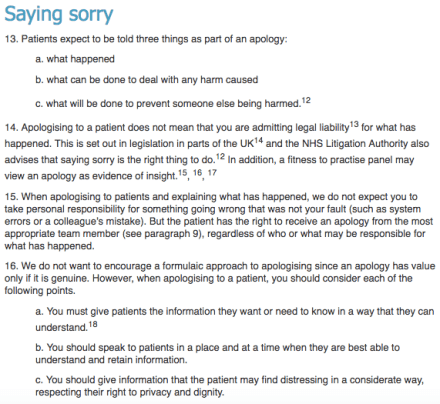
GMC says

Saying sorry

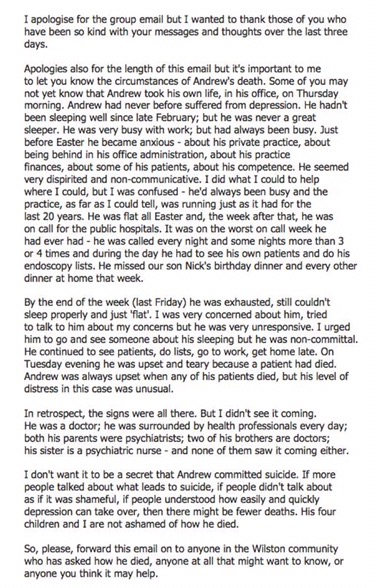
A letter I wrote this morning to the world’s first medical defence organisation that is proud of its rich history of guiding, supporting and defending its members:

Dear Medical Defence Union,

Here, I speak more as the mother of a deceased child than as a Consultant Anaesthetist. When a patient comes to my hospital to have surgery, there is a legal contract between him/her and the hospital. As per that, the hospital is obliged to safely complete his/her operation.

When I see that patient on the morning of their surgery, I speak with them and gain their confidence. The trust they place in me when I look into their eyes and assure them safety is not legislated for. Trust is an empowering human sentiment essential to the patient, enabling them to come for their operation. Trust is the basis of any meaningful relationship.

2 days before my son died, his GP, Dr F assured us that he was on the right medications and would soon start showing signs of improvement. After my 20 year old son, Saagar Naresh’s death on the 16th of October 2014, I didn’t hear at all from our GP. Not a word of condolence or sympathy. Complete silence. At the Coroner’s court the GP said that he followed the advice given to him by the MDU, to not call me after my son’s death.

Considering he knew me for 10 years and I entrusted my child’s well-being in his hands, I think it would have been ‘basic decency’ for him to call or visit. Legally speaking, a 20 year old is not a child. But for me he is. Human relationships are way beyond ‘legal’.

In light of GMC’s Duty of Candour, please rethink your advice in the future. The practice of medicine is founded on humanity.
Please do not take it away.

Kind regards,
SM.


Day 954

photo (4)

Recovery Room is also known as POCU – Post Operative Care Unit. While most patients have a smooth emergence from anaesthesia, others may feel disorientated or confused. They might feel mild pain, nausea or experience other side effects of surgery and anaesthesia.  The calm and caring presence of Recovery nurses helps them smooth over all these turbulences and come back to themselves before being sent to the ward.

K is one such nurse. Her sweet voice and soft Australian accent is unmissable. She smiles all the time. She listens and asks intelligent and relevant questions. She is full of kindness and clever ideas to get around problems. She respects other people’s priorities and time. She is an old soul.

Last Saturday, after work she went out to a pub with friends. She heard some troublesome noises on the street and went out to help. I can picture her excusing herself, ”I’ll just nip out and be back in a sec.” Little did she or her friends know that that would be her last act of kindness. She was killed in the incident near London Bridge that night.

How is it that some people can go out of their way to be vicious and others can show extraordinary kindness at a huge cost to themselves? We all belong to the same race. We all cry the same salty tears and bleed the same red blood. We all feel the same insane love for our kids and the same burning pangs of hunger. Ultimately we all want to be free, to be loved and understood for who we are. Why this deep divide?

Can I imagine K not offering to help? No. That is just the kind of person she was – true to herself till the very end. Bless you K. We love you and miss you. Recovery Room is not the same without you and this world is a better place because of you.

Love and blessings from London to all broken lives and hearts, everywhere.


Day 952

A surgeon’s wife writes

img_1418

The Dark side of Doctoring is an insightful blog written by a surgeon.
The common themes that push doctors into dark despair are:

1.Loss of control.
2. Loss of support. 6am. Repeat.
3. Loss of meaning.

One would think that those who look after other people would know how to look after themselves and their colleagues. Not so at all.

Thank you Dr Eric Levi.


Day 950

IMG_3147

Let me not defer…

Rush hour in London is a perfect example of organised chaos. Buses, cycles, pedestrians, taxis and cars miss each other by millimetres and head purposefully towards their respective destinations. The sun shone generously this morning, throwing light on every minute detail.

He sat on the edge of a low shop window on York Road. I saw him on my way from the bus-stop to the hospital. He sat there holding his head in both his hands – the classic pose. He must have been in his mid-twenties. There was darkness in his eyes, a small blue travel bag by his right foot. Not sure if he spoke English. He didn’t look drunk. I walked past him. I wanted to stop and talk to him but I knew this could take time and I would get late for work. I kept walking. Hundred yards ahead, I turned around and looked. He was still there. Still in the same position. Something needed attention. I thought I would quickly go to work, see if I could be spared and come back asap.
I did exactly that. I came back after 40 minutes but he was gone.

What could I have done? There are so many people, each one with their own problems and stories. What difference can I make?

I can ask – Are you ok? Can I help you?
I can offer my phone if they want to make a call.
I can have a phone number handy – 0808 800 4444 (Shelter)
I can have the belief that there is something I can do.

Postponing a positive action is a sure way of missing the entire fleet.
I was unaware that every day 150 families in Britain become homeless.


Day 949

Iatrogenic

download

Antipsychiatry – I knew the sentiment but I didn’t know the word.
Dr Bonnie Burstow has helped hundreds of “highly suicidal patients,” as a psychotherapist. She’s come to believe that conventional psychiatric treatment isn’t in their best interests.

For half a century, scholars have been looking closely at Psychiatry as a coercive instrument of oppression. Dr Burstow is a prominent figure in the field of antipsychiatry, which she describes as “a movement of both psychiatric survivors and professionals saying that we need to abolish psychiatry”. She’s the author of “Psychiatry and the Business of Madness” and “The Myth of Mental Illness”.

“Longitudinal studies have shown that people who go off their drugs after a few years do better in the long run than people who stay on them. But guess who does the best of all? The people who were never on them in the first place. So, then the answer is, no one should be on them in the first place. These are not medical substances. They do not address a single chemical imbalance. They, in fact, cause imbalances and not surprisingly they cause all sorts of problems for people who can then never get off them because they now have a disordered brain that is caused by the medical profession. You know I spend a lot of time building up that and showing how it happened. But once you take in that position, it is a very convincing argument for abolition.

Since the 19th century, psychiatry has been defrauding vulnerable people. There was dunking people in cold water. There was rotating people in chairs. There was also opium. There was bleeding. Remember we had bleeding for a long time. There was also genital mutilation, just don’t forget they thought madness was being caused by masturbation.”

The University of Toronto has recently started a scholarship in Antipsychiatry. It is a historical breakthrough and hopefully a precursor to a better society. It signals to the world that this field of inquiry has come of age.