Day 952

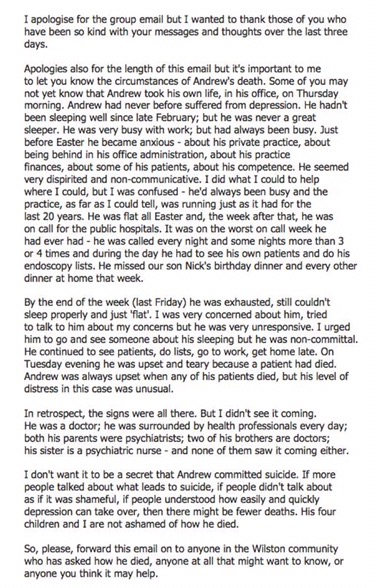
A surgeon’s wife writes

img_1418

The Dark side of Doctoring is an insightful blog written by a surgeon.
The common themes that push doctors into dark despair are:

1.Loss of control.
2. Loss of support. 6am. Repeat.
3. Loss of meaning.

One would think that those who look after other people would know how to look after themselves and their colleagues. Not so at all.

Thank you Dr Eric Levi.


Day 951

download

Who? The young. 

1 in 6 people is an adolescent. More than 3000 adolescents die every day from largely preventable causes, according to a new report from WHO and partners. That amounts to 1.2 million deaths per year.  Many key risk factors for future adult disease start or are consolidated in adolescence. Adolescent mental health and well-being are often overlooked.

In 2015, more than two-thirds of these deaths occurred in low- and middle-income countries in Africa and South-East Asia. Road traffic injuries, lower respiratory infections, and suicide are the biggest causes of death among adolescents.

Most of these deaths can be prevented with good health services, education and social support. But in many cases, adolescents who suffer from mental health disorders, substance use, or poor nutrition cannot obtain critical prevention and care services – either because the services do not exist, or because they do not know about them.

“Adolescents have been entirely absent from national health plans for decades,” says Dr Flavia Bustreo, Assistant Director-General, WHO. “Relatively small investments focused on adolescents now will not only result in healthy and empowered adults who thrive and contribute positively to their communities, but it will also result in healthier future generations, yielding enormous returns.”

Suicide and accidental death from self-harm were the third cause of adolescent mortality in 2015, resulting in an estimated 67 000 deaths. Self-harm largely occurs among older adolescents, and globally it is the second leading cause of death for older adolescent girls. It is the leading or second cause of adolescent death in Europe and South-East Asia.

“Improving the way health systems serve adolescents is just one part of improving their health,” says Dr Anthony Costello, Director, Child and Adolescent Health, WHO. “Parents, families, and communities are extremely important, as they have the greatest potential to positively influence adolescent behaviour and health.”

At long last, the world is waking up and so is the World Health Organisation.

Podcast:
In conversation with Meera S and Dr George at Business FM, Malaysia:

Doctor in the house: Adolescent Health

Day 948

Why Pinky?

My deepest thoughts are in Hindi. Only when I am in a hurry do I think in English. It’s my second language. A legacy of the Raj. Even though I have been using it for most of my personal and professional life, I need to constantly work at it. Being bilingual means one has 3 languages to have fun with – Hindi, English and Hinglish.

The English in the UK is different from the one I learnt as a child. That English was more a medium of education. As a teenager I started to enjoy it, especially through Tintins – billions of bilious blue blistering barnacles.

The usage of a language in its native country is very different from anywhere else. I had no idea what ‘Pinky’ was. For me it’s a person’s name, mostly a girl but could also be a boy. Little finger? Really? It would never have crossed my mind.

This notice in the loo on the train showed me the endearing way in which vernacular can be used : ‘Please don’t flush nappies, sanitary towels, gum, old phones, unpaid bills, junk mail, your ex’s sweater, hopes, dreams or goldfish down this toilet.’

‘Numpty’ is not quite the same as idiot. It has a particularly affectionate tone to it. Cute! Again, a new one for me. ‘Skulking’ is not as simple as loitering. It is, moving about shadily, with something to hide. It has a naughty/sinister connotation to it. ‘Four Weddings and a Funeral’ introduced it to me.

This evening I asked 2 English men their favourite word and both of them perfectly pronounced the same one:  Floccinaucinihilipilification.

Recently I was flattered to be asked to write an article for the charity Mind, about a simple coping mechanism that has helped me and can help anyone. I wrote about writing. This is how I grieve: Woes and Prose.


Day 944

ernest-hemingway-9334498-2-raw

The Great Master

All I manage to read these days are short stories. Partly due to my abbreviated attention span and partly because the time has come when I ‘should’ start wearing reading glasses but I don’t. I get by, by increasing the font size and by reading for short periods of time. Also by squinting a lot.

‘The First Forty nine stories’ is a collection by the Nobel prize winner, Earnest Hemingway. In the preface he says, “In going where you have to go and doing what you have to do and seeing what you have to see, you dull and blunt the instrument you write with. But I would rather have it bent and dull and know I had put it on the grindstone again and hammer it into shape and out a whetstone to it, and know that I had something to write about, than to have it bright and shining and nothing to say, or smooth and well-oiled in the closet, but unused.”

After devouring the collection, I read up about him and was saddened to find that he suffered with depression and died of suicide. Here’s an example of the sensitivity and vulnerability of his characters and the simplicity of his story telling style. It’s called ‘Cat in the rain’.


Day 939

Me? Lonely? Naah!

images

Joe put an advert in his local paper which read: “Senior citizen, 89, seeks employment in Paignton area. 20 hours plus per week. Still able to clean, light gardening, DIY and anything. I have references. Old soldier, airborne forces. Save me from dying of boredom!” He said he had lived alone since his wife, Cassandra, died two years ago and had been lonely. “When you live on your own there is no one to speak to. Since she died I’ve moved into a flat and it’s a big block. Once you walk into that flat it’s like solitary confinement,” he said. He is due to start work at a cafe in the town after the owners of the family-run business spotted his request.

Film-maker Sue Bourne says it’s a major public health issue. Her BBC documentary is called “Age of Loneliness”. It tells the stories of 14 people, young and old. “A silent epidemic that’s starting to kill us. But we don’t want to talk about it. No-one really wants to admit they are lonely.”

Si is away for a week. It’s only tolerable because I know I will see him at the end of the week. I tell myself it’s ok but it’s not easy. I miss him. I have something planned with friends for every other evening of the week so that I have something to look forward to. Something to keep me distracted. I can’t imagine how it must feel to loose a spouse or a partner you love and have been with for decades.

Source:
View: An online magazine that talks about issues that matter.
Editor: Brian Pelan

http://viewdigital.org/2016/11/03/need-talk-suicide-prevention/