Day 634

beds

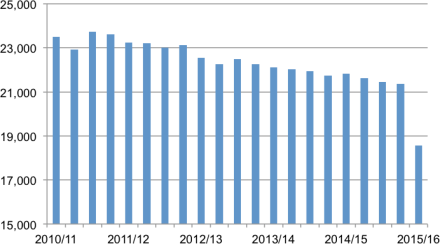
Total beds available for Mental Illness in England

The total number of beds available for mental patients has steadily declined in recent years in response to acute funding pressures in the NHS and a latent preference for physical illness over psychosis. This is creating intolerable pressure on families and care in the community resources and frequently results in young people being sent for treatment hundreds of miles from where they live. This is unacceptable.

iapt

Access to Psychological Therapy (IAPT) in the NHS

The demand for psychological treatment has escalated dramatically in recent years. Whilst Improving Access to Psychological Therapy (IAPT) treatments has risen, it has not kept pace with demand and increasing numbers of referrals are being refused. The net effect is that treatment thresholds are rising – sufferers have to be in ever deeper crisis before they can access care. Those accepted for treatment are then faced with weak pathways and absurd waiting lists, leaving sufferers, families and communities in despair and anguish. This is unacceptable.

(Source: The MindEd Trust)

Dat 626

Twenty-two years ago a 37 years old journalist Mike McIntyre felt his life was quickly passing him by. So one day he hit the road to trek from one end of the USA to the other with just the clothes on his back and not a single penny in his pocket. Through his travels, he found varying degrees of kindness in strangers from all walks of life and discovered more about people, values and life on the road in America than he’d ever thought possible. The gifts of food and shelter he received along the way were outweighed only by the touching gifts of the heart – the willingness of many he met to welcome a lonely stranger into their homes…and the discovery that sometimes those who give the most are the ones with the least to spare. He wrote an insightful book called ‘Kindness of Strangers’ based on his travel experiences.

The rail industry in the UK is piloting a new on-line service called Rail505. It empowers rail users to identify individuals on railway platforms who might be at risk of harm and provide them with resources to get help for these individuals. They have four 15 second you-tube clips on their website (Rail505.com) that are recordings from a CCTV camera. They are titled – shoes, bridge, sign and bench. Each of them is subtle and educative at the same time. Even if we think we can’t do much to help, there is always something we can do. Trust your instincts, says the website. The signs that someone is at risk from harm aren’t always obvious, but we all know when something doesn’t feel right.

“There was a time in this country when you were a jerk if you passed somebody in need. Now you’re a fool for helping. Gangs, drugs, murderers, rapists, thieves, carjackers. Why risk it? I Don’t Want to Get Involved has become a national motto.” – Mike McIntyre.

Time to talk. Time to change.


Day 608

We live in an age of sleep deprivation. In the 1950s, most people got on an average 8 hours of sleep every night but now it is reduced by at least an hour and a half. Teenagers need 9 hours but they often get only about 5 on a school night.

Sleep is restorative. It helps with conservation and regeneration of energy. It also helps with basic brain processes such as memory, creativity, problem-solving and learning. Shortage of sleep and poor quality of sleep is deeply damaging, as in shift workers. Not only does it have subtle effects on one’s personality, it also increases the risk of road and other accidents due to micro-sleeps in the day and increased impulsiveness.

“You always get sleep disruption in people with mental illness. That’s because they don’t have jobs, so they go to bed late and get up late” remarked a psychiatrist. This led Dr Russell Foster into the study of relationships between sleep and mental illness. His team at Oxford found that in patients with schizophrenia, regardless of antipsychotic treatment, sleep patterns were not just disrupted but totally smashed. Bipolar and Seasonal affective disorders and depression also involve bad sleep as do dementia, Alzheimer’s and Parkinson’s disease.

Sleep disruption is being studied as a biomarker of potential mental health problems and it offers the possibility of early intervention.

Researchers at Oxford have found that if sleep can be partially stabilized using CBT in patients with schizophrenia, levels of delusional paranoia can be reduced by 50%. It is possible that consistent improvement in sleep patterns may delay the onset of certain conditions by knocking the brain into a different developmental trajectory.

“Sleep is the golden chain that ties health and our bodies together.”


Day 602

Victoria and Adam are Elaine’s little kids. Her husband Martin is an airline pilot. In March 2005 Elaine went into hospital for a routine operation on her nasal sinuses. Unfortunately things didn’t go as planned and she died after 13 days due to an anaesthetic mishap. Just a routine operation turned into a tragedy for this lovely family.

The inquest brought out the fact that the anaesthetist was unable to establish a patent airway on her after anaesthesia was induced. He was helped by a surgeon and another anaesthetist and still they were unable to keep the oxygen levels in Elaine’s blood at a safely high level.

At the inquest it was also evident that in that situation the anaesthetist ‘lost control’ and it was unclear as to who was in charge. Awareness of time and seriousness of the situation were lost too. There was a clear breakdown in communication between team members. The decision making ability, situational awareness and ability to prioritise were all inadequate.

It was interesting to note that the nurses in attendance knew what the next step should be and they brought the appropriate kit into the room but they were not paid any attention by the doctors. There was a clear lack of assertiveness on the part of the nurses. The inability to listen and be open to suggestions on the part of the doctors possibly contributed a great deal to Elaine’s death.

Human factors are responsible for 75% of aviation accidents. If we were to look at the mortality caused by human factors in the medicine, it would be equivalent to 2 plane crashes per day.

“In short, human factors, not technical inability led to my late wife’s death” says Martin. He went on to set up the Clinical Human factors Group in 2011, working with health care professionals and managers to make healthcare safer.

Thanks to Martin, the awareness of human factors has come into the forefront of medical practise and training. I have huge respect for the man. Victoria and Adam will know that although their mother died, many others will live due to the lessons learnt.


Day 601

‘Never let an aircraft take you where your brain didn’t get to five minutes earlier’ – this is a commonly understood concept amongst pilots.

While none of us can predict the future, the ability to anticipate problems that might arise given a particular set of circumstances is a basic requirement for many high risk jobs such as fire fighting, policing, armed combat and medicine. Doctors do have a licence to kill and they inadvertently use it when they can’t or don’t anticipate problems. Working backwards, if we don’t think the worst might happen, we don’t actively look for it and definitely don’t plan for it. Before we know it, it’s too late and the adverse outcome is inevitable.

Four days into it’s maiden voyage, the largest passenger liner of its time, the Titanic sank. It received six warnings of sea ice on 14 April 1912 but continued travelling near her maximum speed when her lookouts sighted an iceberg in its path. Unable to turn quickly enough, the ship suffered a killer blow and slowly sank over the early hours of 15th April. 1635 of the 2224 people on board died.  The vast majority of the crew were not trained sailors but were either engineers, firemen, or stokers, responsible for looking after the engines or stewards and galley staff, responsible for the passengers. They were taken on at Southampton on short notice and had not had time to familiarise themselves with the ship. Knowing what we know now, is it surprising that the ship sank?

Saagar gave us warnings but we didn’t pick them up. Shouldn’t alarm bells be ringing nice and loud when a young man with a recent diagnosis of a mental illness is discharged in a hurry from Psychiatric services and he scores 27/27 on his PHQ-9? Whose responsibility is it to join up the dots?

When a plane goes down, the pilot goes down with it. When a patient dies, often nothing happens to anyone else. There is no black box. Tracks get covered, mothers over-react, things get forgotten and life goes on….