Day 585

photo

The Dragon Café is starting to feel like second home. Every Monday morning I look forward to going there for a cup of tea (and homemade banana bread) after work, meeting interesting people and being introduced to new dimensions of mind, body and spirit. Now I know some of the names and faces. I am turning into a regular and people are getting to know me too. It feels great.

This afternoon I attended a very simple but smart chess workshop and an art display by a Child and Adolescent psychiatrist and some of his patients. He talked about one of his patients with Selective Mutism, Megan Winton (self portrait above) who could not speak at all outside of her home but now does public talks on her artwork. He discussed their creativity process, the positivity of art and wellbeing and the crossover between service users and providers.

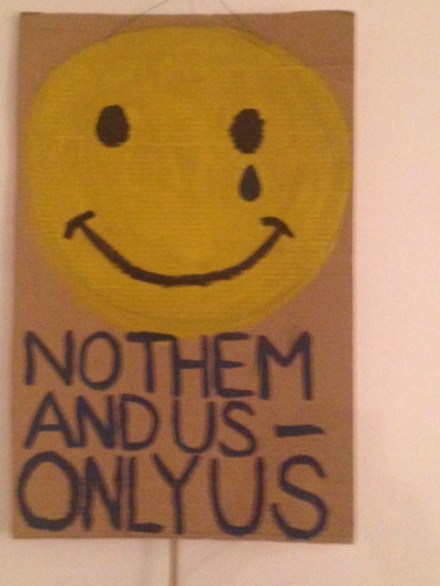
I also met with a passionate artist from a group called ‘Mental Spaghetti’ that brings together marginalised groups of society and the general public to help reduce stigma, enable social interaction and to encourage artistic practice in people of all abilities. They are working on an exhibition titled ‘Cross Pollination’ with the aim of blurring the lines of ‘Us vs Them’ (ie. service providers vs service users).

All those years I spent stuck inside a hospital building seem like such a waste now. We all are the same humans, yet there is a such a wide gap between the social model and the medical model of illnesses. I am intrigued to step out of my little world and see all these imaginative, inclusive and heart felt ways of dealing with people.

I wonder if Saagar would have enjoyed any of these things. I think he would have been a stunning percussionist and a very funny mimic. I think he would have had fun if he would have got this far. Oh! There I go again…


Day 579

header_Geel-by-Gary-Porter

Hospitals can sometimes be a problem rather than a solution.  They cannot provide the collaborative information sharing needed to care for today’s typical patients who may have multiple problems. This is especially true for the elderly and the mentally ill. Royal College of Physicians has proposed the concept of “hospital without walls” which aims at providing continuity of care for patients, coordinated and delivered by a single consultant-led clinical team. The hospital ceases to be “somewhere”. It becomes everywhere.

The little market town of Geel  in Belgium is well known for its early de-medicalisation of care of the mentally ill. For at least 7 centuries, it’s inhabitants have been taking the mentally ill or disabled into their homes as ‘guests’ or ‘boarders’. These are people who, whatever their diagnosis, have come here because they’re unable to cope on their own, and because they have no family or friends who can look after them. When they meet their new families there is no clinical diagnosis. During the Renaissance, Geel became famous as a place of sanctuary for the ‘mad’, who arrived and stayed for reasons both spiritual and opportunistic.

A boarder is treated as a member of the family, involved in everything and particularly encouraged to form a strong bond with the children, a relationship that is seen as beneficial to both parties. They call it ‘family care’, possibly the best form of therapy. Often the boarder lives with the family till they die, first as a child, then a sibling and later on as an uncle or aunt. Doesn’t that fulfil a basic human need of relatedness with other beings? The tradition still exists albeit to a limited extent due to faster paced city life, fewer farms and more double income families. However, the main reason for its longevity is not just tolerance, but pride. “Half of Geel is crazy, and the rest is half crazy,” runs a local joke.

Today, in London we aim to provide ‘Community Care’ in the absence of a community and no understanding of the word ‘care’. It’s obviously not working because the basic values on which it is based are wrong ie. cost saving.

We, the people need to educate ourselves, open our hearts and develop a deeper understanding of our human condition.

To kick off the Mental Health Awareness week, here are a couple of attempts on my part:

18 Months on…

Podcast from Croydon Radio


Day 578

image

This is the question : How can we Re-create Psychiatry?

How can we break down the“us” versus “them” approach?

How can we stop ourselves from putting people into neat little labelled boxes rather than perceiving each one as a unique individual with their own unique story and experience?

How can we communicate in a way where we respect boundaries but do not create barriers? How can we truly listen in a way that we can put ourselves in someone else’s shoes?

There is a hierarchy in knowledge. Intellectual knowledge is considered superior to emotional or experiential knowledge, which in turn is rated higher than seemingly irrational knowledge, which could come from ‘patients’ with seemingly little insight. Who makes these decisions? How come the power balance between psychiatrists(intellectual/clinical) and patients(experiential/seemingly irrational) is so extremely warped? Does looking at people through templates give us any idea of who they truly are?

The Open Dialogue approach is a philosophical/theoretical approach to people experiencing a mental health crisis and their families/networks, and a system of care, developed in Western Lapland in Finland over the last 25-30 years. In the 1980s psychiatric services in Western Lapland were in a poor state, in fact they had one of the worst incidences of ‘schizophrenia’ in Europe. Now they have the best documented outcomes in the Western World. For example, around 75% of those experiencing psychosis have returned to work or study within 2 years and only around 20% are still taking antipsychotic medication.

Working with families and social networks, as much as possible in their own homes, Open Dialogue teams work to help those involved in a crisis situation to be together and to engage in dialogue. It has been their experience that if the family/team can bear the extreme emotion in a crisis situation, and tolerate the uncertainty, in time shared meaning usually emerges and healing is possible.

This Open Dialogue training launches in London next month.


Day 575

‘Everyone’s better than me’
‘I’ll never be good at anything’
‘I’m not as clever as my friends’
‘I’m fat’
‘I’m ugly’
‘I’m hideous’
‘Everyone hates me’
‘Other people at school tell me to die’

Lack of self-worth is driving increasing numbers of young people to thoughts of suicide, according to national charity PAPYRUS Prevention of Young Suicide. Young people need to be taught that good relationships with others start with their own self-care. PAPYRUS is calling for more general mental wellbeing sessions in schools and awareness by society in general, to help young people begin to build a positive self-relationship. As well as the basics – getting enough sleep and rest, fresh air and exercise, eating well – we need to teach young people how to deal with negative put-downs.

Contacts made with HOPELineUK helpline services last month increased by 130% over April last year. Lack of self-worth is now a dominant theme and increasing numbers of much younger callers (around 11 plus) say they are not good enough.

“We must all watch out for invitations from young people that say ‘I need help: please ask me how I am feeling’,” urges Ged Flynn, CEO of Papyrus. “Talking about suicide is not easy, but society needs to toughen up. Young suicide is everyone’s business. Talking about it does not make it more likely happen – and it can save young lives.”

Day 573

In the summer of 2012, Saagar attended a formal family lunch to which he was invited by his friend. His friend’s grandmother turned to him and asked, ”How does it feel to be the only foreign person to be sitting down?” (Hidden message: All the other foreign persons present there were waiters.) He was a bit shocked by that but just laughed it off. I wonder how many times he had faced such occasions where he had no choice but to do that.

Microaggressions are the everyday verbal, nonverbal, and environmental slights, snubs, or insults, whether intentional or unintentional, which communicate hostile, derogatory, or negative messages to target persons based solely upon their marginalised group membership. This term was coined by social scientists at Harvard in the 1970s  to describe an inequitable treatment of another person in a manner that is not overtly “aggressive”, yet which might stem from negligence, ignorance, or what we now call unconscious bias. Eventually, the term came to encompass the casual degradation of any socially marginalised group, such as the poor and the disabled.

Recently I watched a short film called STOP  (trailer) by Green brothers. It very cleverly portrayed a vulnerable young black man’s position in his society.

Here are some other examples of microaggressions:

  • A White man or woman clutches their purse or checks their wallet as a Black or Latino man approaches or passes them. (Hidden message: You and your group are criminals.)
  • A female physician wearing a stethoscope is mistaken as a nurse. (Hidden message: Women should occupy nurturing and not decision-making roles. Women are less capable than men. Happens with me a lot.)
  • The outfit worn by a TV reality-show mom is described as “classless and trashy.” (Hidden message: Lower-class people are tasteless and unsophisticated.)

Microaggressions are active manifestations and/or a reflection of our worldviews of inclusion/exclusion, superiority/inferiority, normality/abnormality, and desirability/undesirability. Even though these biases are implicit, they can be deeply damaging. The deaths of African-Americans at the hands of the police in Ferguson, Cleveland and on Staten Island have reignited a debate about race.

Is it a pure co-incidence that people from black and minority ethnic groups living in the UK are:

  • more likely to be diagnosed with mental health problems
  • more likely to be diagnosed and admitted to hospital
  • more likely to experience a poor outcome from treatment
  • more likely to disengage from mainstream mental health services, leading to social exclusion and a deterioration in their mental health?