Day 627

photo

(A young artist’s pictorial depiction of Bipolar Disorder)

Everyday I struggle with what it must have been like for Saagar. What state of mind did his illness create? Why couldn’t he find any words for it? How much of it was due to the medicines he was on? I have tried to imagine it and learn about it from various books and blogs. The closest understanding of it comes from reading the first hand accounts of those who suffer from Bipolar disorder. Their writing is as honest and as human as can be.

“It has been a fascinating, albeit deadly enemy and companion. I have found it to be seductively complicated, a distillation both of what is finest in our natures and of what is most dangerous. At first my illness seemed to be simply an extension of myself- that is to say, of my ordinarily changeable moods, energies and enthusiasms. I perhaps gave it at times too much quarter. And because I thought I ought to be able to handle my increasingly violent mood swings by myself, for the first ten years I did not seek any kind of treatment. Even after my condition became a medical emergency I still intermittently resisted the medications that both my training and clinical research expertise told me were the only sensible way to deal with the illness I had.

Manic Depression distorts moods and thoughts, incites dreadful behaviours, destroys the basis of rational thought and too often erodes the desire and will to live. It is an illness that is biological in its origins, yet one that feels psychological in the experience of it; an illness that is unique in conferring advantage and pleasure, yet one that brings in it’s wake almost unendurable suffering and not infrequently, suicide.

Medications brought with them seemingly intolerable side-effects. It took me far too long to realize that lost years and relationships cannot be recovered, that damage done to oneself and others cannot always be put right again and that freedom from the control imposed by medication looses its meaning when the only alternatives are death and insanity.”

– an excerpt from “An Unquiet Mind”, a personal testimony of her own struggle with Bipolar Disorder since adolescence by Kay Redfield Jamison, a Professor of Medicine.

Day 619

photo

An entire family of doctors, some of them psychiatrists, with 2 young men in the family who live with a mental illness, all get together every year and talk about everything except the illness. They often speak on the phone to each other about all kinds of things but never about the illness. There just isn’t the space for that specific topic. This happens with ‘educated’ families.

A highly qualified mental health professional who specialises in children and adolescents is someone I have known for years and is very close to our family. When Saagar was ill, I wrote an e-mail asking for help but there wasn’t as much as a phone-call to find out what the problem was. In this age of Facetime, Skype, Viber, Whatsapp and what not, the means of communication couldn’t have been a barrier.

What are the barriers? Is mere talking about it too uncomfortable? Is it too much responsibility to take on? Is it too difficult to accept that the problem exists in such close proxomity? Is it too scary? Is it shameful?

I just googled ‘Stigma’ and this came up on top:

“stigma
ˈstɪɡmə/
noun

  1. a mark of disgrace associated with a particular circumstance, quality, or person.

“the stigma of mental disorder”
synonyms:        shame, disgrace, dishonour; More

  1. (in Christian tradition) marks corresponding to those left on Christ’s body by the Crucifixion, said to have been impressed by divine favour on the bodies of St Francis of Assisi and others.”

This is the society we live in. It is ours to keep or change. EP, my 81 years old friend is also a doctor. She lost her son to a mental illness in 1993 and has been working tirelessly for the last 23 years on the medical community to address this problem of stigma. She doesn’t use the internet but her beautifully hand written letter says:

“Not to give up is the first task. To support each other is the next priority.”

Day 612

Edward was 18. He had recently been offered a place at Cambridge University following 12 A*s at GCSE and 100% scores at AS level. He also excelled at playing the piano. He was a popular and friendly young man who now has the heartbreaking legacy of having played all of the music at his own funeral. He ended his own life in February 2015 following the unexplained, rapid and catastrophic onset of depressive illness.

He sounds so much like Saagar. His father, Steve Mallen strongly believes Edward was let down by the health services, just like Saagar was.

“Sometimes they call depression the curse of the strong. In other words the stronger, more resilient, more intelligent and more capable you are, the better you are able to conceal the difficulties you might be experiencing,” said Mr Mallen.

He has set up a The MindEd Trust with this mission statement:

“We mind what happened to Edward Mallen and we will do all we can to avert similar tragedies through the prevention and alleviation of mental ill-health amongst young people.”

Speaking to a friend in Bristol it emerged that CAMHS there now refuses to see youngsters who have attempted suicide. The charity Mind says on its website that the types of problems CAMHS is meant to help with include violent or angry behaviour, depression, eating difficulties, low self-esteem, anxiety, obsessions or compulsions, sleep problems, self-harming and the effects of abuse or traumatic events. CAMHS can also diagnose and treat serious mental health problems such as bipolar disorder and schizophrenia.

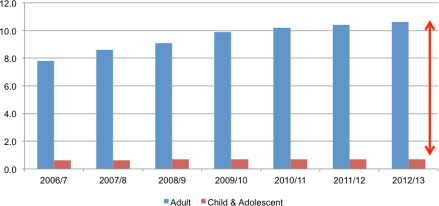
How have we come to this? In the light of the fact that the incidence of mental health problems in the young is on the rise, does the graph below on expenditure (in billions) on mental health services offer an explanation?

expenditure-on-mental-health


Day 607

Wonder what it’s like to be 18 or 19.
To have a decent upbringing and great friends.
To have a sharp mind and many talents.

To find out life is complicated.
To learn relationships are difficult.
To know jobs are hard to find.
To have faith you can cope. To have hope.

To be ruled by an un-understandable mind.
To have no tools to dissect the goings-on within.
To hold a fascinating companion and a deadly enemy inside.
To be able to handle them both tactfully.
To have no way of showing them to others.
To not know how much of you is you and how much is them.

To believe you can conquer these beasts.
To hope you can make them beautiful.
To see them as extensions of yourself.
To watch them distort your moods and thoughts.
To love life one minute and abhor it the next.
To watch the clouds of confusion slowly shutting out the light.

To resort to silence as time goes by.
To watch your friends move ‘ahead’.
To feel left behind, small and inadequate.
To have to contend with the inaccessibility of Life.
To loose faith in medicines and trust in medics.
To be utterly lost.

Wonder what it’s like to be that 20 year old.

Day 604

‘Dying from a mental illness is just the same as dying from any other disease’ says Paulie O’Byrne, a young man from Canada.

Paulie suffered sexual abuse at the age of 19. It took a long time for him to get past his shame and tell someone about it. Many people didn’t believe him including his parents. He suffered with anxiety, depression and PTSD and took to drugs and alcohol in a big way to be able to cope with the pain. He felt suicidal on many occasions.

His recovery could only begin when somebody believed what he had to say. That’s his message – when someone tells you they have a mental illness or that they are suicidal or that they have been abused, all they ask for is to be believed.

‘As much as I love my support and friends and family, for me I would not call them. The reason I say this is because in my mind it would cause more hurt and confusion if I told someone close that I have a plan to end my life. I thank god every day for crisis lines- the humans that work for them are angels among us. I can boldly state right now I’ve called the crisis line over 50 times since 2010, and I’m still here. I’ve thought about ending my life on my birthday before, for the sole reason people will only have to feel sad 1 day a year, not my birthday and death day.’

He worked incredibly hard to get out of the dark place where he was. His counsellors didn’t give up on him and he didn’t give up on himself. He started a movement called ‘1 in 5’, the motto of which is ‘strength from pain’. He speaks and blogs about the high incidence of sexual abuse in men (1 in 5) in Canada and encourages other victims to come forward and speak about their experiences by doing so himself.

He lives in gratitude, one day at a time.
‘I am grateful for the fact that I can breathe.’