A report and a film.

A report published last month by National Child Mortality Database (NCMD) identifies common characteristics of children and young people who die by suicide between 1st April 2019 and 31st March 2020. It investigates factors associated with these deaths and makes recommendations for policy makers.

Every child or young person who dies by suicide is precious. These deaths are a devastating loss for families and can impact future generations and the wider community. There is a strong need to understand what happened and why, in every case. We must ensure that we learn the lessons we need to, to stop future suicides.

Key Findings:

-Services should be aware that child suicide is not limited to certain groups; rates of suicide were similar across all areas, and regions in England, including urban and rural environments, and across deprived and affluent neighbourhoods.

(No one is immune.)

-62% of children or young people reviewed had suffered a significant personal loss in their life prior to their death, this includes bereavement and “living losses” such as loss of friendships and routine due to moving home or school or other close relationship breakdown.

(Saagar was unable to return to his life at University due to a new diagnosis of a mental illness.)

-Over one third of the children and young people reviewed had never been in contact with mental health services. This suggests that mental health needs or risks were not identified prior to the child or young person’s death.

(Saagar had been in contact with Mental Health Services but they discharged him as soon as he showed signs of improvement. They did not follow him up. His GP was unable to identify his high risk of suicide despite his Depression scores being the worse they could be for at least 4 weeks.)

-16% of children or young people reviewed had a confirmed diagnosis of a neurodevelopmental condition at the time of their death. For example, autism spectrum disorder or attention deficit hyperactivity disorder. This appears higher than found in the general population.

(Saagar did not.)

-Almost a quarter of children and young people reviewed had experienced bullying either face to face or cyber bullying. The majority of reported bullying occurred in school, highlighting the need for clear anti-bullying policies in schools.

(At his Primary school in Belfast, his peers called him ‘Catholic’. He didn’t know what it meant but he knew it was not right. This went on for more than a year before I found out. When I spoke to his class teacher about it, she denied any problem.)

The film ‘1000 days’ tells us about Saagar and what we have learnt from his life and death. I am not sure what or how much the policy makers and service providers have learnt or changed but we have learnt and changed a lot and here we talk about that. The film is presently available on-line at the Waterford Film Festival (Short Programe 6), till the 15th of November at the link below. Please take 20 minutes to watch it if you can. You will learn something too. Each one of us can make a difference.

https://waterfordfilmfestivalonline.com/programs/collection-jlvwfxb8ctq

Mum’s not the word.

He didn’t want to go. The new school was an hour’s drive from home. His bags were packed. Each piece of clothing had been labelled, “Baxter 289”. Each set had been neatly marked and packaged – rugby, cricket, football. He was getting ready to leave for the most prestigious Boarding school in town. Nothing less would do for a seven years old lad from such a good family as his. It was for his own good. This precious boy needed a proper education, even if he had to be separated from his sweet mum, wrenched away from his big house on the hill and the fields all around, his playground. This was unquestionably the right thing to do and it was being done. They would make a proper young man out of him. 

His mum knelt beside him in his room, combed his curly brown hair back from his forehead and kissed him there, gently. She looked at his freckled face and spoke apologetically, “I’ll see you at the weekend my darling.”

“I don’t want to go Mum.” He said, looking straight into her big blue eyes.

“I know sweetheart. But once you get there, you’ll have so much fun. You won’t want to come home” she said.

He looked at her face, his eyes now pleading. She felt an ache in her chest and looked down and away at the green Persian carpet.

“Don’t send me away. Please. I promise to be good.”

“My sweet, sweet child. Your dad only wants what’s best for you. Let’s not keep him waiting in the car.”

She held his hand and walked him out into the sunny afternoon of that last Friday in August. The sun was keeping the car warm even though all the windows were open. The day looked like it ought to be a happy one.

It was never the same again.

Forty years later.

He wanted to come home for Christmas. The Government had locked everyone in their homes because of the bugs. He lived in the big smoky town full of bugs. She still lived in her lovely big house on the hill in the open, clean and green countryside.

“It’s not as bad as they make it out to be Mum. We are well and strong and so are you. Nothing will happen. Don’t worry.”

‘I do worry darling. Let’s meet once this season of calamity is over.’

“I would really like to spend Christmas with you.”

‘Yes. That would be nice but I am not sure. The government has not given permission yet.’

“They really should. If they don’t, that would be more of a political decision than a scientific one.”

‘The Government only wants what’s best for us. Let’s not disobey the rules.’

That sounded familiar. He was seven again.

— — — — — — — — — — — — — — — — — — — — — — — — — —

Ref: How early maternal deprivation changes the brain and behavior? by Masa Cater and Gregor Majdic

EJN – 18 April 2021: https://onlinelibrary.wiley.com/doi/10.1111/ejn.15238

Ordinary people

Once upon a time there was an ordinary person. Making a living, being honest, spending time with the family, having a few friends and simple pleasures. Nothing special. Just ordinary.

Then they lost their child to the monster of unbearable pain. They carried on breathing and giving and receiving love. There was nothing ordinary about that. They couldn’t bear the thought of the same thing happening to anyone else. So, they went out to tell the stories of their angels to everyone. To exhibit the smithereens of their bleeding hearts. That was not easy or normal but they did it anyway. To say that there were other options that they wish their kids had been encouraged to explore. To give out the phone numbers of the good people out there who can help. To remind everyone that there was hope. There is hope.

These 3 dads were ordinary people. Now they are walking together for 300 miles over 2 weeks, making waves all over the country, connecting with people, smashing the stigma and sharing the stories of their lovely girls. Ordinary and beautiful. Just like you.

Please listen and take a look at what’s possible when love speaks and acts.

Now, they are pink.

The day after he died, our door-bell went berserk. This time the same young woman from the local florist, who had been here thrice already, stood at the door again. She had arrived with yet another bouquet of pure white lilies and roses. She stood just outside our front-door with tears rolling down her cheeks. Had this stranger accessed her own sadness or was she feeling mine? I thanked her and tried to console her, wordlessly holding her hands in mine, not believing any of that was happening.

Our eyes met through the fresh white flowers and films of salt water. She didn’t know me or the young man who had died and I didn’t even know her name. But we were flowing in the same river of humanity. Of loss.

For weeks, every room in our house reeked of the sickly-sweet stink of white lilies. I used to like that fragrance before all this but now it screamed ‘DEATH’. It crept into every empty space, crevice and corner. It sneaked under tables and inside locked cup-boards. It suffused my clothes and hair and got into my body like poison.

All these years later, that smell can still hit like an axe on top of my head when I walk past an innocent flower shop.

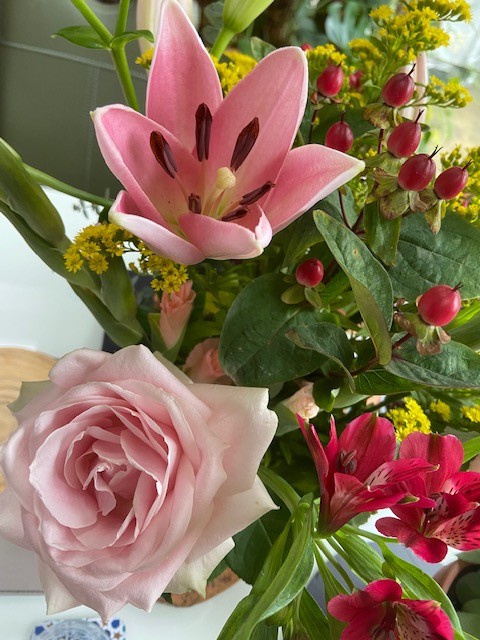
On my birthday last week, a bunch of Freddie’s flowers arrived unexpectedly. I thought I had cancelled that delivery but it seems I hadn’t. Roses, lilies and gladioli – but this time, they are a pretty pretty pink. Six days on, they are open and smiling and guess what … no heart-breaking fragrance.

Our long-distance relationship is working. Thank you, sweetheart.

Men like dahlias.

Without fail, he abandoned her the moment they entered the residence of the hosts of any drinks party they ever attended.

They had lived in the village for two years. Here everyone knew everyone. In the summer of 1976 Jane and Christian attended one such party. As soon as they got there, Christian was off, having a drink and a laugh with his friends. She could hear them raising a toast at the other corner of the large garden. Jane found herself standing near the hedge, admiring the flower beds and talking to her local GP, Dr Hamilton and the vicar. It was 7 pm and the garden was bursting with colours. “I do love these glorious dahlias” said Jane gazing down at the voluptuous crimson beauties. She looked up to find a shocked expression on the faces of both the men in her company. Had she said something awful? She worried.

The vicar looked at his feet, his left eyebrow still lifted in an arch. The doctor glanced sideways awkwardly, pretending he had heard nothing. ‘Only men like dahlias’ murmured the vicar. Jane turned red. There was so much she did not know. She quickly changed the topic to the nearby white roses, hoping they were safer. Uncontroversial.

The next day Jane had an appointment with Dr Hamilton. She said, “The Tamoxifen is terrible. I can’t fit into my shoes or get a full night’s sleep. Food makes me sick and I am impossible to be around. Don’t know how anyone puts up with me. My husband must be a saint.”

‘Yes. It can be quite de-feminizing” empathised Dr Hamilton.

“It was only a small tumour and they got all of it out. That was two and a half years ago.” Jane reminded him.

‘Okay. If the side effects are so bad for you, maybe we should stop it’ he thought aloud.

“That would be wonderful. And … it might make me stop liking dahlias.”