Wrap-around?

“What can we do to offer wrap-around care to our patients?”

In the live Q&A at the end of the NCISH conference yesterday, this question was asked of the panel. The Chairperson directed it towards me. I can’t remember what I said. This morning I woke up with what I would have liked to say.

For wrapping, we need two things. One, the fabric which we are going to use to wrap and the person we want to wrap. Let’s discuss them one by one.

  1. The fabric

The fabric of Suicide prevention in Health-Care is made up of two things – people and systems. Let’s look at them a bit closely.

  1. People

What are the beliefs of the people?

I know of an ENT surgeon from another country who wanted to move to the UK and the only job he could find was in Psychiatry. So, he is now training to be a Psychiatrist. Is he interested in suicide prevention? Do Health-care professionals believe that suicides are preventable? Are they content that simply by treating mental illness they are doing their job?

What are the attitudes and abilities of the people?

When the Emergency department calls to say there is a suicidal individual waiting to be seen, how do they feel? Are they excited to have an opportunity to make a difference? Or is it a drain on the limited time and energy they have? Do they know how to build a compassionate connection with someone who has lost all hope? Have they received any training in Suicide Prevention? Do they have enough self-compassion to look after someone else well?

Do they have the resources and the knowledge to do a good job?

Do they have access to their past history? Do they have beds on the ward? Can they ask a colleague for a second opinion if they have a doubt about how to involve family or friends in their care? Do they know of other resources, like charities, activities and people that may help this person? Do they have comprehensive and informative leaflet they can share with them? Do they have the means to follow them up?

b. Systems

Does the system have capacity? Are the various parts of the system effective and joint-up enough to be able to hold the person they are trying to wrap or are there big holes in this part of the fabric? Do the various parts of the system share the same mental model, a shared knowledge, pre-suppositions, and beliefs that can be used to help achieve mutual goals? Are their practices evidence- based? Do they investigate deaths with a view to learn lessons and implement change? Do they look after the well-being and emotional health of their employees? Do they hold themselves accountable when things go wrong?

2. The person

Allowing space for them to express themselves. Help maintain their sense of agency. Inform them it is safer for them to involve other people who care for them. Equip them with resources. Give them the support they need. Ask them what would help them? Listen. Sit with their despair. Acknowledge it. Keep them connected with their life as they know it. Keep hope alive for them.

Know that the person at the centre of the wrapping is of great value.

Information is useful if it becomes knowledge. Knowledge is useful when it becomes wisdom. So, let us not stop at information.

Ref:

Reaching common ground: The role of shared mental models in patient safety : https://journals.sagepub.com/doi/full/10.1177/2516043518805326

The older I grow, the lesser I know.

A book with frayed edges sat tucked inside the pocket behind the driver’s seat. After an overnight train journey from Sakleshpur to Goa, we were going home in a taxi. No coffee yet. I was not quite switched on. Bleary eyed, I pulled the book out of the elasticated edge. It was Walden by Henry David Thoreau. Some poor tourist had mistakenly left it behind while traveling to the airport to fly back home.

Thoreau wrote this book while he lived in a cabin he built near Walden Pond, hundred and eighty years ago. He was testing the idea that divinity was present in nature and the human soul. He stripped his life down to the barest of essentials and secluded himself as much as he could, living off the land as much as possible. He wanted to find out just what in life is necessary and what is superfluous.

(Picture, courtesy Maria Popova )

Having chosen to live in a place where, for hundreds of miles very few people speak our language, with no cinema halls, restaurants, therapists or book shops, where the food is of one particular kind, but nature is abundant, that question has arisen for me too.

A few weeks back, a quote by Thoreau had whistled right into my heart:

“Life! who knows what it is, what it does?”

Such a beautiful sentiment. I had wished for more of his writings. After learning some more about him and his love of birds, streams, woodlands and meadows, I got busy with other things.

When I brought this question to CORe, it generated a rich discussion.

“What is our relationship with not knowing? What feelings does it provoke?”

Some excerpts from our conversations:

  • It is a real test of oneself, dropping how things should be and taking each day as it comes. It took me a long time to realise how much my mind was tied to certainty. In Africa, the relationship with death is very different. They have many ways to remember a loved one. They believe they’re still here and it gives them great joy.
  • Anxiety of the need to know at work. I have to change my mind set to curiosity. Some things we’re not meant to know, such as, where is he? It would spoil it. I must accept that I’m not meant to know.
  • When he went, I didn’t want to be here. Now I do. I have a life that I want to have. I have lots of godchildren who have promised to take care of me. I have a vision of him and his dad, which I hope will come through in my own death. Maybe when it’s my time they’ll be there, and their peace will be shattered.

Yes. The older I grow, the lesser I know. There is a freedom in that, to be with whatever is happening. It allows for the mystery of life to unfold as it will and it allows me to witness it without conditions, with an open heart. The smallest things. The book that I had wished for a month ago, appears right in front of me after I had forgotten all about it.

Life. Who knows what it is, what it does?

Who’s the boss?

Did you know there’s an organisation that brings science and spirituality together? Its mission is to create a kinder, heart-centered world where we care for one another and live harmoniously. It’s called the HeartMath Institute and offers many free resources.

They have found that the heart is not just a mechanical pump. It contains thousands of nerve cells. That is probably the reason our memories and trauma are stored in various parts of our body, mainly the brain and heart.

We were taught in school that the brain is a master-organ but it’s the heart that tells it what to do. The intelligence of creativity, innovation and intuition resides in the cells of the heart. Brain neurons are the antennae that follow the heart’s desires. For example, I want to speak and understand Spanish says the heart. The brain follows.

We humans have a stunning ability to self-regulate. Our biology is engineered as a soft technology. Our fundamental physiology is made up of ion-potentials across membranes. We’re the only form of life that can harmonise its two major neural organs through Heart-Brain Coherence. We can alter the chemistry in our bodies. Once this coherence occurs, we can heal and be healthy. The immune system is strengthened, longevity enzymes rise and stress is reduced at a molecular level. Three minutes of this shift can produce beneficial effects for 6 hours.

3 steps:

  1. Shift in focus – into the heart
  2. Shift in breath – slow it so the exhalation is longer than the inhalation
  3. Shift in feeling – a positive feeling – initiate Gratitude on demand.

We are powerful self-regulators. It is a God-like ability that we have, to heal ourselves. We’re conditioned to feel helpless and think we need external help. Sometimes we do need interventions, but we can honour the gift of this body to heal ourselves.

Let there be joy, peace and colour!

Mandalas draw me into their whorls. A casual glance is never enough. My gaze gets fixated on each one and I lose myself in the movement and the stillness in that form. The patterns seem to be spontaneous and well thought through, calm and dynamic, chaotic and yet, organised. The literal meaning of the word is, a sacred circle and it feels like one.

A random advert on YouTube and I was at the local stationery shop buying a geometry box. I needed a compass and a protractor for the Mandala Workshop I had signed up for. I was excited at the prospect of making one but also worried about making a mess of it. My artistic abilities are fairly limited but I am a good doodler. Many a lengthy-phone-call have produced intricate henna-esque patterns on the handiest bit of paper loitering on my table.

The first thing the facilitator said was, today you will draw your Universe. Don’t erase anything. There are no mistakes. You will see, everything has a place, even the so called ‘mistakes’. So, erase nothing. It’s not about producing a beautiful piece of art. It’s about the process. After making the grid, she had us light a candle and guided us through a grounding exercise. Then she played a mellow piano tune and asked us to start from the centre of the circle and work outwards with a black uniball pen. No rules. No meaning. No right. No wrong. No special colours or materials. Just allow whatever wants to appear on the page to appear.

She said this practice can heal us as it opens the heart, takes place in the moment and is non-judgemental. Watch your inner critic coming at you pointing its index finger. Ignore it and carry on. Smile 🙂

Joyland

Islam forbids suicide. It calls it a grave sin or ‘haraam’. It is viewed as taking away the gifts of life given by God. The Qu’ran says, trust God, have faith in the mercy of God and do not destroy life.

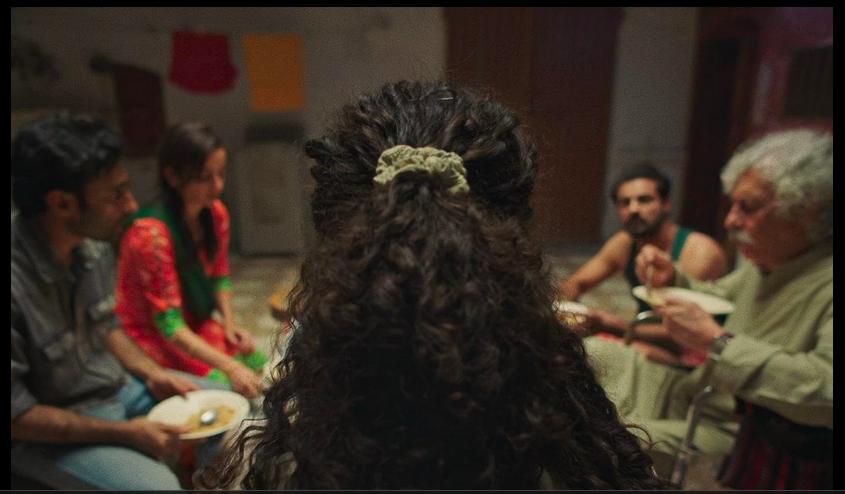
Joyland is a bold film, the first Pakistani feature to be premiered at Cannes in 2022.

It is about being alone in a crowd of expectations, being punished for having secret desires and accidentally making them seen. It is about someone else having to pay the price for our impulsive indiscretions, about how the bucket of shame topples itself on our heads as soon as we allow our innermost wants to be visible. It talks about how others can forcibly live their dreams through us, how our roles in society hold us firmly in one place and make us invisible as individuals, how we don’t have permission to be confused and are not allowed the time and space to think and talk things through, how life can be cluttered and noisy.  It’s about knowing you want to ‘run away’ but not knowing what that means or looks like. It’s about having to figure all this out, all by yourself.

It’s about treasuring moments of joy when they arise.

They could be hidden in the kitchen, on the Ferris wheel or inside the pages of an old book.