Over and over I asked myself – Now what? Now what? What happens after a severance such as this? How long do one’s bones bleed? Do the tears ever finish? What does ‘recovery’ look like? Is it even possible? How does one keep placing one foot in front of the other? Where is the road? Where does it come from? Where does it go? How long and meandering is it? When does the screaming in my head stop? How long can I keep up the facade? Pretend to be sane? Is this what a new diagnosis of a terminal illness feels like? Is forgiveness possible? Self-forgiveness? Acceptance? Surrender? All these big words! Surrender what? To whom? Who am I now? What do I do?
No answers. Silence. The tilted earth keeps spinning around its imaginary axis. It keeps cradling me. The sun stays at the center of its orbit. My son stays at the center of my being. My breath keeps coming and going. I grow new eyes. My bones carry my weight even though they bleed. The road appears under my feet. It reveals itself one step at a time. Rumi and Khalil Gibran come and hold my hand. The screaming softens. The wall of bricks that was my body, loosens. I come to know the terror and the joy of being insane, catch glimpses of being free. Respect for those who went before and sadly others, who follow. I stop fighting with the big words and keep it simple. Watch. Observe. See. Open. Let the gash in my heart, allow the light in.
Si was flummoxed by the ‘<3’ sign appearing repeatedly in the chat box on a zoom call with friends. Sometimes all by itself, without context, without a before or after. It took him a while to realise what it was. I suppose you know already. Don’t you?
“Love thy neighbour as thyself” implies that respect for one’s own uniqueness and integrity is inseparable from the understanding of anothers. Yet, it is widely believed that it is virtuous to love others. But to offer that same love to yourself is somewhat indulgent. In fact, this misconception goes as far as to say that the degree to which I love myself, I do not love others. Self-love is commonly understood to be synonymous with selfishness or narcissism. The French theologian, John Calvin speaks of self-love as ‘a pest’. Self-love bad, hence, unselfishness good.
Selfishness and self-love are opposites. When selfish, one is incapable of loving others and incapable of loving oneself.
Only recently have I come to know this to be the truth – I am deserving of my love. In fact, I cannot fully love and respect another, until I love and respect myself a hundred percent. I don’t need to buy expensive gifts for me to experience it. Sitting quietly with myself is an act of love. It does not need evidence. It is free of all obligatory burdens. It is freedom itself.
On this day, I hope you can be your own Valentine. Happy Valentine’s day! Today and every day.
“If you love yourself, you love everybody else as you do yourself. As long as you love another person less than you love yourself, you will not really succeed in loving yourself, but if you love all alike, including yourself, you will love them as one person and that person is both God and man. Thus, he is a great and righteous person, who, loving himself, loves all others equally.”
Vikram Patel is a psychiatrist and a Professor of Global Health who works tirelessly to improve the mental health of people living in low and middle income countries like India and Ethiopia.
His recent research has found that all countries are ‘developing’ countries when you look at the low proportion of the health-budget they spend on mental health. Some wealthy countries may have better systems of care for maternal and child health but overall, mental health remains universally, at the end of the queue.
At present, COVID has overtaken all other agendas. However, now more than ever before, there is a recognition of the two-way relationship between poverty and mental ill-health. This may be a historic opportunity to get this right.
The relationship between poverty and mental ill-health is a complex one. How can we distinguish a normal response to poverty from a disease process? Poverty can increase the risk of poor mental health via multiple pathways, for example, poor physical health, high levels of noise pollution, violent neighbourhoods, insecurity and humiliation.
Can an increase in income improve mental health? Yes. It can but it needs to be sustained.
The fact that having a mental illness may induce poverty is less well recognised. It may affect one’s education and hence, employment opportunities. In low and medium income countries, health care is paid for by people. Due to the length of time it takes to find an effective treatment, much effort and money is wasted in doctor-shopping. Depression is inequitably distributed in society but not recognised as such because wealthy individuals also get it. We accept that long term expensive therapies cannot be delivered to the poor, so what’s the point in studying them?
After nearly a year of job-losses, the number of people below the bread-line all over the world will increase by tens of millions. In India alone, the gains made in economic growth over the last decade are predicted to be wiped out this year. The historically disadvantaged will fare worse, suffer more.
We can expect a surge in mental health problems like we did after the 2008 global financial crisis, mainly led by suicide and drug misuse. Sir Angus S Deaton, a Nobel prize winning economist wrote extensively about these deaths of despair. Economists and global health experts warn that this one will possibly be far worse.
In India, while the state is spending all its energies on the pandemic, livelihood-based organisations are finding very poor mental health in their members. Taking a broad, multidisciplinary approach to depression and anxiety rather than viewing it through the lens of a medical specialty is the need of the hour. Policies all over the world need to de-medicalise the emphasis on specialists and empower front-line providers and communities to enable them to foresee, identify and address this problem.
The bi-directional relationship between mental health and finances means that appropriate mental health interventions can improve finances. Can we persuade policy-makers world-wide to listen to global health experts and economists, look at this fast-approaching avalanche and steer policies to protect those who are being and will be hit by it?
In July, looking for inspiration to think and write beautifully, I spent an hour on 3 consecutive Sundays listening to David Whyte, a wise and warm poet of English/ Irish origin who speaks and writes, seemingly from his spirit. I thought he was some kind of a magician as I felt mesmerized, awakened and soothed by his presence and his words.
He described the simple involuntary act of breathing as a life-sustaining exchange for the planet – inhaling is receiving and exhaling is giving. Generosity and gratitude – reciprocity in every moment. Last Sunday he spoke on the seasonal subject of ‘giving’ and I can’t help but share the synopsis of his talk in his own words here.
The foundational understanding that giving is not just a logistical act of transferring something from one person to another, but an art form to be practiced. Like all art forms, practicing it takes time and spaciousness and the ability to create a relationship with the unknown, the invisible and the unspoken.
To learn to give is often the simple, heart-breaking act of giving again.
Giving is an essence of relationship. To stop giving is often to call an end to relationship.
Giving asks us to have a close relationship with both time and timelessness. All gifts change with the maturation of both the giver and the receiver.
Giving is an imaginative journey into another’s life with all the implications accompanying that journey.
Giving can be a form of blessing, a way of empowering another life. The blessing is made through giving what a person does not even know they need themselves.
Giving, in the words of Shakespeare, is ‘Twice Blessed’. Through exploring the edges of our own generosity, we come to understand where we have trouble receiving ourselves; and this teaches us to ask for what we ourselves might not feel we deserve. In the enriched relationship, giving becomes a reciprocal harvest where giver and receiver are not so easily distinguished.
(PS: On 3 Sundays in January 2021, he speaks about resolutions for new beginnings. Recordings and written resources available if you are able/unable to attend the live event)
This video was made after a spate of suicides by senior NFL players in the USA as they were starting to feel the effects of Chronic Traumatic Encephalopathy (CTE). Michael Irvin spoke from the heart without a script and his truth is visible.
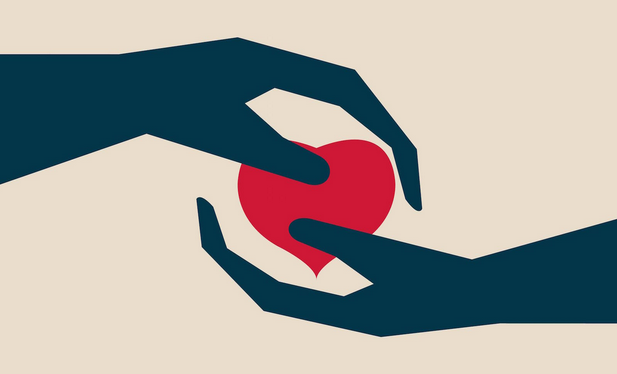
If your isolation is getting the better of you, know that you are not alone. You are loved, silently. Reach out your hand and they will be there.


 kidsaregifts