Day 978

Primum non nocere- First do no harm.

Doctors could save lives by breaking rules on privacy.

Screen Shot 2017-06-29 at 22.23.06

This is a point worth making again and again and again and again and as many times as it takes. Few excerpts:

Hamish Elvidge, father of Mathew – “Before my son took his own life, he had only just been discharged as a low-risk patient, despite coming in as a high-risk patient that very same day after a suicide attempt. At no point were his family involved in any part of the process. There is a chance that, had the hospital decided to share information with his family, our son would still be here today.”

“Confidentiality is far too embedded within the medical profession. The default position has to be one where you have to explain why you haven’t involved the family.”

Prof. Appleby said: “Psychiatrists should feel able to use their clinical judgment on where the balance of patient safety and confidentiality lies. Families are devastated when they discover too late that their loved ones had been talking to professionals about suicide.”

Professor Sir Simon Wessely, president of the Royal College of Psychiatrists, said: “In my experience, if doctors make well- justified, well-recorded decisions to share information in the best interest of a patient who is in suicidal crisis, consistent with their professional codes of practice, this will be understood, respected and upheld in courts of law.”

 (Source: The Herald_Congress17_suicide story.pdf)


Day 971

Truth will set you free. But before that, it will piss you off. 

If you’ve heard public speaking gurus speak publicly, you will know that not all of them are as fantastic as they think they are.

This is a snatch from a private conversation:

“When I was first married, I was right on time with the biological clock which set the pattern of correctness and timely dutifulness and the predictability of a marriage that lasted 14 years, kids, two of them, of course, divorce, a second marriage which was a disaster because, like everyone who divorces after 14 or 18 or 22 years, you’re crazy as a loon and you don’t know it and you think you’ve learnt so much and now you know what you really want and then this man shows up who tells you that you’re the one he’s been looking for forever and your body wakes up and you feel attractive and valued and excited about life again and so what if he’s a lot younger than you and even though all your friends and all the books and articles warn you that it’s too soon, that you need at least a year or two to figure things out, what’s the rush etc etc, you’re so caught up in the look in his eyes and, besides, he seems to know what he’s doing and it just feels so good to be in love and lust again that you go ahead and marry him and then it takes a week or two, maybe a month to figure out that you blew it. All your friends and books and articles were right. I mean he doesn’t even know the words to your favourite songs but then it takes a year or two to finally give up and get out and then you finally meet someone right for you. You marry him and you don’t see it coming. One morning two weeks before Christmas when you’re reading the newspaper over a cup of coffee and you are in your nice home with your nice husband and you are suddenly terrified that your life will continue exactly as it is until the day you die and you realise you better put your seat belt on because lunacy is sitting in the corner behind the Christmas tree, and it just irritates the hell out of me that all this is part of the schedule, you know, all that midlife crisis stuff, and I’m right on time as usual. I am a compulsive punctual, having a nervous breakthrough.”

That’s a stump speech. Showing up to yourself.
Write one for yourself. I will too. Answer four questions:

Where am I going?
Why am I going there?
Who’s going with me?
How will I get there?

Day 968

Artspace

‘Art should comfort the disturbed and disturb the comfortable.’ – Cesar A. Cruz

Yesterday’s play on ‘Shifting perspectives’ through theatre and today’s trip to the Dragon café brought this truth home.

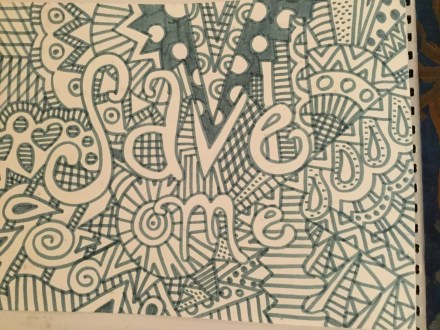
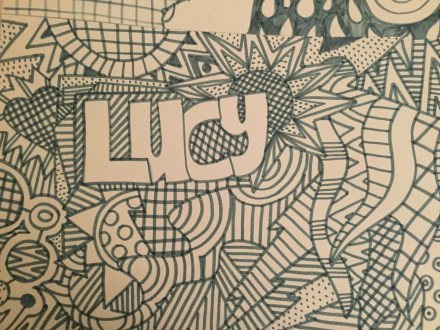
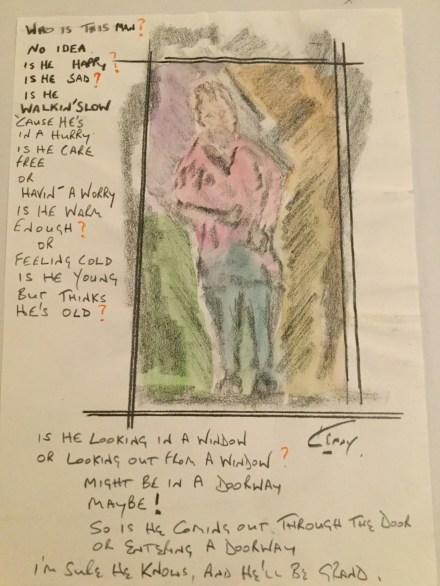
The work done by the patrons of the Dragon café was compiled into a big black book called ‘Artspace’. Looking through it was an immersive experience. Some brought me comfort and some disturbed me, making me a mixture of ‘comfortable’ and ‘disturbed’.
I shall let you find out how they make you feel.

saveme

lucy

lucy1

lucy2

mesittingJPG

maninwindow

Certain events or times of day are more difficult – like being alone late at night, or having arguments. During these times it can often be more difficult for us to feel a sense of hope, to feel connected to the idea of safety, to feel our own resilience. This is the times when ‘self-care’ is essential – taking time out to be kind to ourself, to find activities that feel good, or allow us to connect with ourself again. Self-care is about caring for ourself, inside and out.

Focusing on the present moment, the present activity, whilst allowing thoughts and feelings to just be – has a long history of helping people with their mental wellbeing. By allowing ourself to become absorbed in the moment it’s possible to feel a sense of calm and focus that can distract from painful thoughts and feelings. No wonder colouring books for adults and kids alike are taking a special place on book store shelves.

Here’s PAPYRUS’ bright idea

peacefulmind.JPG


Day 967

DAwbtccWAAEAAgj

One of the actors at the above workshop, who is also a mentally ill patient in recovery spoke about his insights, “I realised that as long as I depend on the State to look after me, I will be met with the lowest common denominator. This brought me to the conclusion that I may not have control but I have agency.”

After I got home, I looked up the meaning of ‘agency’ to figure out exactly what he meant. Agency is an ‘action or intervention producing a particular effect’. For example, many infectious diseases are caused by the agency of insects. Synonyms to this effect are: influence, power, effect, force, means, channels, routes, mechanisms and techniques.

In effect, he was referring to ‘self-help’. He was saying, “I have the power to change my situation.” It was inspiring for me to hear him say that. That statement reinforced the message of the workshop – there is a very thin line between the well and the ill. Role reversals are common. Sometimes visible. Often not.

I came away from there with a mixed bag of feelings. On the one hand, I could clearly see the daily struggles of mentally ill patients and on the other, their brilliance shone through. I wonder how Saagar would have been, had he got through that big dip.

May the force be with you. And me.

Day 963

Wysa

A young couple, committed to making a difference used their love and  intellect to create Touchkin, Artificial Intelligence for proactive care, integrating behavioural health into medical practice.

Tom Insel, a psychiatrist from National Institute of Mental Health (NIMH), the world’s largest mental-health research institution, spoke frankly about how MH services and research were failing to help the mentally ill. He openly dismissed the DSM (Diagnostic and Statistical Manual of Mental Disorders). At any given moment, roughly one in seven of the world’s 7.5 billion people is struggling with mental illness. “We’re not going to reach all those people by hiring more psychiatrists,” says Insel. But we might reach them with smartphones.

In one of his talks, Insel was sharing the intricacies of the delicate workings of the brain.   Someone interrupted him and said, “You don’t get it. The house is on fire, and you are discussing the chemistry of the paint”

Jo Aggarwal, one of the developers of Touchkin says:

“This line from the article resonated deeply with me. It’s a familiar sentiment – one many of us in development have had in conferences on employment, education, conflict. They are all at some level connected to the base fire that engulfs our world today – that of mental health. Until this fire is brought under control, we don’t have a hope for any of the rest of it.

His dramatic move lends credibility behind the idea that phones may be the answer. Identifying issues using smartphone behavior is powerful, though it can feel creepy. But detection is not enough. In our trials at Touchkin, phone sensors were able to predict depression in people with diabetes to a 90% accuracy, and went a long way in getting the physicians convinced to integrate mental health into their regimen. But only 1 in 30 people diagnosed went on to take treatment for the depression.

It said to us – “The house is on fire, the fire brigade is missing, and here we are saying how accurate our fire alarms are”

Wysa the emotionally intelligent penguin willed itself into existence somewhere along the way. It was a side feature created between ‘formal’ projects to improve accuracy. Taken by how people reacted to the prototype, we all kept working on making it better… in three months it crossed a threshold. It started changing lives. Last month, 3 people wrote in to say it saved their life, it is what is keeping them from suicide. Over 50,000 people talked to it anonymously, and thousands of them wrote in to us to say how much it meant to them.

Unlike the Stanford psychologists creating Woebot- we have no hypotheses around Wysa. It is evolving entirely based on what works for its users. It has evidence-based techniques, but everytime we add more tools or advice or tips we get users telling us to just let them talk to Wysa, and not to underestimate how much of a difference that makes.

“The fire in the house, is in our brains. The fuel is the language of the conversations we have inside our head. “

We started out, like Insel, trying to detect the fires… Wysa is leading us to try and put a fire extinguisher in everyone’s pocket. Any pretence of our own hypothesis went out of the window when the first person wrote in to say it saved their life. Now we are following it to see where it goes.

Like us, like Tim, there are many unwitting recruits to this fight.

Rick Little started fighting it as soon as he graduated college. So many of my friends… Sangeeta Mahajan who lost her son to suicide and has dedicated her life to preventing it for others. Anjana Ajay who is changing others lives after healing her own Stage 4 cancer by focusing on healing her mind. Bhavana Issar who is doing amazing work at Caregiver Saathi.Pooja Goyal who is creating resilience in pre-school children and their parents, bravely facing all the storms that come her way. Archana Aggarwal Sarda has made emotional support a way to get intl level diabetes outcomes in rural children, long before she realised that she was doing it.

None of them are psychologists. They each have options of more comfortable, lucrative ways to spend their time. They are all powerless to not do this. “The house is on fire. Once you see it, and you realise that you can stop it spreading, it is hard to do anything else.”

11078077_10152678753741035_8566229743541697060_n