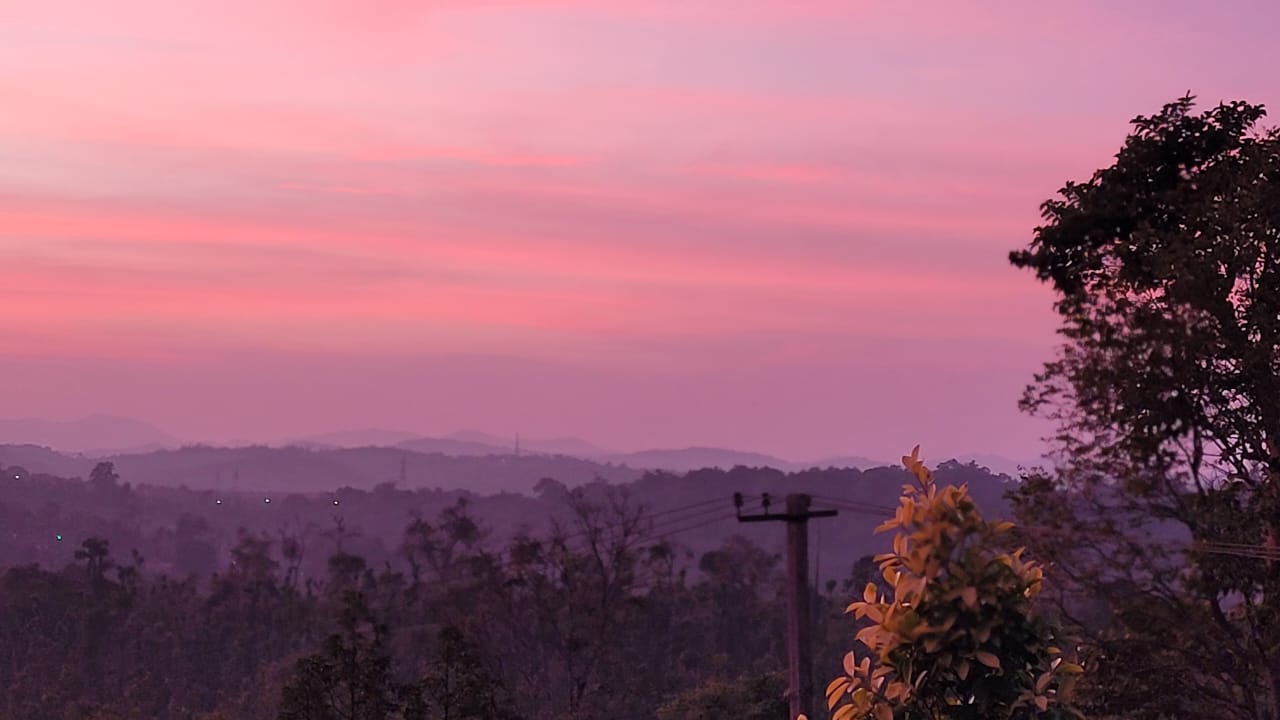
Stories are us.

Why are they here? These random strange-looking foreigners? One is white and the other we’re told is from the north of India. Wonder which is worse. At least one of them is easy to steel from. Surely the other is obnoxious. But she teaches English at the Primary school for free. Wonder what’s in it for her. Oh yes. She’s using our kids to learn Kannada for free. That must be it.

The minds of the villagers are desperately trying to make sense of what we’re doing here, in this remote village. The nearest airport is 5 hours’ drive away and the closest decent hospital, at least an hour from our village. We don’t speak the local language and hardly anyone speaks Hindi or English.

The first story of us was that I am a film director and Si, an actor. We’re scouting a suitable location to shoot a period drama. But then no camera or crew showed up. So, that was discarded.

The next tale was that we are here to set up a petrol station. That’s how people with connections in high places syphon off their black money. That fits, they believed, knowing nothing about us. But then no signs of construction appeared for months.

The next guess was that we want to open a bar and restaurant. As we are close to the highway, it’s a great place to open-up something for the travellers to rest and refresh. That didn’t seem to be happening either.

What can it be? Oh. They both have seriously grey hair. All their friends must be old. They must deeply empathise with old people. They must be planning an old people’s home. Well, no signs of that yet.

What are they about after all? The dogs and kids seem to love them. They seem like nice enough people. Maybe they’re planning to start an orphanage?  Don’t know. We’ll have to wait and watch.

Well, all they seem to be doing is planting more trees and making more compost and playing music to their plants, setting up irrigation systems and so on. Maybe they’re doing all the groundwork to ultimately grow cannabis.

Oh! How we need stories!

The older I grow, the lesser I know.

A book with frayed edges sat tucked inside the pocket behind the driver’s seat. After an overnight train journey from Sakleshpur to Goa, we were going home in a taxi. No coffee yet. I was not quite switched on. Bleary eyed, I pulled the book out of the elasticated edge. It was Walden by Henry David Thoreau. Some poor tourist had mistakenly left it behind while traveling to the airport to fly back home.

Thoreau wrote this book while he lived in a cabin he built near Walden Pond, hundred and eighty years ago. He was testing the idea that divinity was present in nature and the human soul. He stripped his life down to the barest of essentials and secluded himself as much as he could, living off the land as much as possible. He wanted to find out just what in life is necessary and what is superfluous.

(Picture, courtesy Maria Popova )

Having chosen to live in a place where, for hundreds of miles very few people speak our language, with no cinema halls, restaurants, therapists or book shops, where the food is of one particular kind, but nature is abundant, that question has arisen for me too.

A few weeks back, a quote by Thoreau had whistled right into my heart:

“Life! who knows what it is, what it does?”

Such a beautiful sentiment. I had wished for more of his writings. After learning some more about him and his love of birds, streams, woodlands and meadows, I got busy with other things.

When I brought this question to CORe, it generated a rich discussion.

“What is our relationship with not knowing? What feelings does it provoke?”

Some excerpts from our conversations:

  • It is a real test of oneself, dropping how things should be and taking each day as it comes. It took me a long time to realise how much my mind was tied to certainty. In Africa, the relationship with death is very different. They have many ways to remember a loved one. They believe they’re still here and it gives them great joy.
  • Anxiety of the need to know at work. I have to change my mind set to curiosity. Some things we’re not meant to know, such as, where is he? It would spoil it. I must accept that I’m not meant to know.
  • When he went, I didn’t want to be here. Now I do. I have a life that I want to have. I have lots of godchildren who have promised to take care of me. I have a vision of him and his dad, which I hope will come through in my own death. Maybe when it’s my time they’ll be there, and their peace will be shattered.

Yes. The older I grow, the lesser I know. There is a freedom in that, to be with whatever is happening. It allows for the mystery of life to unfold as it will and it allows me to witness it without conditions, with an open heart. The smallest things. The book that I had wished for a month ago, appears right in front of me after I had forgotten all about it.

Life. Who knows what it is, what it does?

PDA

(Awakening Needs Cards Created by Linda Nolan and Karen Plumbe)

It was natural, spontaneous and normal in London. Now, we must look around to ensure no one’s watching us.

Holding hands in public? At our age? Oh my God! At any age. Strange.

A hug. Inappropriately bold.

A peck on the cheek? Unthinkable.

A quick kiss on the lips to say hello or bye. Absolutely scandalous.

“Your husband even holds the umbrella for you in the market”, an acquaintance remarked.

I had not given it a thought. “Yes. He’s very good”, I said. I was tempted to defend his actions by making statements like, it’s easier for him as he’s taller than me or it helps me use both hands to select the fruit and veg but I stopped myself. He needs no defending. I was learning about what is normal here.

Affection isn’t a thing here. Public Display of Affection (PDA) is prohibited.

Food. Yes. Gifts. Yes. Laughter. Yes. Folded hands as greeting. Yes.

Hugs. No.

A young man of seventeen studies Biology with me for an hour, twice a week. He wants to be a doctor. He showed me an MCQ that he did not understand. It was about Barrier contraception. I asked him if he had covered the chapter on Sexual Health in School. He said the teacher had completely omitted it. She had asked the students to read and learn that chapter on their own.

The next day I found myself retrieving a little square white and blue packet from the small cupboard outside the door of the local Health Centre. It was labelled Nirodh (the Government sponsored condom). I had not signed up for this, but I turned out to be the one to explain Sexual health to him.

In a society where men and women pretend, they never touch each other and it is somehow wrong to do that, how can the adolescents learn affection, let alone intimacy?

“Affection is responsible for nine-tenths of whatever solid and durable happiness there is in our lives.”

– CS Lewis.

Dad, boys and crow.

Once upon a time there were two boys who purposefully misremembered things about their father. It made them feel better if they ever forgot things about their mother.

There were a lot of equations and transactions in their small family. One boy dreamed he had murdered his mother. He checked it wasn’t true, then a put a valuable silver serving spoon that his father had inherited in the bin. It was missed. He felt better.

One boy lost the treasured lunchbox note from his mother saying ‘good luck’. He cried alone in his room, then threw a toy car at his father’s framed Coltrane poster. It smashed. He felt better. The father dutifully swept up all the glass and understood.

There were a lot of punishments and anticipations in their small family.

Eight years ago it was hard work and I could remember it only vaguely.

I read it for the second time this morning. It felt brand new, easy, fun and hearbreaking. Part memoir, part sound-poem. A bit more than 100 pages long. No more than 18 thousand words. The ‘missing’ in the life of a young family after the mother dies suddenly is palpable. In the background rings the sound of a crow flapping its wings. One big black feather has dropped on the ground. It lies near my right foot.  

PS: Losing a parent or a close relative or friend at a young age puts the young at a high risk of suicide.

What is your Superpower?

When I lived a cramped, hectic life in London, I often romanticed the texture of life in a scenic little seaside cottage with no neighbours in Cornwall or a tiny remote island a few miles off the coast of the Pacific Northwest or a lonely dwelling on the side of a vast mountain in the Himalayas. Deep down lay an incipient desire to experience it.

A few years on, I make the choice to live in a one bed-room house in remote South India. Malnad, the region of rain, notorious for a long heavy monsoon. The nearest airport, five hours by road on a good day and the closest half-decent hospital an hour’s drive away. After a few months the newness of this rural setting starts to diminish. Mornings begin with chirps and trills emerging out of a serene silence. I draw the curtains to find the morning fog gently floating across layers of overlapping lush green slopes, reaching right up to the horizon. I am filled with gratitude. I say to myself, ‘Don’t ever take this for granted.’

If I start listing all the things that are not here, an exhaustive inventory might appear – a library, a café, a restaurant, a museum, an art gallery, a community centre, a swimming pool, a book shop and so on. But I do have a superpower. On whatever I put my attention, that seems to grow, fill my awareness. Music, chanting, yoga, reading, writing, meditation, nature – all the things that I used to struggle to make time for, are now in abundance.

I can choose where I want to place my attention because this is my one precious life, my one chance to live and learn and enjoy. I am exactly where I want to be and need to be. This is the perfect opportunity to match my inner silence with the one I sit within. To observe and let go. Examine and let go. Feel and let it go. Think and let it go. Breathe in and let go.

Contentment does not need objects to justify itself. In every moment, it is present as a choice. At the tiniest hint of my attention, it shows up, smiling. The more I sit with it, the more it makes itself available. When I touch, its texture is silky.

Caves are well-known conduits to enlightenment. May be this is mine. I wonder if contentment is another name for happiness.