Day 767

For months I have been noticing that more often than not, whenever I randomly turn on the radio in the car or at home, I hear something closely related to what’s going on in my mind.

‘Stand by me’ was the first episode of a series called ‘We need to talk about death’ on BBC Radio 4. Given that death and dying are an essential part of the stream of human existence, many of us shy away from the subject. In this series Joan Bakewell explores the choices open to us and other questions on the subject that are most feared. http://www.bbc.co.uk/programmes/b083pd1p

Last Sunday, on the long drive home, between Bollywood and Jazz music, we tuned into the radio to check what was on. We were introduced to an enigmatic Welsh word, ‘Hiraeth’ (pronounced Here-eyeth with a rolling ‘r’). There is no exact English word for it. The best we can do is ‘homesickness’ but that doesn’t do it any justice. Hiraeth is a feeling of something lost a long time ago. To feel hiraeth is to feel a deep sense of incompleteness, a yearning for something better, a grief for something left behind, an aspect of impossibility, pining for a home or a person. It can push the nostalgia button and bring on the belief that things were better in the past. It is the signature tune of loss. http://www.bbc.co.uk/programmes/b083m307

I think I know what that feels like.
 

Day 766

“I have only a story and my belief in the power of story to save us.”
– by Bruce Weigl.

“We are beings who require language to be. It is an existential imperative that people share stories. Indeed, the human experience is contingent upon the interaction of stories.”
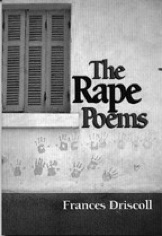
– by Frances Driscoll, a survivor of rape and a writer with the power to heal through poetry as a way to process pain, giving voice to the voiceless.

Island of the Raped Women

There are no paved roads here
And all of the goats are well-behaved.
Mornings, beneath thatched shelters,
we paint wide-brimmed straw hats.
We paint them inside and outside.

We paint very very fast.
Five hats a morning.
We paint very very slow.
One hat a week.
All of our hats are beautiful
and we all look beautiful in our hats.

Afternoons, we take turns:
mapping baby crabs moving in and out of sand,
napping, baking.
We make orange and almond cake.
This requires essence and rind.
Whipped cream. Imagination.
We make soft orange cream.
This requires juice of five oranges and juice of one lemon.
(Sometimes we substitute lime for the lemon. This is also good.)

An enamel lined pan.
Four egg yolks and four ounces of sugar.
This requires careful straining,
Constant stirring, gentle whisking.
Watching for things not to boil.
Waiting for things to cool. We are good at this.
We pour our soft orange cream into custard cups.
We serve this with sponge cake.

Before dinner, we ruffle pink sand from one another’s hair.
This feels wonderful and we pretend to find the results interesting.
We all eat in moderation
and there is no difficulty swallowing.
We go to bed early.
(Maybe, we even turn off lights. Maybe, we even sleep naked. Maybe.)
We all sleep through the night.

We wake eager from dreams
filled with blue things and designs for hats.
At breakfast, we make a song,
Chanting our litany of so much collected blue.
We do not talk of going back to the world.

We talk of something else sweet to try with the oranges: Sponge custard.
Served with thick cream or perhaps with raspberry sauce.
We paint hats. We paint hats.

droppedimage


Day 765

Happiness. That’s what it’s all about – greetings, festivals, blessings, wishes, prayers, careers, relationships, food, fame, fortune, birthdays, weddings, everything. Directly or indirectly it is the subject of countless books and films. Most stories and encounters navigate through all odds steering their way towards happy endings. Many spiritual and religious programs promise lasting happiness. ‘Happily ever after’… is the stuff fairy tales are made of.

At this point in my story, my relationship with happiness is elusive. Intellectually it seems unfortunate because I have everything a girl could want and more, but my heart physically aches. The dagger that struck 25 months ago is still wedged in there. Every now and then it twitches and twists, radiating shooting pains. I sit with it, observe it, experience it and honour it. I look at it with love and as love. I live and breathe through it. I absorb it and carry on as ‘normal’. It is a part of me.

Could this very dagger be the route to access true happiness? Is this wishful thinking? A fantasy? Or is it really possible? If happiness arises from within and that is exactly where the pain is, there must be a relationship between the two. May be there is tonnes of happiness there, waiting for me to unlock it and ‘let go’ of the things that make me sad. May be it’s all up to me. May be it is do-able and I am just not doing it. May be it’s time.

I don’t know.

images


Day 764

paratrooper

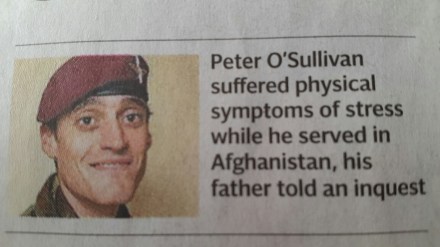
He served for 10 years in the Parachute Regiment. He had witnessed and been a part of ‘very severe military activity’ in Afghanistan as a result of his service in the elite Pathfinder Platoon. He left the army in 2010 and started to work in close protection in Iraq. In 2012 he married a Thai woman who commented that 2 years later he ‘wasn’t good’.

He sought help from the Combat Stress charity (http://www.combatstress.org.uk/) in December. A nurse referred him to a Consultant Psychiatrist as she felt he might have PTSD. His father noticed that Pete had started to have a tic and facial problems and that was a clear indication that he was suffering from deep psychological trauma. The psychiatric appointment was available for a date 4 months away, in April. Faced with this long wait, Pete went back to Iraq for 2 months. He returned home briefly before flying to Vietnam for a kite-surfing course. Pete never went on the course and sadly ended his life in Vietnam in February.

The Coroner heard that drugs were found in Pete’s blood and ruled there was insufficient evidence for either suicide or accidental death. His family are hoping that the authorities will recognise Pete’s death as a direct result of PTSD resulting from his service. They want his name to be included at the National Memorial Arboretum.

Another tragic loss of a young life, not getting timely help despite asking for it. Another family lost, not knowing exactly how to help their young man. Another suicide not registered as such, adding to the underestimation of the national scandal that it is. Another charity, offering more assistance than the NHS. Another child not coming home for Christmas.

Preventable? Yes.

RIP Pete. 


Day 763

leaf-collection

The semi-circular Green was covered with autumn leaves. The skeletons of trees stood semi-nude, exposed yet statuesque. Andy, who normally clears up the leaves is away on a long holiday. The others in the neighbourhood took it upon themselves to fill in for him. One woman with a new hip came on to the Green with her ‘Bulldog’ rake and leaf-collector called ‘Anita’. The gadget was a Christmas gift from a few years ago. She thought it was rather quaint at the time but it had proved to be cleverly designed and very useful. Next came her friend who is 79. She brought her ultra-light yellow rake and a couple of light wooden boards that served as efficient leaf collectors. Along came a couple in their 60s with a wheel-barrow, another metal rake and huge bags to carry the leaves in.

They caught up on the gossip, exchanged remedies for wasp stings, made jokes, talked about their respective pets and took pictures of each other. Together they piled the leaves up in little hillocks dotted randomly across the Green, deposited them in a big bag, mounted it on to the wheel-barrow, took it away to a designated spot, emptied it out and brought it back for more. That cycle repeated itself a few times with team members assuming different roles at different times. More people joined in and left at various points over the course of the activity. The Green was green again.

We gathered in our house for a cup of tea. A country morning well spent.