Day 220

Change is the only thing that is constant.

That is true for our bodies, our minds and the world around us.

Over the past few months my life and priorities have changed drastically in so many different ways. The fact that I am a doctor meant something to me but now it is immaterial. My notion that living in a big city means there isn’t enough time has been proven utterly wrong. My limited vision of having time and resources just enough to look after my family and myself has also been challenged. I now have time for learning about mental illness and sharing that learning. I have enough time for myself, his friends and mine, to reach out to a lot of people on a personal basis and through this blog.

Yet, when someone says, ”Something good comes out of every misfortune.” I want to kill them.

From a place of holding on to all his things as tightly as I could, I have reached a point where selected items are passed on to carefully selected individuals who fulfill a very specific set of criteria, bearing in mind what he would have wanted.

This evening I shared with a Consultant Psychiatrist friend that I was puzzled by the strong evidence in medical literature about the cause of Bipolar disorder being essentially genetic. As far as I know there is no history of overt mental illness on either side of his family.

On a lengthier and deeper exploration of the subject it emerged that some behaviours and personality traits can be sheltered and covered up in a way that they appear ‘normal’ for a particular person or family when in fact they are milder forms of the illness which can then find full expression further down the line in future generations.

Just as I expect everyone else to, I must give ‘parity of esteem’ to mental illness as well. Just like physical illnesses claim lives, so do mental ones, especially when managed poorly.
Day 217

When I got to the train station, the normal services to our local train station were disrupted. I quickly worked out an alternative route to get home after work as fast as possible. This was on Day 0.

Today evening I reached another London Train station which seemed to be in absolute chaos and I assumed it was because today is the Friday of a long weekend. A little while later I discovered that an ‘incident’ had taken place at the station earlier this afternoon which had thrown everything into a state of complete mayhem.

Another loss! Another family thrown into an abyss of deep grief. Another terrible tragedy! I stood still at the platform just mourning for everything all over again while the frantic activity around me kept buzzing on. I felt crushed.

I thought it might be useful to compile a list of well known risk factors that make any of us relatively more prone to want to end our lives. Here it is.

  1. Male gender
  2. Single people
  3. Low socio-economic level
  4. Unemployed
  5. Substance abuse
  6. Psychiatric illness
  7. Gays/Lesbians/ Bisexuals/ Not sure
  8. Childhood bullying/ abuse/ dysfunctional families
  9. AIDS patients
  10. Chronic Epilepsy
  11. Chronic Pain
  12. Alcoholism
  13. War veterans
  14. Previous history of attempted suicide
  15. Deliberate self harmers leaving A&E without a psychiatric assessment
  16. Social isolation – eg. migrants
  17. Physical illness – cancer, stroke to name a few.
  18. Those recently bereaved.
  19. People on antidepressant medication. 

Let’s look out for each other.

Day 216

A few things I learnt at a recent meeting on Suicide Prevention:

Only 25-40% of people who end their own lives have been  in contact with Mental Health services in the year before their death. So, it is everyone’s problem. It is important to educate everyone about recognising ‘at risk’ people; symptoms typically include dramatic withdrawal, reduced self-esteem, restlessness and agitation, severe hopelessness, acting recklessly, threatening to harm themselves and talking or writing about death.

A patient went to her GP with many of the above features and he said to her,” Why don’t you go shopping?” Not surprising at all. Is it? GPs are not trained adequately to deal with these situations.

Taking time to care and pay attention to everyone, no matter who we are or where we live and work, makes them feel valued. Each one of us can make a difference. It is our responsibility to:

  1. Ask.
  2. Listen.
  3. Give hope.

Very often the professionals will say that a particular suicide was ‘unavoidable”. Really? How do we know? Did we anticipate it? If yes, then did we do our best to prevent it? If not, then why not?

What is an acceptable suicide rate?

There needs to be a change in mindset. A cultural shift needs to take place. We need to believe that we can achieve a Zero Suicide Rate as some places in America have done.

As a society we need to:

  1. Talk openly about suicide as our problem.
  2. Remove access to means of suicide by tackling the hotspots such as multi-storey car parks.
  3. Improve access to Secondary (Specialist) care.
  4. Offer training to all professionals, especially GPs, police, airport and railway staff.
  5. Have a safety plan for patients with a known illness be it mental or physical, such as chronic pain and stroke, that might make them prone to suicide.
  6. Forget about the ‘risk assessment’ approach which is essentially a form of rationing. Do the same thing for everyone – have a safety plan.

Apparently each suicide costs the government £1.4 million. Police and coroners cost plus lost employment for the deceased person and the damaging impact on the people affected by the event. On an average 60 people are deeply affected by each suicide. So, even the treasury is interested in reducing the suicide rate.

Ask. Listen. Offer hope.

Day 213

S is SBK

Today I missed my counseling session. Got held up at work. Felt really disappointed. I feel like a pressure cooker that has built steam up to maximum pressure but the pressure-release valve is stuck.

Sometimes it’s easier to talk to a stranger than to relatives or friends. He listens to me and helps me find my own answers to problems, without judging. He gives me time to talk, cry or just think. It’s an opportunity to look at my problems in a different way with someone who’ll respect and encourage my opinions and the decisions I make. He mostly listens but drops a few gems here and there. For instance he once said, ”The mind is always looking for a reason but there is none.”

Wouldn’t it be wonderful if we all could listen and respond to each other like that?

Although there are many different types of talking therapy, they all have a similar aim: to make you feel better. Some people say that talking therapies don’t make their problems go away, but they find it easier to cope with them and feel happier.  Talking therapies can help with depression, anxiety, an eating disorder, a phobia and an addiction and, of course, in my case grief.

Talking therapies are commonly used alongside medicines for more serious mental disorders such as Bipolar disorder and Schizophrenia.

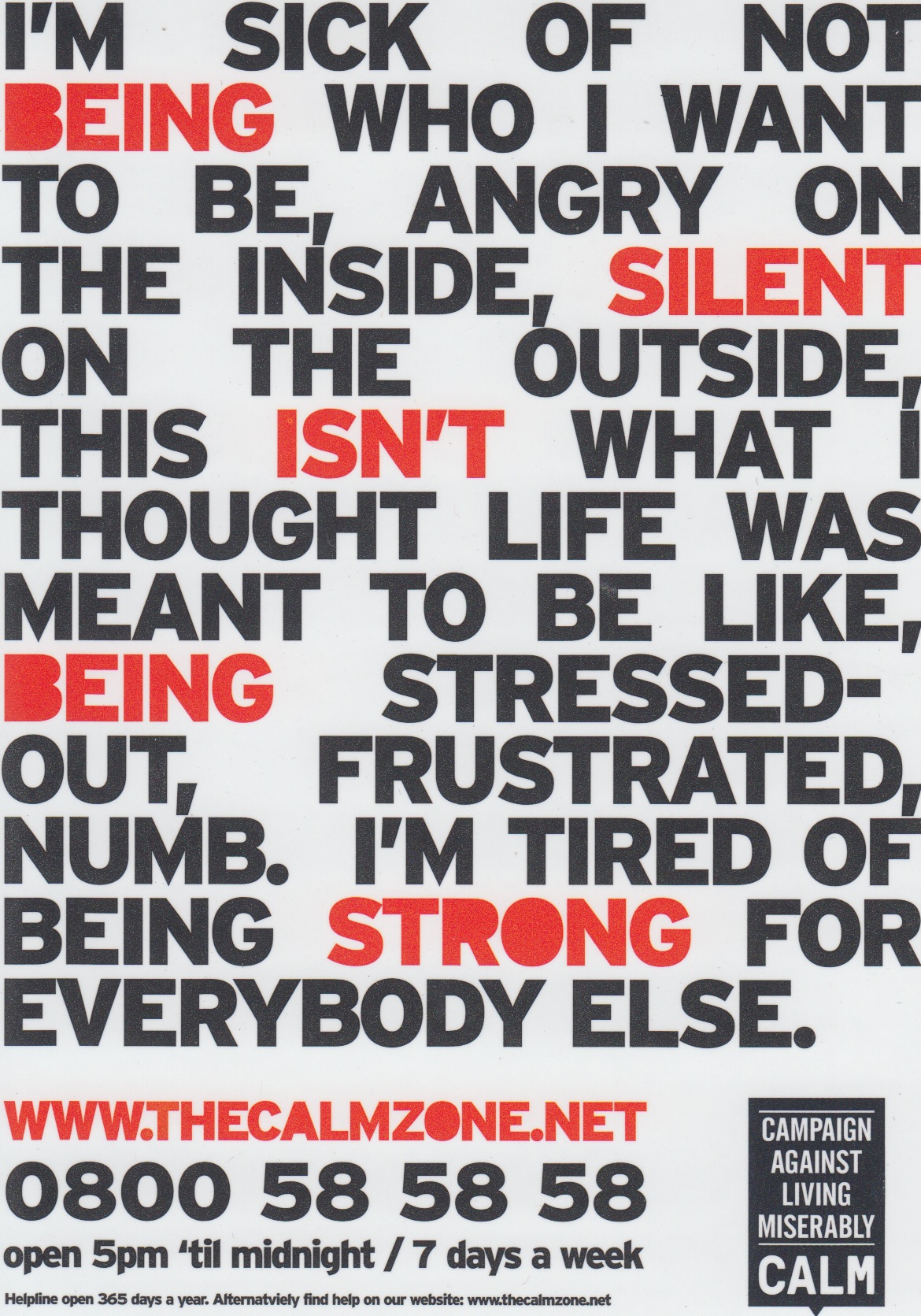
Campaign Against Living Miserably promote learning to talk and listen in a way that is helpful.

Day 212

Self-harmers are commonly looked down upon. They are considered by many as wasters : wasting their own time (seeking sympathy and attention), other people’s time and precious resources.

They are much misunderstood. Self-harm is a coping mechanism. It is a way of expressing very deep distress that cannot be put into words or even thoughts. It is an ‘inner scream’ that helps release emotional pain and show someone else how they feel.

Young women are most likely to self-harm, although the number of young men who do so is on the rise. Mental health problems, stressful circumstances (being homeless, being a single parent, being in financial difficulty), using drugs and alcohol are the commonest causes.

Myth 1: People who self harm don’t feel pain and therefore do not need painkillers to stitch wounds.

Of course they feel pain. They should be offered full assessment of their physical, psychological and social needs by a professional who has been trained in their treatment in an atmosphere of respect and understanding.

Myth 2: Young people who self-harm always have mental health problems.

Not always. Sometimes that is the only way they can cope with traumatic experiences from the past, for example, bullying or abuse.

Myth 3: Young people who self-harm want to commit suicide.

They often don’t. In extreme circumstances though, life can get too much for a young person and that is why it is important to seek help.

Myth 4: People who self-harm are just seeking attention or being manipulative.

Sometimes it is the only way they can express their pain, even though this can be very upsetting for those around them.

How can we help?

  1. Don’t ignore what’s happening.
  2. Tell them that you want to understand how they are feeling and want to help.
  3. Be honest about your feelings while not being critical of or blaming the young person.
  4. Emphasise the positive aspects of the young person’s life.
  5. Be realistic. They may not stop self-harming just because you want them to.
  6. Don’t take over but show you care.

Whether you are a patient or a carer, please seek professional help from GPs, psychiatrists, emergency departments, councellors, psychologists or psychotherapists.

(Source: http://www.bernardos.org.uk)