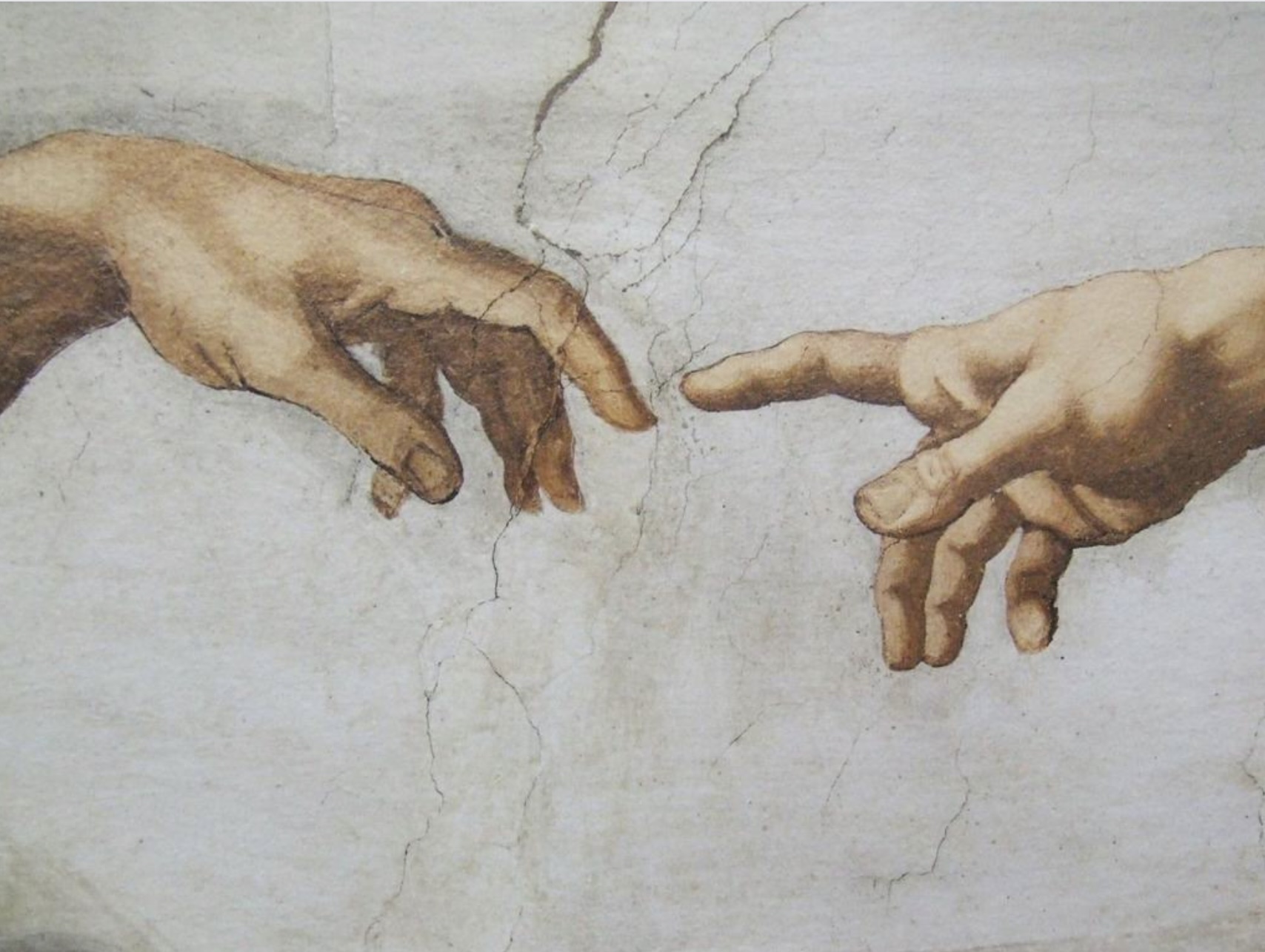
Why do love and crying go together?

(From The Creation of Adam by Michelangelo)

At a recent wedding, halfway through his speech, the bride’s father was overcome with tears. He was so happy for his daughter that he couldn’t help but cry. It was a sparkling moment of a mixture of affection, achievement and perhaps relief. Even though it took him by surprise, it was perfectly normal and rather sweet.

At the hospital, I watched men and women cry with joy at the first sight of their newborn baby. It was joy to behold their love and terror of having this amazing miracle happen to them. I have taken many photos of those moist eyes brimming with love.

Babies cry to express their hunger or discomfort or pain. Adults also cry to express themselves but somehow, they don’t seem to have as much permission as kids. When we’re happy, we laugh and that’s okay. When we’re sad, we cry and that’s often not okay.

Jesus wept. (John 11:35)

When he visited the tomb of his friend, Lazarus, Jesus was moved to tears seeing the sorrow of those mourning his death. The verse comforts believers by showing them that Jesus had empathy for the grief, loss, and pain that humans endure. Despite knowing he was about to raise Lazarus, he felt for them in that moment. He had solidarity with the human heart.

The protective mechanisms built into our bodies are very subtle. The eyelids blink to ensure that the cornea remains moist, so we can continue to see clearly. It happens without us noticing. As soon as we put something in our mouths, our saliva starts to counter potential troublemakers in our food. When we change our position from sitting to standing, the biomechanics in the body readjust to ensure that we don’t fall over. A sense of balance in innate to us while standing and walking.

Crying also protects. It works as a pressure-release valve. When our emotions are intense and difficult to contain, crying helps to reestablish emotional equilibrium. It is a cue for connection with others as it is founded in our vulnerability as humans.

To stay with each other until the flood subsides.

To hold each other. Talk. Listen. Be present

That’s how we hold space for feelings, allowing them to be fully expressed.

That is how we experience divine love.

Resource:

CORe: Circle of Remembrance. A free online peer support group for bereaved parents, where crying is honoured.

The C – Word

It might explode like a grenade thrown into a small room. I worried that everyone might be put right off by it. They might log out, log off, shut their laptops and go for a walk.

What do you mean ‘Celebrate’? What is there to celebrate? Nothing. NA – Not Applicable.

After a severance such as this. The death of my child? How can I? To me, it does not apply. I belong to another club now. Here, the air is laden with a sense of exclusion and non-deserving. Here, the rejection of invitations to celebrate is automatic.  

Memories of our kids. The foods they loved, toys, TV shows, films, books, nursery rhymes, practical jokes, school and Christmases. Our hugs. Sweet stories revealed through their friends after they died. Their hidden kindnesses. Laughter. Tears. A whole life worth remembering. Worth honouring. Celebrating.

What of us? Parents. Alive. Old labels stripped off and new strange ones slathered on. The ground beneath our feet taken away and replaced with quicksand. Our identity shattered. Life in the After becoming something resembling life. An unthinkable exile. Aloneness, inside the non-understanding of the world. Every day, a fight. A reconciliation. Every day, showing up and facing whatever shows up. Keeping the broken bits of our hearts held together with the glue of love inside our silently sighing chests. Still alive.

The invitation at the Circle of Remembrance was to celebrate ourselves for being here. Now. It did not go off like a granade in a small room. No one left in a huff. It was accepted graciously. At the end of an hour and a half, the virtual space was filled with acknowledgement of things to celebrate – our love, patience, resilience and compassion reflected in this poem by Lucille Clifton written in the 1960s. We can replace ‘nonwhite and woman’ with any other phrase:

won’t you celebrate with me

what I have shaped into

a kind of life? i had no model.

born in Babylon

both non-white and woman

what did I see to be except myself?

i made it up

here on this bridge between

star-shine and clay

my one hand holding tight

my other hand;

                        come celebrate

with me that everyday

something has tried to kill me

and has failed.

PS: Circle of Remembrance is an international online peer-support group for bereaved parents that has been effectively working for the past three years and four months. Please visit the website http://www.core-community.com to learn more. Please recommend it to any parents you know who might be struggling alone after a tragic loss.