Day 580

Ode to Broken Things
by Pablo Naruda

Things get broken at home
like they were pushed
by an invisible, deliberate smasher.
It’s not my hands or yours
It wasn’t the girls
with their hard fingernails
or the motion of the planet.
It wasn’t anything or anybody
It wasn’t the wind
It wasn’t the orange-colored noontime
Or night over the earth
It wasn’t even the nose or the elbow
Or the hips getting bigger
or the ankle
or the air.
The plate broke, the lamp fell
All the flower pots tumbled over
one by one. That pot
which overflowed with scarlet
in the middle of October,
it got tired from all the violets
and another empty one
rolled round and round and round
all through winter
until it was only the powder
of a flowerpot,
a broken memory, shining dust.

And that clockwhose sound was
the voice of our lives,
the secret
thread of our weeks,
which released
one by one, so many hours
for honey and silence
for so many births and jobs,
that clock also fell
and its delicate blue guts
vibrated
among the broken glass
its wide heart
unsprung.

Life goes on grinding up
glass, wearing out clothes
making fragments
breaking down
forms
and what lasts through time
is like an island on a ship in the sea,
perishable
surrounded by dangerous fragility
by merciless waters and threats.

Let’s put all our treasures together
— the clocks, plates, cups cracked by the cold —
into a sack and carry them
to the sea
and let our possessions sink
into one alarming breaker
that sounds like a river.
May whatever breaks
be reconstructed by the sea
with the long labor of its tides.
So many useless things
which nobody broke
but which got broken anyway.
Day 403

Now, more than ever before I feel the need to explore the meaning of being human. While on the one hand I can see the frailties, failings and fragility of humans, on the other I can see the light that shines through some of them that can provide strength, hope and inspiration to others. Sometimes I see both attributes in the same individual at the same time. Other times I see someone completely transform from one end of the spectrum to the other over time.

Who better than Rumi to look to for some answers:

“I am not Christian or Jew or Muslim, not Hindu, Buddhist, sufi, or zen.
Not any religion or cultural system.
I am not from the East or the West,
not out of the ocean or up from the ground,
not natural or ethereal,
not composed of elements at all.
I do not exist,
am not an entity in this world or the next,
did not descend from Adam or Eve or any origin story.

My place is placeless, a trace of the traceless.
Neither body or soul.
I belong to the beloved,
have seen the two worlds as one and that one call to and know,
first, last, outer, inner, only that breath breathing human being.”

And:

“We are pain and what cures pain, both.
We are the sweet cold water and the jar that pours.
I want to hold you close like a lute, so that we can cry out with loving.
Would you rather throw stones at a mirror?
I am your mirror and here are the stones.”

Day 392

images

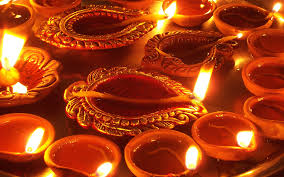
In India, the festival of Diwali equals Halloween, Christmas and New Year’s eve, all rolled into one. It’s about festivities, food, family, gifts, sweets, fire-crackers, new traditional clothes, lamps, gambling and prayers to the Goddess of wealth, Laxmi. Underneath all that, it is about the victory of good over evil, knowledge over ignorance and light over darkness.

In mythological terms it is the day Lord Rama and his wife Sita returned to their kingdom after being away for 14 years during which time they went through a lot of difficulties and learnt many lessons as per the epic of Ramayana. It is a day of celebrations with a very festive build up which starts at least 3 weeks prior.

Every year the date changes according to the lunar calendar as it always falls on the night of the new moon. Households and streets are lit up with oil lamps and candles to dispel the darkness of the night.

I remember when my son was little all the extended family was together lighting fire crackers. Before we lit the first lot we all greeted each other with “Happy Diwali!”. Thereafter every time we went to light them he said in his joyful little voice “Happy Diwali!” He was a happy kid. Always up for a good time.

Last year, he died one week before Diwali.
But he continues to be the light of my life.

A very Happy Diwali to him and to all of you!

“A physical lamp is just a symbol. The real lamp is ‘You’ and you have to be lit up, vibrant, smiling, joyful and full of energy because that is the real festival. And this can only happen with knowledge, not just with comforts, gadgets, money or friends. Real happiness comes with knowledge.” – Sri Sri Ravi Shankar.

Day 391

“Suchness” or “thusness” means “it is so”.
It cannot be described in words as it is not a mere concept.
It can only be experienced.

Suppose someone asks you what an orange tastes like. Rather than describe it, best to invite them to taste an orange. This allows them to enter the suchness of the orange.

To remind his disciples on the beginningless and endless nature of reality, Buddha asked them to address him as “Tathagata” – one who arises from suchness, abides in suchness and returns to suchness, a non-conceptualisable reality.

Who or what does not arise from suchness? You and I, a caterpillar, a speck of dust – all do. In fact, the words “arise from”, “abide in” and “return to” have no real meaning. One can never leave suchness.

When asked what happens to Tathagata after death, Buddha replied, “As Tathagata cannot be found in form or outside form, cannot be recognized through feeling, perception, mental formations or consciousness, why worry if I will continue to exist or cease to exist, or neither continue, nor cease to exist after death.

Robert Oppenheimer, the physicist known as the father of the first atomic bomb understood this based on his observations of particles:

“To what appeared to be the simplest questions, we will tend to give either no answer or an answer which at first sight be reminiscent more of a strange catechism than of the straightforward affirmatives of physical science. If we ask, for instance, whether the position of the electron remains the same, we must say ‘No’; if we ask whether the electron’s position changes with time we must say ‘No’; if we ask whether the electron is at rest, we must say ‘No’; if we ask whether it is in motion, we must say ‘No’.”

The language of science has begun to approach the language of ancient wisdom. Being a practitioner of science and of ancient teachings, I am starting to see the deep connection between the two. ‘Understanding’ is an intellectual pursuit. Some knowledge is beyond understanding. The above paragraph awakens something within me that has been there, lying dormant for many centuries. Once again, bringing me back to – It is so.

Day 389

This day last year, a memorial service was held for my son at the Great Hall of his former school. It was a deeply moving occasion, filled with love. More than 250 people attended. He earned more love in his 20 short years than some people do in a lifetime.

The Coroner’s inquest into the suicide of my son is still unfinished but as his mother and his prime carer here are a few facts.

  1. An Honorary Consultant Psychiatrist saw him 3 weeks into his illness and made a diagnosis of Bipolar Disorder.

Did he speak to any of the family members/carers about this diagnosis and what it might mean for us as a family?
No.
Did he send him home?
Yes.

  1. His GP was the only one who knew he was severely suicidal for at least 4 weeks before he died as he did not mention it to anyone else.

Did he tell any of the family members/carers?
No.
Did he send him home?
Yes.

  1. The handover from the psychiatric team to the GP should have highlighted the diagnosis.

Did the letter tell the GP about a new diagnosis of Bipolar Disorder?
No.
Did it tell him to watch out for depression?
No.

  1. The trainee psychiatrist who wrote the discharge letter to the GP must have seen my son at least once.

Had he?
No.

Am I surprised now that my son is dead?
No.
I am surprised that he lived for as long as he did. He followed every instruction he was given and took his medications religiously. He really wanted to get better.

He just didn’t get the care that he deserved, from the specialist services, primary care services or his parents. All of them failed to talk to each other in a way that would keep him safe.

In theory, the NICE guidelines say that carers should be given written and verbal information about the diagnosis and management of Bipolar Disorder, about positive outcomes and recovery and about the social and psychological support available for them. They encourage a ‘collaborative approach’ respecting the interdependence between the patient and their carers.

In practice, none of the above took place.

It was as if the existence of carers, in this case his parents, was not acknowledged. I felt that my concerns regarding his ill health fell on deaf ears.

I believe that unless families and carers are empowered with inclusion and information, young people will continue to die unnecessarily. Unless primary and secondary care services work in unison with each other and with the carers at home, patients will continue to fall through the gaps. This is not the first time it has happened but no lessons have been learnt.

I would not wish this nightmare on any family and I want to do everything I can to highlight the areas where we can improve care. Suicide is the biggest killer of young men all over the world and the numbers continue to rise every year. We as a community need to educate ourselves and help young people. We need to ask more questions. We need to demand better care for our children and other close relatives and friends.

Carers care. He was my only son. His well-being was on the top of my list of priorities. I had a right to know about his diagnosis and his suicidality in order to look after him properly.

He did not get to celebrate his twenty-first birthday.
I miss him every minute of everyday and I always will.