Half-saree ceremony

We’re back home, in Sakleshpur, and finally, after more than six months of monsoon, the rain seems to have stopped for now. After making us wait for ages, the sun is finally smiling in all its brilliance. The monsoon arrived one month earlier than expected and stayed a month longer. Many coffee beans were knocked off their branches by sharp rain drops. Moisture laden air meant that fungus started infesting the plants. Months of sogginess in the soil made the roots of the pepper rot. The local farmers were seriously worried, and the return of the sun has brought them and us huge relief.

One of my students reached puberty this month. How do I know? Because her family hosted a celebration, the Half-Saree Ceremony to mark the occasion. The name comes from the brightly coloured silk dress that is worn by the young girl at the centre of it all. A long skirt with a matching blouse and an unstitched piece of silk draped elegantly around her. She wears beautiful jewellery, adorns her hair with flowers and sits on a throne like a precocious princess. The maroon lipstick looks terribly out of place on her cherubic face.

In South India this ceremony symbolizes the communal acceptance of a girl’s transformation into a young woman. It is sacred and hence accompanied by elaborate rituals and fragrant prayers using sandalwood, roses, jasmine and a hundred other things. It is an occasion to formally introduce the young lady to her extended family and community, as well as to reinforce her traditional roles. Generations up and down gather, fostering a sense of identity and belonging, celebrating both, her individual milestone and the timeless traditions that define her heritage. 

I wonder what it’s like for her to have the entire village know this very personal thing about her. Maybe it’s so normal here that there’s nothing strange about it. A healthy normalisation of a potential taboo. I wonder if this is a hidden invitation for marriage proposals not so far in the future. I wonder if she feels the pressure of expectations of her family and community change overnight. I wonder how she sees herself now. She is only 12.

Comings and goings.

As usual, I sit here at my table by the window of my study, admiring the autumnal trees standing in the park across the road, looking for inspiration to write. They have been my encouraging companions for years. The difference is that today might be the last time I write sitting here.

Early autumn has cycled back again. The fullness of the moon has synchronized with the one eleven years ago. The comings and goings of the seasons, of the world carry on as usual. Moving away from this home to live elsewhere was unthinkable at one time. But now, the heart has settled. It knows things it did not before. It carries a treasure of love and memories. Saagar lives in this heart now. He cannot be left behind. He is with me everywhere.

This, our home is ‘under offer’ now. A young couple wants to buy it for the same reasons we did twenty years ago. A quiet street. A diverse neighborhood. A garden. Parks and good schools nearby. Last few days of packing up have been intense. Things that have surfaced from deep recesses – a handheld Nintendo Gameboy carefully wrapped in its purple case, a proper Canon camera, one black sock with TUESDAY on it in yellow bunched together with another with SATURDAY printed on it in green.

I know not to trust my memory. It often fails me. It misremembers things, puts them in the wrong order. Omits some entirely. It plays tricks, causes confusion. Forgets what I want to hold on to and remembers what I’d rather forget. Luckily, the job of the heart does not include remembering but feeling – how it feels to sit here looking out the window and then at a blank page, to fold a much-loved photo in silk and cover it in more soft clothing, to look at an empty room and see it filled with light, to know it’s okay. I can trust this thing in the center of my chest. It’s all okay.

People

So many disappeared.
I saw them on Day 1 and 2 and then nothing. Not even a text or a call.
Luckily, the early days were a fog, a maze. Luckily, I have forgotten so much.

Some people, who were nothing more than work colleagues showed up big time. They could sit with my despair. They sent me little books of poems for difficult times in the post. They met with me for coffee in town. They called up and chatted on the phone. They made a note of Saagar’s birthday and death anniversary and sent me cards, saying, thinking of you today. Simple, small things that meant the world.

Some people spoke very little but their body language boomed loud and clear. They mirrored the contraction inside me. Their empathy shone through that. On the second day, Rajeev, an old friend sat with us for two hours in silence. Before leaving, he said, “If there is anything I can do, please let me know.” Over the next months and years, he followed my blog, commented on posts and casually dropped by when he could. He let me know he was there.

Some people possibly saw in me, the worst possible lashing of fate as a parent. Maybe they got frightened. The speed of their exit indicated their fear of catching it. Some people who were previously in the ‘life-long friends’ category, vanished. One of them was a Psychiatrist, a mother of two. One of her children, Rajat, was a close friend of Saagar when we were neighbours in Belfast. The two boys spent every evening together cycling, playing and talking. They often had their dinner and their bath in each other’s houses. I still have a picture of them at six-year-olds, with the alien they constructed together from their toys and balloons. We were the closest of friends for four years and then they moved to Birmingham and we, to London. We stayed in touch and visited each other but the boys grew apart as boys of that age do. After their visit on Day 2, our next contact was a wedding invitation to Rajat’s wedding by a WhatsApp message, eight years on.

Of course, people don’t understand. They can’t. It’s not their fault. I wouldn’t want them to because they would have to experience this. If this had happened to a friend of mine, I would like to think that I would’ve been there for her but I don’t know that for sure. The woman I was in the ‘Before’ might have been too busy or too afraid or too awkward. I don’t know.

Some of Saagar’s friends have been with us all along. We’ve attended every concert we could as Hugo and Azin have risen in their musical careers. We have met up for meals and walks as often as possible. We’ve met their partners, watched them buy houses and change jobs. Our connection with them seems to be made of the same silk as our love for Saagar, and his memory. We feel blessed to have these young people in our lives.

Yes. My address book has radically changed. Like me.

Resource: How to be with someone who is grieving:

https://outlive.in/suicide-loss

Forty pine cones and the story of a name.

(Courtesy: Mary Kennedy, my friend.)

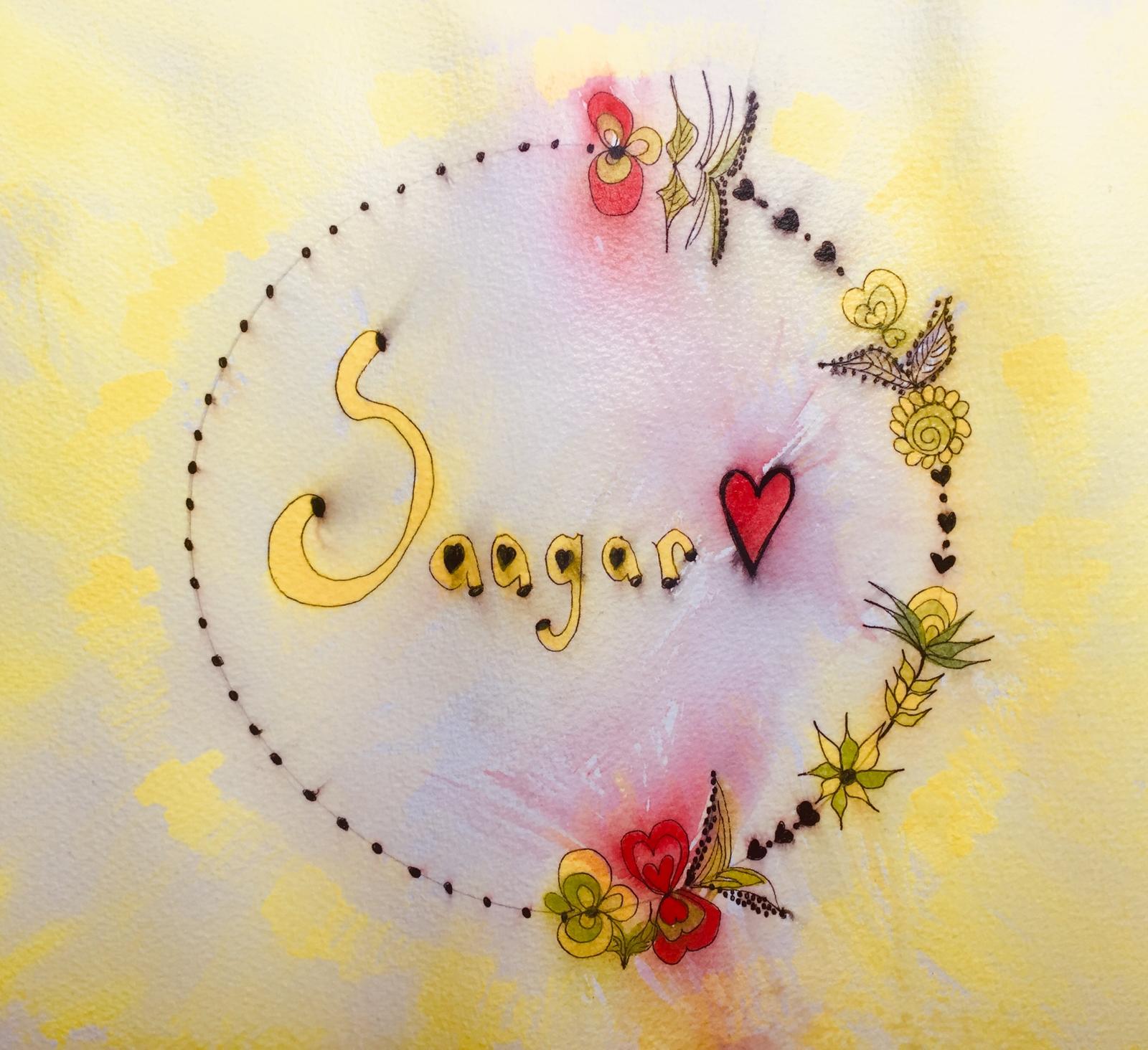
S A A G A R.

In Delhi, it was simple and sweet.
In Belfast, it was a problem. It had to be spoken out slowly with exaggerated lip movements and spelt out clearly. Still, it was uttered in all kinds of ways – Segaar, Sega, Saaga, Sags, Sagsy-wagsy. “As long as you call him with love, you can say his name in any way.” I would say with a smile. But of course, it was his name. Not mine.

At the age of seven, one day he came home from school and said, “Can’t you change my name to Aran or something?” I felt for him but laughed. What else could I do? I asked him if something happened at school that day, if someone said something hurtful and he just picked up his soft stuffed grey elephant and cuddled it.

I told him the story of his name. I was 24 when I got married. My in-laws lived In Chennai. We visited them a few months after the wedding and one evening we all visited a place called Besant Nagar beach. That was the first time my eyes fell upon the expansive ocean. On the map this water body had the boring label, Bay of Bengal. The vision of a dark blue shimmer below meeting a pale blue glow above in a clean, delicate, straight line made everything else disappear. Its calm, its rhythm, its enormity, its subtle dance, its grace and openness pulled me in. All conversation faded away and there I was, completely soaked in the bliss of the ocean. My soul soothed. My body relaxed. My eyes quenched. My heart happy. I was in love. In that moment, I knew that if we ever had a son, he would be called, ‘Ocean’: Saagar. I reminded him that his name was Saagar because his heart was as expansive and as beautiful as the ocean. He smiled and wrapped his soft cuddly arms around my neck.

As he grew older, he came to own his name. He came to live it. The waters of this ocean ran deep. On the surface, it appeared playful but strong currents ran underneath. All I saw was the steady flow of gentle waves, rhythmically lapping against the shore, through all the seasons. It oscillated with the moon but the high tide was never too high and the low tide was never too low, until many years later it was.

In October 2000 we went shopping to the Abbey Centre, around Halloween. Saagar was six years old. He loved riding the miniature cars left dancing on thick metal springs atop short sturdy plinths, strategically placed outside women’s clothes stores. I planted him in a blue car, instructed him not to move and stepped into the shop for no more than a few seconds to take a closer look at a long black dress in the window. I felt the texture of the fabric between my right thumb and forefinger, looked at the label for the price and size and rushed back out of the store. He was not to be seen.
Just like that, we lost each other. He must be so scared. I was petrified! Gosh. The stories you hear… No. No. He’s got to be nearby. ‘Saagar! Saagar!’, I called out, trying not to yell, desperately hiding my panic, my eyes hunting, hurting from the assault of his sudden disappearance from the blue mini-car.
What felt like absolute eternity must’ve been no more than five minutes. An announcement sang out of the PA system. He was walking down the corridor accompanied by a big uniformed man. My son, in his blue jeans and dark blue jacket ran into my arms. Phew! I cried with relief. Thank God!!! I got down on my knees and held him tight. All colour had left his face. His eyes were wide and blank. “It’s okay beta. It’s okay. We’re fine.”
Later that day we went out to collect pine cones from the thick green grass underneath the trees within the premises of Whiteabbey Hospital. I wanted to nest with my baby. I wanted to keep him close to me in small, cozy places where he wouldn’t get out of my sight and I, out of his. We collected forty pine cones in a basket. We talking. The cones half-filled a wide spherical glass jar which took a place of pride in all of our many homes. It followed us everywhere as a reminder of the day we made the promise to never ever lose each other again.

Vincent and James.

2017 – 16. Male. RIP.

2024 – 19. Male. RIP.

Brothers. Second generation Chinese immigrants in USA. Their mother, a writer who lost both of them to suicide.

Where Reasons End (2019) by Yiyun Li, after Vincent’s death.

I read this book when it was first published. An imagined conversation between her and her older son, Vincent who lived ‘feelingly’. Sixteen chapters, one for each year of his life. It has a witty and mischievous tone. Nicholai, a name he gave himself, chides his mother’s new embrace of cliches and adjectives. “If you’re protesting by becoming a bad writer, I would say it’s highly unnecessary,” he says. (“Dying is highly unnecessary too,” she shoots back.)

Things In Nature Merely Grow – Pulitzer Prize Finalist 2025, by Yiyun Li, a memoir. She wrote it within two months of her younger son, James’ death. I feel deeply for her and with her but I am not sure I want to read that book right now. A few lines from it sing true:

“I am in an abyss. If an abyss is where I shall be for the rest of my life, the abyss is my habitat.”

“My children were not my burden. My sadness is not my burden.”

“I am very realistic in that I would always acknowledge that I am limited as their mother. I was limited, and I am still limited as a mother, so I can only do my best.”

When people hold an expectation that her grief must have an end date, she retorts, “How lonely the dead would feel, if the living were to stand up from death’s shadow, clap their hands, dust their pants, and say to themselves and to the world, I am done with my grieving; from this point on its life as usual, business as usual.”

“This is a very sad fact of our lives, they took their own lives knowing we would accept and respect their decision.”

Could I accept and respect Saagar’s decision one hundred percent? I believe it was not his decision. It was his utter helplessness and desperation in the face of his illness, his unsuitable antidepressants, lack of medical care, his isolation, his inability to recommence his education, our inability to talk about it and so much more. He was driven to it. It was not by choice. Anyone who knew him, knows that. I do understand though.

I understand, my darling.

References:

https://www.theguardian.com/books/2019/feb/05/where-reasons-end-yiyun-li-review#

https://www.theguardian.com/books/2025/may/17/author-yiyun-li-on-the-suicide-of-both-her-sons