Day 995

A Path by the River

path-along-a-river-sergey-sergpinsky

(A path by the river: A commentary on modern spiritual search by D. Patrick Miller)

“As a journalist and reviewer in the field of contemporary spirituality I receive an almost daily deluge of books and other media that promise me accelerated enlightenment, total wellness, and sure-fire, karmically sanitised methods to achieve personal wealth and power. If even a fraction of these spiritual nostrums delivered the goods, my life would be a series of ever-brightening explosions of greater consciousness, finally culminating in the full flowering of affluent guruhood. That seems to be the American way of spiritual evolution these days.

Yet my spiritual life has never felt like a fireworks display of enlightenment-bursts building to a grand finale. When I picture it, my spiritual life looks like something completely different.

Imagine that you’ve spent years building a house to shelter you from the inevitable storms, deep freezes, and hot spells of life. The house is far from perfect; in fact most of the rooms seem to need remodeling as soon as they’re finished. But at least you’ve got a home of your own. Call this home the ego, or your normal sense of self, arduously constructed from the raw materials of the psyche following a haphazard blueprint based on your personal beliefs and experiences, your likes and dislikes, your hopes and dreams.

One day you’re sitting comfortably in the living room of your ego- home and the floor suddenly drops out to reveal a rushing river where you thought you had laid a firm foundation. Hanging on for dear life to a shuddering wall mantel, you realize that the house crashing down around you has become a mortal danger, likely to

snuff you out at any moment with a flying shard of window glass or a tumbling timber. Your only hope of survival is to let go of your familiar home, drop into the river and literally “go with the flow.”

This river is the onrushing life of the soul, which cannot be long hidden or confined even in the most spacious of homes built by the ego. Falling into the inner life of the soul is commonly called a spiritual awakening, and is usually precipitated by a profound crisis that shakes apart our usual self-serving foundations, the conventional ethos of “looking out for No. 1.”

But few of us can swim for long in the soul’s turbulent waters. Sooner or later you manage to struggle to the bank of the river and pull yourself onto solid ground, gasping for breath and wondering how you’ll survive in a strange new territory. After a while you may notice that the scenery ain’t bad from this new vantage point. You get to thinking that this might be just the place to build a new, finer house than before, in sight of the magnificent river but wisely removed by a few hundred yards. Who knows – you might even start a school here to teach river-rafting.

If you do stop here to rebuild a home for your ego, it will simply never occur to you that rivers tend to flood every now and then.

If you’re not focused on rebuilding a shelter immediately, you may notice that a footpath runs by the river where you dragged yourself onshore. In one direction the path will lead to the river’s source; in the other direction, to its destination. Without knowing how you know, you realize that the source and the destination of this river are the same, and it doesn’t really matter which way you head. And so you start walking. As the days stretch into months and then years, you learn to live a life in the wild following the river.

Sometimes the going is rough; you get lost in the underbrush, losing sight of the river and discovering that you’ve walked in circles just to get back to where you were days before. Sometimes the path turns muddy and steep, and you fall back two steps for every three you climb. Sometimes you slide into the river and get swept away again for a while. All these trials are part of the spiritual journey toward selflessness, the placeless destination that you started heading for the moment you fell out of the house of ego.

If you’re handy you may learn how to build yourself a canoe out of tree bark. But after a few days of coasting along the soul’s river – justifiably proud of your ingenuity and your determination to get ahead spiritually – you realize that it’s not really the speed of this journey that matters.

What matters is the seriousness with which you are following the route of the river. If you’re really serious, you’ll find yourself laughing pretty often at how ludicrous your situation is. Because regardless of your station in life in the everyday visible world – and no matter what anyone else thinks of you, whether they call you genius, guru, or fool – you know that you are truly an inward, homeless wanderer following a river without end for no reason you can practically explain. On this journey you’ll certainly never get ahead of anyone!

This is how I picture my spiritual life nowadays – stumbling uncertainly along a rocky path somewhere between the devil and the deep blue sea, pausing occasionally for attacks of helpless hilarity. Despite the wild rigours of following my path by the river, I don’t miss that old house I once built. When I think back, I remember how alone I usually felt within its walls. Sitting out by the river and watching its complex, ceaseless flow, I know that I am flowing there too, my soul inseparably mixed with all the souls who create the water of life.”

Day 994

Stop carefully

“I felt like I had been run over by a bus,” says James Moore, a mental health campaigner. When he tried to stop taking his antidepressant, Mirtazapine, he got severe dizziness, headaches and nausea.
Around 1 in 10 people in the UK are on antidepressants. Many find them helpful and even life-saving. Some struggle to stop taking them when they are ready as they experience severe withdrawal symptoms along with panic attacks and memory problems.
Cinderella Therapeutics, a Dutch charity helps people safely come off a range of 24 different medications.  It creates personalised tapering kits with precisely weighed out tablets that gradually reduce in strength over several months. Since 2014, the project has distributed around 2000 such kits, mostly within the Netherlands as the kits are legal there. The site only sends kits to those with a doctor’s prescription and recommends people use the kits under medical supervision.
Severe withdrawal symptoms are managed by some doctors in the UK by prescribing liquid formulations of their specific medicine which can be measured out in small amounts. Liquid medications are often more expensive, so GPs are reluctant to prescribe them. Switching to Prozac is the other option suggested by some but that does not work for everyone.


Day 991

Light and day and night.

nihms2913f1

The longest day of the year is behind us.

It’s well known that lack of sunlight has an adverse effect on our brains. It might stop a part of the brain called the hypothalamus from working properly:

  • Production of melatonin – Melatonin is a hormone that makes us feel sleepy. The hypothalamus may produce it in higher than normal levels.
  • Production of serotonin – Serotonin is a hormone that affects our mood, appetite and sleep. Lack of sunlight may lead to lower serotonin levels, which is linked to feelings of depression.
  • Body’s internal clock (circadian rhythm) – Our body uses sunlight to time various important functions such as the time we wake up. So, lower light levels may disrupt our body clock, mood and alertness.

A recent study by Klaus Martiny of the Psychiatric Centre in Copenhagen shows that people being treated for severe depression were discharged almost twice as quickly if their rooms faced south-west in comparison to those whose rooms had a north-west orientation. Depending on time of the year, the intensity of daylight in the south-west rooms was 17-20 times brighter. The results support findings in previous studies of the importance of architectural orientation providing natural daylight as a factor for improvement. “We don’t know the precise mechanism, but I think it’s to do with exposure to the morning light, which advances and stabilises their sleep-wake cycle,” says Martiny.

Light acts as a powerful reset switch, keeping the clocks in our brain synced with the outside world. This clock can weaken as part of ageing, Parkinson’s disease, strokes and depression. To tackle this problem several hospitals are installing dynamic ‘solid state’ lighting which changes like daylight over the course of the day : whitish-blue in the morning, growing warmer and dimmer through the day and turning orange or switching off at night.

Light can be a drug.


Day 989

Accidental findings

The_ACE_Pyramid

In the mid 80s, Dr Vincent Felitti ran an Obesity clinic in America. Many people enrolled and hundreds of pounds were shed by them. But he found that the drop-out rate from his programme was as high as 50% despite good results. He did not understand this and went back to look closely at patient notes.

“I had assumed that people who were 400, 500, 600 pounds would be getting heavier and heavier year after year. In two thousand people, I did not see it once. When they gained weight, it was abrupt and then they stabilized. If they lost weight, they regained all of it or more over a very short time.”

The turning point in Felitti’s quest came by accident. He was running through yet another series of questions with yet another obesity program. How much did you weigh when you were born…when you were in first grade…when you were in high school…when you first became sexually active…

One female patient replied – “Forty pounds” and broke down in floods of tears, “I was four years old.” He found similar common themes emerging from various stories and went on researching this subject for the next 25 years.

The obese people that Felitti was interviewing were 100, 200, 300, 400 overweight, but they didn’t see their weight as a problem. To them, eating was a fix, a solution like IV drug user calls a dose a “fix”.

Eating made them feel better. Eating soothed their anxiety, fear, anger or depression – it worked like alcohol or tobacco or methamphetamines. Not eating increased their anxiety, depression, and fear to levels that were intolerable. For many people, just being obese solved a problem. In the case of the woman who’d been raped, she felt as if she were invisible to men.

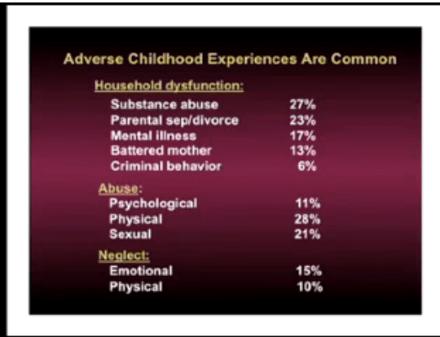
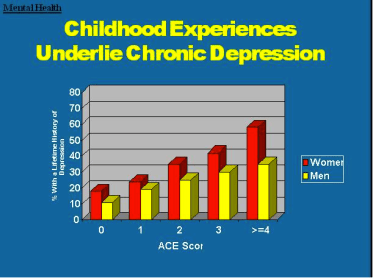
Felitti went on to further explore the  impact of childhood trauma on people and coined the term – ACE, Adverse Chilhood Experience. He found a strong co-relation between the number of ACEs and early death.

aceslist

acedepression

Film: https://www.youtube.com/watch?v=v3A_HexLxDY


Day 988

Transition is the cliff edge.

IMG_0591

Alas, poor Yorick…

Eighteenth birthday! Yay! No more a child. You are mentally, emotionally, socially, spiritually and physiologically an adult. That’s it. Over to Adult services now. Easy.  The number ‘18’ is completely arbitrary. It is designed for the convenience of the service providers, not in the best interest of children. There is a strong case being made now for raising the ‘transition’ age to 25 and rightly so. The recent publication “State of Child Health 2017” has recognised that the transition from Paediatric to Adult services is poorly organised and unsafe for mental and physical health conditions.

This is how one of the parents felt: “In my experience the teams did not work together. They each did their separate thing. When Rebecca left school, she was left with without regular support or advice. When she turned 18 we just stopped receiving information. Emails and phone calls didn’t get answered.”

Chronic conditions such as Epilepsy, Asthma, Diabetes, Juvenile Arthritis and Childhood Obesity are often associated with significant mental health problems. The budget for kids was 6% of the Adult MH services until recently. The government promised an increase and guess what! It has gone up to 7% now. Hurrah! Considering that mental illness most often begins in adolescence and early intervention is of paramount importance, the allocation of funds is highly disproportionate.

Piet Jansen, Director of International Relations, Yes We Can Youth Clinics, Netherlands, commented:

‘There was a lot of talk at the CAMHS congress about the Green Paper, but in my view the only green thing that matters here are dollar bills (in this case pounds). Without sound financial and genuine political commitment, structural changes are not to happen.’

DC2K3UbXUAAai4p