Day 717

Sunday lunch at the start of autumn on a warm day of blue skies and a warm sun, sitting under a wise old carob tree with supported branches and multiple dried brown beans hanging from a wide umbrella of dark green leaves with friends and strangers making introductions followed by conversations, smiles and laughter, references to this and that, occupations, travels and hobbies, daughters and mothers, food and wine, so on and so forth …. as if straight out of a film set infused with a sweet subtle smell of eucalyptus.

All of it completely meaningless, empty, futile, feckless, inane and pointless. Words, words and more words! Exhausting! I had to get up and walk away with my i-pad and take pictures of something. Anything.

In 2 weeks time he will be dead. Around this time 2 years ago he was scoring max on his depression scores and he gave it in writing to his GP in the form of a PHQ-9 form but got no help. No escalation of care. No attention. No mention of ‘suicide’ to us and yet holding a firm belief that a safety plan was in place. Sent home with the suggestion, “It will get better. Give it time. Rome was not built in one day” and a piece of paper.
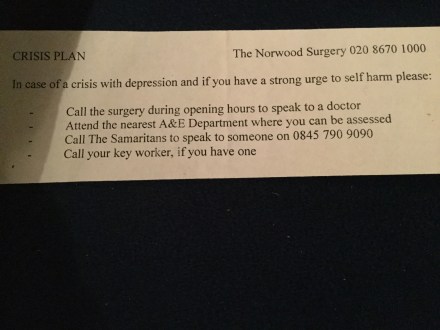
img_0279

It was early autumn then and it is early autumn now.
I lived in what I thought was our world then.
I live in a world of my own now. It sort of overlaps with this one in places but most of this one is irrelevant to me.

img_0270

Day 700

When our GP heard of Saagar’s death, the first phone call he made was to the Medical Defence Union and they advised him not to call us. Despite having known us for more than 7 years and seeing Saagar every 2 weeks with us for the last few months of his life, he did not call us on his death.

A qualitative study of GPs’ experiences of dealing with parents bereaved by suicide by Emily Foggin et al was published last month in the British Journal of General Practise.

It acknowledged that bereavement by suicide is a risk factor for suicide but the needs of those bereaved by suicide have not been addressed and little is known about how GPs support these patients, and how they deal with this aspect of their work. 13 GPs in the UK were interviewed in a semi-structured format. It explored experiences of dealing with suicide and bereavement.

GPs disclosed low confidence in dealing with suicide and an unpreparedness to face parents bereaved by suicide. Some GPs described guilt surrounding the suicide, and a reluctance to initiate contact with the bereaved parents. GPs talked of their duty to care for the bereaved patients, but admitted difficulties in knowing what to do, particularly in the perceived absence of other services. GPs reflected on the impact of the suicide on themselves and described a lack of support or supervision.

It concluded that GPs need to feel confident and competent to support parents bereaved by suicide. Although this may be facilitated through training initiatives, and accessible services to refer parents to, GPs also require formal support and supervision, particularly around significant events such as suicide. Results from this qualitative study have informed the development of evidence-based suicide bereavement training for health professionals.

Ref : http://bjgp.org/content/early/2016/08/15/bjgp16X686605

This evening a vigil was held by SOBS (Survivors Of Bereavement by Suicide) at Hyde Park to remember those lost through suicide. Some of the people there had lost a brother 25 years ago or a sister 5 years ago or a friend 1 year ago and so on. Some of the families had not been able to speak about it for many years. Others had kept quiet as they were not sure if anyone would understand. But in that space, we sat together on the brownish-green grass with the pictures of our loved ones and lit candles in their memory and we opened our hearts. For about 2 hours we claimed that space and made it our own knowing full well that we are being listened to and perfectly well understood. What a rare gift that is!

When it comes to suicide, post-vention is pre-vention.


Day 681

About 5 months after Saagar’s passing, one of my close friends sent me a subtle message suggesting that I should be careful about what I write in my blog as a few of my work colleagues read it regularly and if I appear to be too fragile or vulnerable, it might have a negative impact on my professional life. I understood her concern. The medical profession is not known for its understanding and compassion for mental frailty in colleagues.

Dr Wendy Potts was a GP in Derbyshire who blogged about living with Bipolar Disorder on a regular basis. One of her patients read the blog and complained to her Practise. The doctor was suspended. A few weeks later she ended her own life.

Firstly, I don’t understand the basis of the complaint. Would patients complain if their GP had diabetes or cancer?

Secondly, I don’t understand the basis for suspension from work. If the doctor’s performance was not questionable, then there is no ground for that.

Ref : https://www.theguardian.com/uk-news/2016/aug/26/gp-found-dead-after-being-suspended-over-bipolar-disorder-blog?cmp=oth_b-aplnews_d-2

This is one of many examples of poor treatment of medical colleagues with mental health issues. I think we are a long way from seeing parity between physical and mental illnesses as the ones who are supposed to put that into practise are themselves caught in the stigma associated with mental illness.

(PS: apologies for not being able to insert the link to the article in a better way. The ‘link’ icon on my page doesn’t seem to work anymore. Any ideas? )


Day 657

When someone becomes depressed, many of their activities function as avoidance and escape from aversive thoughts, feelings or situations. Depression therefore occurs when a person develops a narrow range of passive behaviours. As a result, someone with depression engages less frequently in pleasant or satisfying activities and obtains less positive reinforcement than someone without depression.

40 years ago the first behavioural treatment for depression was described by Lewinsohn et al. Many successful trials were done which somehow got forgotten with the advent on CBT in the 1980s.

Behavioural Activation (BA) focuses on activity scheduling to encourage patients to approach activities that they are avoiding. It focuses on encouraging people to take part in meaningful activities that are linked to their core values. It helps people find out which activities make them feel better. Patients are also taught how to analyse the unintended consequences of their ways of responding, including inactivity and rumination.

A recent paper published in the Lancet by Richards et al at University of Exeter studied 440 people with depression. They were randomised into 2 groups – one received BA and the other received CBT. They found that BA, a simpler psychological treatment than CBT, can be delivered by junior mental health workers with less intensive and costly training, with no lesser effect than CBT. Hence, effective psychological therapy for depression can be delivered without the need for costly and highly trained professionals.

Professor David Richards says:

“Effectively treating depression at low cost is a global priority.
Our finding is the most robust evidence yet that Behavioural Activation is just as effective as CBT, meaning an effective workforce could be trained much more easily and cheaply without any compromise on the high level of quality.
This is an exciting prospect for reducing waiting times and improving access to high-quality depression therapy worldwide, and offers hope for countries who are currently struggling with the impact of depression on the health of their peoples and economies.”

UK is one of those countries.

Day 648

Patient safety skills in primary care, a national survey of GP educators by Ahmed et al was published in 2014. This study aimed to determine the views of General Practice Educators regarding the qualities and attributes of a safe General Practitioner (GP) and the perceived trainability of these ‘safety skills’ and to compare selected results with those generated by a previous study of hospital doctors. This graph represents the perceived importance of safety skills:

12875_2014_Article_206_Fig2_HTML

It is interesting that 6 to 7 out of ten GP educators thought ‘leadership’ qualities to be unimportant or inconsequential. Being a good doctor means more than simply being a good clinician. Every day, doctors provide leadership to their colleagues, and vision for the organisations in which they work and to the profession as a whole.

The definition of leadership has undergone an evolution in recent years. We recognise that some doctors are formal leaders who are accountable for the performance of their team, department or organisation. However some confusion exists between the terms ‘leadership’ and ‘management’.

Hospital doctors often have clearly defined leadership roles as part of clinical teams at the frontline and also as part of clinical directorates at managerial level. This may make leadership in respect to safety a more recognised construct within secondary care.

Important but subtle differences exist between what primary care and secondary care doctors perceive as core safety attributes. As the burden of avoidable harm becomes better understood in primary care, such safety skills training will ensure that current and future GPs possess the necessary competencies to engage in efforts to enhance the safety of healthcare.