Day 565

What people do may be a better marker of depression than how people say they are feeling. Behavior can be objectively measured using mobile phones. It is an active sensing and prediction platform to identify behavior changes when individuals suffer from common colds, influenza, fever, stress and depression.

Studies have found a strong relationship between location (using GPS) and clinical PHQ-9 scores. The daily pattern, variability and extent of communications can also be analysed to give valuable clues to changing trends in activity. It is possible to monitor depression passively using phone sensor data. This has significant public health implications. Most people are unwilling to answer questions repeatedly over long periods of time, while passive monitoring could improve the management of depression in populations, allowing at risk patients to be treated more quickly as symptoms emerge or monitoring patients’ responses during treatment.

The efficacy of smartphone sensors and self reporting for mental health care has not been proven yet and remains a very important research question in the pervasive health community.

2 billion people already carry their smartphone with them most of the time. Even the cheaper models have sensors that can track movement and activity, generating data to provide insights into our wellbeing.

StayClose is a free family care app, powered by Touchkin’s predictive care platform. The app helps families care for loved ones while being afar by enabling them to know how they are, without having to ask. They can also share a touch or video moment, or do something to help, like send a ride to take them to the doctor.

For example, when a person is depressed, their phone is likely to show more time spent at home, unusually low activity, changes in communication or sleep patterns. It is possible for a machine learning engine to learn anyone’s phone’s normal sensor patterns and generate alerts if unusual activity indicates any health issues.

I look forward to collaborating with Touchkin for a few pilot studies in London.


Day 534

Professor Guy Goodwin, the main author of the third and latest revision of the BAP Bipolar Guidelines said in his e-mail accompanying the publication:

“The third revision of the British Association of Psychopharmacology (BAP) Bipolar guideline is now available. It is substantially revised from last time to reflect changes in the available evidence, obviously, but also a changing perspective on how to weigh the evidence. It is intended to provide a counterbalance to the NICE document of 2014 which in places shows partiality (to psychological treatments) and a lack of common sense. The authors hope that the BAP revision will be useful in guiding and improving treatment of what remains a curiously neglected disorder.

 09c48df2-1880-4795-a043-562daa8a726a

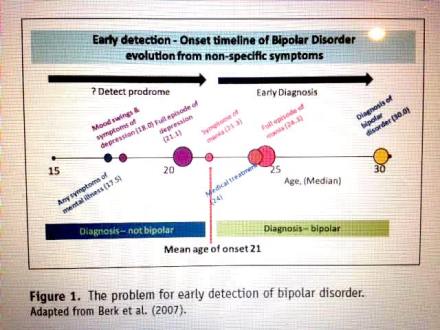
The BAP Guidelines for Bipolar Disorder is a 59 page document. The above picture is on page 20. It is a clear depiction of the evolution of the disease and elicits a ‘full episode of depression’ at the age of 20 years and a few months which was exactly the age Saagar was when he had the full episode of depression – 20 years, 5 months and 10 days. Yet he was discharged to the GP without highlighting the possibility of this happening and all the doors to access specialist services were closed behind him.

On page 23, it goes on to say – “Premature discharge to primary care can further dilute the treatment package available in the early stages of managing the illness.”

He was discharged by the Psychiatrist to the GP after 20 days of having made the diagnosis of Bipolar Disorder.

What more can I say? Poor kid!


Day 530

Self-harm. What can we do?

Well, the most important thing is to keep one’s prejudices aside. It is also the most difficult. Ask them how they feel and listen with empathy.

Put no blame on them so they don’t feel guilty about it. Respond as calmly as you can and try not to appear shocked or angry. Don’t be dismissive. Self-harm could be an important warning sign.
Perform first aid and accompany the person to A&E or the GP as appropriate.
Ask directly about suicidal thoughts.
If they share thoughts of suicide, continue listening and ask open-ended questions.
Stay with them.
Reassure them.
Tell them about the treatments and support available such as school nurses and CAMHS for the young and clinical psychologists, psychiatrists and counsellors in general.

Introduce them to ways in which they can help themselves: relevant books and websites; keeping a mood diary to monitor thoughts and feelings; regular exercise and healthy eating; reducing caffeine; getting support from friends and family; identifying enjoyable activities and finding ways of spending time doing those; identifying local support groups and addressing underlying mental health problems.

Saagar’s discharge letter from psychiatric services said – “No history of self harm.” They were wrong. On questioning they said that it was because he had never presented to A&E having harmed himself. But that is not a criterion. I don’t know if he was ever specifically asked about it or whether he misled them. He had prominent burn marks on his left forearm that could easily be picked up by trained eyes. When I asked him about it he made up a story to assuage my worries and made nothing of it.

I didn’t pick up the seriousness of it and sadly, we never spoke about it.

Day 522

imgres

Andrew Kirkman was the same age as Saagar. He was a second year physics and philosophy student at Oxford. He ended his life in December 2013. Earlier that week he had seen the college doctor who had prescribed antidepressants for him. His parents had no knowledge of his illness.

Andrew’s mother, Wendy Kirkman has been actively campaigning for a directive that makes it possible for university doctors to inform parents of their children’s mental illness if they are at all concerned. She hopes this would save the lives of other students. “People seem to be frozen into inaction by the fear of disclosing information to the parents of students who are over 18, when they have always had the legal right and perhaps obligation to do so anyway.”

Dr Geoff Payne has issued new guidelines advising university doctors to contact parents if concerned for a students’ mental health.

The argument against this guideline is that merely telling the parents doesn’t fix the problem. That is true. However parents can provide additional support. Close monitoring of such cases and intensive talking therapies also have a very important role. Non-disclosure by itself is not a problem but it does translate to further lack of support in a system that has long waiting lists and inadequate capacity to provide optimal care for patients in need.

The other argument against it is student’s right to privacy.
Can the right to privacy be more important than the right to life?

Day 506

imgres

Last week I attended an appointment at the new GP surgery with our (new) GP for my annual review of Rheumatoid Arthritis. It was more like the doctor had a consultation with the computer. He looked at the blood results, the prescriptions and notes. He measured my weight and blood pressure but he didn’t ask me anything about the condition I was there for. How are the joints doing? How long have I been in remission? He probably knows as do I that we might never see each other again. He is not ‘my’ GP. He works at the GP surgery where I am registered. I suppose he did what he could in the 10 minutes he was given. The achievement of the day was that I got the prescription of medications.

Last week I met a young man who has recently lost a parent to suicide. He went to his GP asking for help and was instantly offered antidepressant medication. He was dismayed as he knew that is not what he needed. He needed someone to talk to. “People in the UK are consuming more than four times as many antidepressants as they did two decades ago. Despite this, we still do not fully understand the effects of these drugs” says an expert from UCL.

The UK has the seventh highest prescribing rate for antidepressants in the Western world, with about four million Britons taking them each year — twice as many as a decade ago.

According to the analysis conducted by Nordic Cochrane Centre in Copenhagen, the clinical study reports on which decisions about market authorization of these medicines are based often underestimate the extent of drug related harms.”

Four deaths were misreported by one unnamed pharmaceutical company which claimed they had occurred after the trials had stopped. One patient strangled himself after taking venlafaxine but because he survived for five days, he was excluded from the results because it was claimed he was no longer on the trial while he was dying in hospital.

More than half of the suicide attempts and suicidal thoughts had been misrecorded as emotional instability or worsening of depression. In summary trial reports from the drugs giant Eli Lilly, suicidal attempts were missing in 90 per cent of cases. It appears that big pharmaceutical companies reap profits while carelessly tossing aside all human costs and ominously covering them up.