Two overlapping worlds.

The Bhagavad Geeta addresses the ethical and moral dilemmas around the questions of who we are, how we should live our lives and act in this world. If this voluminous text was to be summarised in two sentences, they would be:

  1. Do what needs to be done, knowing that all actions come from God.
  2. Do not be attached to the results of your actions.

Six weeks ago, I re-entered the world of Suicide Prevention due to a presentation I agreed to make. It took me back to a familiar battleground where strong currents of injustice flowed through me. I went over our story yet again, in mind and body. It burnt me up. It made me restless and irritable. It kept me staring at the ceiling at night. It brought back the shit of guilt in big droppings. It was silly of me to agree to do it, but it was too late already. I wrote it down, prepared a set of PowerPoint slides to support the story.  I repeated it for the nth time to many. I wondered, to what end, but I did it anyway.

Four and a half years ago, when my road gradually swerved from the Suicide Prevention world towards peer support with other parents, it was like a cool breeze gently blowing in my face. That conversation felt like a proper invitation. Instinctively I knew it was good for me. Despite huge self-doubt, I trusted that path. I went with it. This work was also about preventing isolation and possibly suicide amongst parents, as our risk is 60-70% higher than others. It did not feel like work at all. We formed strong bonds of friendship. We shared deeply and held each other in understanding and compassion. This felt like home.  

The organisers at National Confidential Inquiry into Suicide and Safety in Mental Health provided me the best possible support to be able to present my thoughts. The comments on the chat were that of gratitude and inspiration to change. One person said that it was better than any training course they had attended. I am glad that I did what was needed. The strength to do it came from somewhere. Now, it can do its work and I can go back home.

The recording is here (‘Bridging the gaps’ starts 6 minutes and 45 seconds in).

Random stuff

After many years, things are being taken out of cup-boards and off shelves, turned inside out and properly looked at. Dusty books, clothes, folders, boxes and sachets. Some familiar fragrances are escaping and some old scenes are playing out on the screen of the mind. Bits of stuff slipping out of other stuff and falling to the ground with a clink. Some stuff that was believed to be misplaced is being placed. Some that was believed to be forgotten is being revisited.

Sample 1

A nappy pin. Special feature – A white safety cap to prevent accidental opening up while the baby has his cloth nappy on. Commonly used in India and other developing countries. Original owner: Baby Saagar.

Sample 2

A business card. Special feature – Simplicity. An invitation to music and joy. Original owner: Saagar.

Sample 3

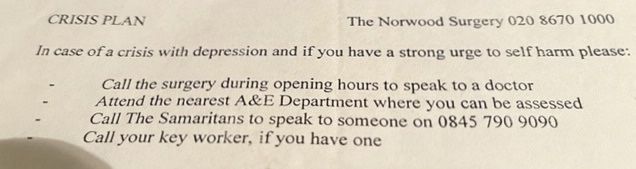
A Crisis Plan. Special features – Not worth two pennies. Highly ineffective. Not accompanied by a conversation. No detail. Not individualised. Not created in partnership with the patient. Not an alive document. Does not mention anything more than ‘self-harm’. Doesn’t tell us what ‘Crisis’ looks like. Doesn’t identify any helpful distractions, activities, friends or family. Doesn’t appear to know the patient, for example, a key fact – does this person have a key worker? Does not express any understanding or compassion.

Commonly used in developed countries.

Oops! The name of the GP surgery is visible. It doesn’t matter. It closed down years ago. We were it’s last few unlucky patients. Owner: Saagar Naresh (1994-2014).

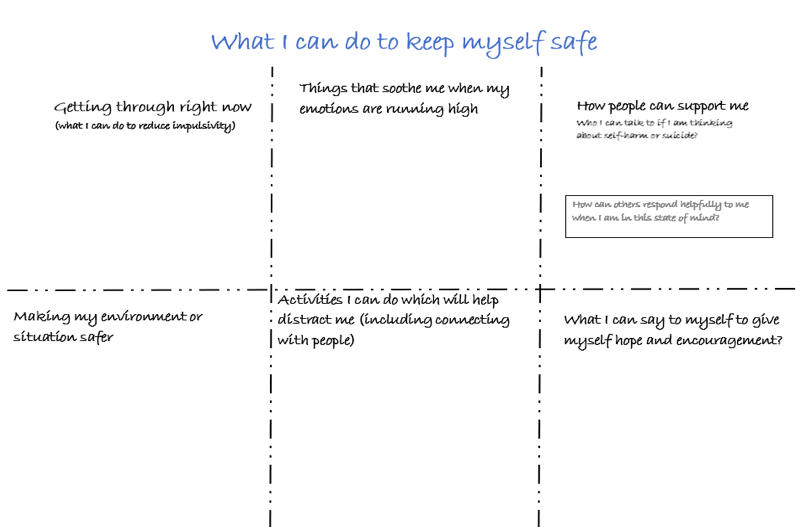
(Resource: Safety Planning is essential to safety: https://stayingsafe.net/home)

CHIME

132 billion pounds = money saved for the UK by unpaid carers.

6.5 million = number of carers in the UK.

6000 = number of people who become carers every day.

1 in 8 adults are unpaid carers for a family member or friend.

Carers UK call them ‘The Second NHS’.

Yet, do we or the Health Service truly value them? Listen to them? Include them? Give them a voice? Understand their concerns? Treat them as an ally? Respect their abilities and contributions? Answer their questions? Educate them? Empower them? Support them? Partner with them as well as we could? Sadly not.

In my experience and that of many other families of individuals with a mental illness, the power imbalance between the health care providers and the service users does not allow for an equitable relationship. Hence, denying the patient the best chances of recovery. There is national and local evidence that proves that carer engagement saves lives.

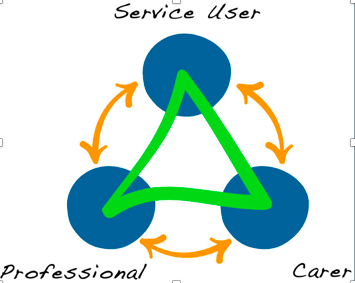
Triangulation of services is essential for best outcomes for patients and professionals. Risk averse practices may help reduce risk in the short term but may increase risk in the long term. A recovery approach to risk and development of a “life worth living” may have longer lasting benefits through rebuilding relationships, increasing service-users skills and confidence in collaboration with carers.

Norfolk and Suffolk Foundation Trust (NSFT) have developed a program called “Stepping Back Safely” up-skilling staff, carers and service-users. It is based on five main drivers of Recovery: CHIME

  • Connection
  • Hope
  • Identity
  • Meaning
  • Empowerment

NSFT are offering free training in Stepping back Safely in July 2021 on-line. Having heard many stories where a life could have been saved only if there was a meaningful and effective communication between the three parts of the Triangle of Care, I think this training is most relevant and essential. I shall be taking it as I am sure it will deepen my understanding of the subject. If you or anyone you know might like a point of contact, here it is: catherine.phillips@nsft.nhs.uk

Bad doctor!!!

Screen Shot 2018-01-28 at 21.23.13

Despite check-lists, protocols and guidelines, mistakes happen. As long as human beings carry out jobs, mistakes will happen. To err is human. Safety is an outcome of a person’s attitudes and actions within a given environment. Both, the person and the environment have a strong impact on each other and the outcomes. The bad mood of one person affects the whole team. Similarly, a stressful milieu for any reason such as lack of time and resources has a direct impact on the performance of each person in it.

In my 19 years in the NHS, the working conditions and morale amongst the staff have gradually worsened.  When things go wrong, clinicians, being visible on the frontline are expected and often willing to take responsibility. Holes in the system and staff morale are hidden. Only on a closer look are they clearly seen.

I sit in a unique position where I work for the same organisation that is at least partly, if not fully responsible for the fact that my son is not in this world any more. Yet, I know and see many doctors and nurses work way beyond their call of duty. However, our very own GMC took the case of a paediatric registrar, Dr Bawa-Garba to the High Court, supposedly in the best interest of the public. She had looked after 6 year old Jack Adcock before he tragically died of severe sepsis under her care. Her Counsel summerised:

“The events leading to [Dr Barwa-Garba’s] conviction did not take place in isolation, but rather in combination with failings of other staff, including the nurses and consultants working in the CAU that day, and in the context of multiple systemic failures which were identified in a Trust investigation.”

Yet, the high court convicted her of ‘manslaughter by gross negligence’.

A blog by concerned UK paediatric consultants stated that:

“On this day: Dr Bawa-Garba did the work or three doctors including her own duties all day and in the afternoon the work of four doctors.
On this day: Neither Dr Bawa-Garba (due to crash bleep) nor the consultant (due to rosta) were able to attend morning handover, familiarise themselves with departmental patient load and plan the day’s work.
On this day: Dr Bawa-Garba, a trainee paediatrician, who had not undergone Trust induction, was looking after six wards, spanning  4 floors, undertaking paediatric input to surgical wards 10 and 11, giving advice to midwives and taking GP calls.
On this day: Even when the computer system was back on line, the results alerting system did not flag up abnormal results.
On this day: A patient who had shown a degree of clinical and metabolic recovery due to Dr Bawa-Garba’s entirely appropriate treatment of oxygen, fluids and antibiotics was given a dangerous blood pressure lowering medication (enalapril) which may have  precipitated an arrest.”

The case has now been put to the Court of Appeal.

So, whose fault is it? No handover, no induction, no senior support, temporary nursing staff, poor IT services, shortage of doctors … whose fault is it? Obviously the doctor’s. Why this huge disparity in the way in which hospital doctors are treated as opposed to the others? It’s not ok for the sickest of patients to die in a hospital whereas fit and healthy young men and women are allowed to die in the community with not an eye-brow raised.

Parity of esteem? Bollocks!


Day 864

This is a well-known story within medical circles. A few years ago, a patient was in the operating theatre to have his diseased kidney taken out. Everyone believed it to be the left kidney, except a medical student who said in a hesitant, soft and muffled voice that he thought it was the right kidney. No one paid him any attention and went right ahead to take the left kidney out. It turned out, that was the wrong kidney. The only person who was correct was the medical student. The person who suffered the damage was the patient.

Large organisations are hierarchical by nature. Decisions taken by those on top are rarely questioned by juniors. But true leadership means, the ability to challenge the status quo. The culture of an organization is shaped by the worst behavior the leader is willing to tolerate.

During their selection process, Google particularly look out for ‘courage’ in candidates. They prefer to hire people who ask the right questions and are not afraid to be open if they disagree with what is being said, irrespective of who says it.

The only way to improve is to be open. That is how we learn.

When was the last time I kept quiet when in fact I had something to say? When was the last time I didn’t have the patience to listen? What are the dynamics at my work place? Who pays the price for my silence or my inability to listen? Will I have the courage to speak-up the next time? Will I have the courage to listen?

“It is not because things are difficult that we do not dare, it is because we do not dare that they are difficult.” – Seneca

Ref: Just a Routine Operation (A short film about the importance of Human factors , one of them being assertiveness) : https://www.youtube.com/watch?v=JzlvgtPIof4