Wrap-around?

“What can we do to offer wrap-around care to our patients?”

In the live Q&A at the end of the NCISH conference yesterday, this question was asked of the panel. The Chairperson directed it towards me. I can’t remember what I said. This morning I woke up with what I would have liked to say.

For wrapping, we need two things. One, the fabric which we are going to use to wrap and the person we want to wrap. Let’s discuss them one by one.

  1. The fabric

The fabric of Suicide prevention in Health-Care is made up of two things – people and systems. Let’s look at them a bit closely.

  1. People

What are the beliefs of the people?

I know of an ENT surgeon from another country who wanted to move to the UK and the only job he could find was in Psychiatry. So, he is now training to be a Psychiatrist. Is he interested in suicide prevention? Do Health-care professionals believe that suicides are preventable? Are they content that simply by treating mental illness they are doing their job?

What are the attitudes and abilities of the people?

When the Emergency department calls to say there is a suicidal individual waiting to be seen, how do they feel? Are they excited to have an opportunity to make a difference? Or is it a drain on the limited time and energy they have? Do they know how to build a compassionate connection with someone who has lost all hope? Have they received any training in Suicide Prevention? Do they have enough self-compassion to look after someone else well?

Do they have the resources and the knowledge to do a good job?

Do they have access to their past history? Do they have beds on the ward? Can they ask a colleague for a second opinion if they have a doubt about how to involve family or friends in their care? Do they know of other resources, like charities, activities and people that may help this person? Do they have comprehensive and informative leaflet they can share with them? Do they have the means to follow them up?

b. Systems

Does the system have capacity? Are the various parts of the system effective and joint-up enough to be able to hold the person they are trying to wrap or are there big holes in this part of the fabric? Do the various parts of the system share the same mental model, a shared knowledge, pre-suppositions, and beliefs that can be used to help achieve mutual goals? Are their practices evidence- based? Do they investigate deaths with a view to learn lessons and implement change? Do they look after the well-being and emotional health of their employees? Do they hold themselves accountable when things go wrong?

2. The person

Allowing space for them to express themselves. Help maintain their sense of agency. Inform them it is safer for them to involve other people who care for them. Equip them with resources. Give them the support they need. Ask them what would help them? Listen. Sit with their despair. Acknowledge it. Keep them connected with their life as they know it. Keep hope alive for them.

Know that the person at the centre of the wrapping is of great value.

Information is useful if it becomes knowledge. Knowledge is useful when it becomes wisdom. So, let us not stop at information.

Ref:

Reaching common ground: The role of shared mental models in patient safety : https://journals.sagepub.com/doi/full/10.1177/2516043518805326

Random stuff

After many years, things are being taken out of cup-boards and off shelves, turned inside out and properly looked at. Dusty books, clothes, folders, boxes and sachets. Some familiar fragrances are escaping and some old scenes are playing out on the screen of the mind. Bits of stuff slipping out of other stuff and falling to the ground with a clink. Some stuff that was believed to be misplaced is being placed. Some that was believed to be forgotten is being revisited.

Sample 1

A nappy pin. Special feature – A white safety cap to prevent accidental opening up while the baby has his cloth nappy on. Commonly used in India and other developing countries. Original owner: Baby Saagar.

Sample 2

A business card. Special feature – Simplicity. An invitation to music and joy. Original owner: Saagar.

Sample 3

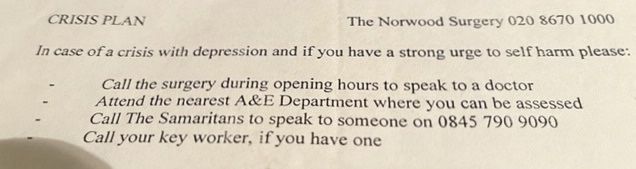
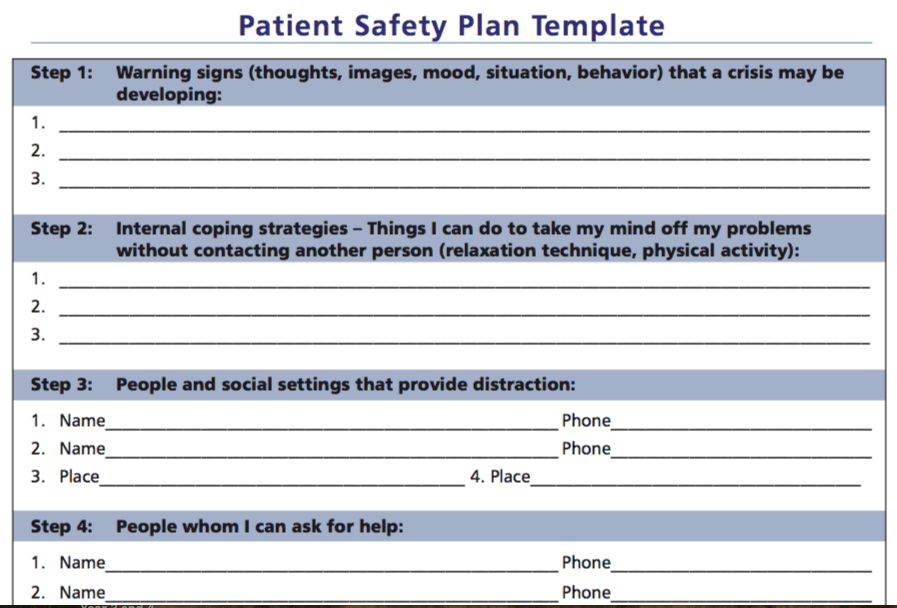
A Crisis Plan. Special features – Not worth two pennies. Highly ineffective. Not accompanied by a conversation. No detail. Not individualised. Not created in partnership with the patient. Not an alive document. Does not mention anything more than ‘self-harm’. Doesn’t tell us what ‘Crisis’ looks like. Doesn’t identify any helpful distractions, activities, friends or family. Doesn’t appear to know the patient, for example, a key fact – does this person have a key worker? Does not express any understanding or compassion.

Commonly used in developed countries.

Oops! The name of the GP surgery is visible. It doesn’t matter. It closed down years ago. We were it’s last few unlucky patients. Owner: Saagar Naresh (1994-2014).

(Resource: Safety Planning is essential to safety: https://stayingsafe.net/home)

Treatment versus Care

It was a clean, warm and open space with well-designed floral furniture in pastel blues and greens. It had plenty of natural light and pots of healthy looking plants thoughtfully dotted around the floor. The artwork on the walls was selected by someone who knew their stuff. It would be hard to guess that this was the entrance to the New Hampshire Hospital. which provides acute inpatient psychiatric services for all age groups.

As I was guided through the facility, I was enamoured by a lush beautiful big greenhouse, two well-stocked libraries, a massive gym for staff and patients, 3 cafés, an outdoor patio and play area for kids, a vegetable patch, a healthy colourful aquarium on wheels, loads of Halloween decorations all around, an art workshop and cooking class in progress, television screens, a chapel, a small shop, a pool table, a ping-pong table, lots of board games and cheerful group therapy, treatment and visitor’s rooms.

Each kid had a room to himself or herself with nice bed-linen of their choice. 2 adults often shared a room. The age groups were appropriately separated. The youngest patient there was 6 years old and the oldest a septuagenarian. The nurse’s station was not a demarcated area. It was part of the ward layout. Social workers, occupational therapists, doctors and nurses didn’t wear any uniforms. They were dressed in everyday clothes. Everyone spoke softly and the atmosphere was relaxed and caring.

The most impressive part of the service was the presence of an Aftercare Liaison officer. It is well known that patients are at the highest risk within 30 days of discharge from inpatient services or Emergency department. (Ref: Luxton, June and Comtois 2013) They concluded that repeated follow-up contacts appear to reduce suicidal behaviour.

Aside from following up on these patients, the Aftercare Liaison Officer has the following roles before the patient is discharged:

  1. Speaks, listens and connects to each child and adolescent patient. Educates them and their support system about warning signs of suicide, triggers, risk factors, protective factors and restriction of means of self-injury.
  2. Draws up a detailed Safety Plan with them and their carers.
  3. Helps them identify sources of social support (trusted adults) and develop personal resources through open conversations.
  4. Interface with other professional agencies (eg. for DBT) and community services that will help dilute their identity as a person diagnosed with a Mental Illness. For example, they match their interests to activities such as therapeutic horsemanship, a running group or a Mountain Teen Project.
  5. Engage their parents, families and friends and anyone they would like to involve.
  6. Use technology if possible – MY3App.

I don’t think we have this service in the UK. I know we don’t.

The one thing that is most important to me and worth living for is … to continually express my love for Saagar and help other parents do the same for their kids.

you is kind. you is smart. you is important.

images-1

My laptop claims to have at least 8 films on it but for some strange reason, on a train from Birmingham to London, it agreed to play just one, called, ‘The Help’. It’s about the writing of a book compiling the stories of African American maids working in white households in Jackson, Mississippi in the early 1960s. A book about an open ugly secret. About the courage of a few to start talking about it as a mark of protest. About the collective impact of small actions in bringing about big changes.

Yesterday was World Mental Health day and the UK became the first country in the world to announce a minister for Suicide Prevention. The day before yesterday, I learnt that Health Education England are very keen to put measures in place to prevent suicides within medical practitioners. Having been a part of the Suicide Prevention Community for the last 4 years, the one profession that is most conspicuous by its absence is Psychiatrists.

At 2 different meetings, I happened to meet 2 different Consultant Psychiatrists. On hearing Saagar’s story, one of them said he was very sorry but ‘this has been happening for 30 years’. I went blank. I just looked at him. I wonder what the public’s reaction would be if a surgeon would publicly admit that his surgical team has been making the same errors, that have been costing people their lives for 30 years. Yes. These are systemic errors. They are difficult to tackle. But, even today, youngsters like Saagar are dying because of lack of leadership within the specialty of Psychiatry, like they have been for the past 30 years.

The other, extremely prominent and respected Consultant Psychiatrist completely rubbished Mindfulness, Yoga and Meditation, without having tried any of them. He said that all these interventions have side effects. He believed that a Psychiatrist is only meant to attend to the most extreme cases. Their role comes into play only after these 5 have been called upon – parents, schools, GPs, CAMHS and Talking therapies. I am sure he knows that many youngsters die while on the waiting list, without ever getting to see a proper Psychiatrist, once. I am also sure he knows the side effects of psychiatric medications that are offered generously to all and sundry by non-psychiatrists. Lastly, I am sure he also knows how unsupported the GPs feel when faced with patients who are severely mentally unwell due to slow and inefficient response from the secondary services. And, I am sure it’s all down to poor funding. The same excuse that we’ve had for decades gone by and will have for decades to come. How about some imaginative leadership?

As parents, let’s start by saying to our kids in words and actions –
‘You is kind. You is smart. You is important.’
To me, I say – ‘I is kind. I is smart. I is important.’
You could too.

Day 886

Ministry-of-Justice1-678x381

“More people are being detained by police under the Mental Health Act as Psychiatric services struggle to cope” says Jacqui Wise in the cover story of the British Medical Journal of 18th March 2017.

Statistics tell us that deaths in custody are up by 21%.
Self-inflicted deaths are up by 13%.
In the female estate, the number has doubled from 4 to 8 in this 12 month period.
Self-harm incidents up by 26%.
Individuals self-harming up 23%
Assaults up by 34%.
Assaults on staff up 43%.
Natural cause deaths up 17%, explained by the ageing population.
5 apparent homicides, down from 7 in the same period of the previous year

Could there be a co-relation between the facts stated in the first and the second paragraph?

“The police to an extent have always been used as an emergency mental health service” says Michael Brown, a police inspector. He adds that police receive little formal training in managing patients with mental health problems. “A highly agitated person may be experiencing Serotonin Syndrome due to the mismanagement of their antidepressant medications. The signs are subtle and most police officers won’t be able to pick up on that. We need to have a proper debate about the role of the police in this area.”

Ref:

Safety in Custody Statistics 2016: https://www.gov.uk/government/uploads/system/uploads/attachment_data/file/562897/safety-in-custody-bulletin.pdf#page=6
Blog about Mental health and the Criminal Justice system:
https://mentalhealthcop.wordpress.com/
Serotonin Syndrome:
https://patient.info/doctor/serotonin-syndrome