Day 952

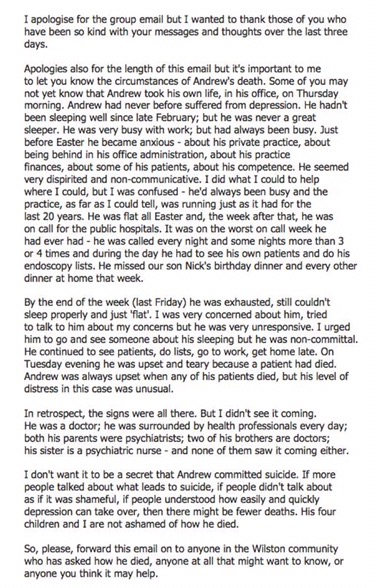
A surgeon’s wife writes

img_1418

The Dark side of Doctoring is an insightful blog written by a surgeon.
The common themes that push doctors into dark despair are:

1.Loss of control.
2. Loss of support. 6am. Repeat.
3. Loss of meaning.

One would think that those who look after other people would know how to look after themselves and their colleagues. Not so at all.

Thank you Dr Eric Levi.


Day 951

download

Who? The young. 

1 in 6 people is an adolescent. More than 3000 adolescents die every day from largely preventable causes, according to a new report from WHO and partners. That amounts to 1.2 million deaths per year.  Many key risk factors for future adult disease start or are consolidated in adolescence. Adolescent mental health and well-being are often overlooked.

In 2015, more than two-thirds of these deaths occurred in low- and middle-income countries in Africa and South-East Asia. Road traffic injuries, lower respiratory infections, and suicide are the biggest causes of death among adolescents.

Most of these deaths can be prevented with good health services, education and social support. But in many cases, adolescents who suffer from mental health disorders, substance use, or poor nutrition cannot obtain critical prevention and care services – either because the services do not exist, or because they do not know about them.

“Adolescents have been entirely absent from national health plans for decades,” says Dr Flavia Bustreo, Assistant Director-General, WHO. “Relatively small investments focused on adolescents now will not only result in healthy and empowered adults who thrive and contribute positively to their communities, but it will also result in healthier future generations, yielding enormous returns.”

Suicide and accidental death from self-harm were the third cause of adolescent mortality in 2015, resulting in an estimated 67 000 deaths. Self-harm largely occurs among older adolescents, and globally it is the second leading cause of death for older adolescent girls. It is the leading or second cause of adolescent death in Europe and South-East Asia.

“Improving the way health systems serve adolescents is just one part of improving their health,” says Dr Anthony Costello, Director, Child and Adolescent Health, WHO. “Parents, families, and communities are extremely important, as they have the greatest potential to positively influence adolescent behaviour and health.”

At long last, the world is waking up and so is the World Health Organisation.

Podcast:
In conversation with Meera S and Dr George at Business FM, Malaysia:

Doctor in the house: Adolescent Health

Day 948

Why Pinky?

My deepest thoughts are in Hindi. Only when I am in a hurry do I think in English. It’s my second language. A legacy of the Raj. Even though I have been using it for most of my personal and professional life, I need to constantly work at it. Being bilingual means one has 3 languages to have fun with – Hindi, English and Hinglish.

The English in the UK is different from the one I learnt as a child. That English was more a medium of education. As a teenager I started to enjoy it, especially through Tintins – billions of bilious blue blistering barnacles.

The usage of a language in its native country is very different from anywhere else. I had no idea what ‘Pinky’ was. For me it’s a person’s name, mostly a girl but could also be a boy. Little finger? Really? It would never have crossed my mind.

This notice in the loo on the train showed me the endearing way in which vernacular can be used : ‘Please don’t flush nappies, sanitary towels, gum, old phones, unpaid bills, junk mail, your ex’s sweater, hopes, dreams or goldfish down this toilet.’

‘Numpty’ is not quite the same as idiot. It has a particularly affectionate tone to it. Cute! Again, a new one for me. ‘Skulking’ is not as simple as loitering. It is, moving about shadily, with something to hide. It has a naughty/sinister connotation to it. ‘Four Weddings and a Funeral’ introduced it to me.

This evening I asked 2 English men their favourite word and both of them perfectly pronounced the same one:  Floccinaucinihilipilification.

Recently I was flattered to be asked to write an article for the charity Mind, about a simple coping mechanism that has helped me and can help anyone. I wrote about writing. This is how I grieve: Woes and Prose.


Day 947

Schools have counsellors. Kids can go to them to speak about their problems. The kids of counsellors don’t go to their own parents. They find someone else. What is the difference between a parent and a counsellor? Parents are judgemental. Counsellors are not judgemental.

Our neighbour’s kid comes to us when they are in trouble and we tell them, ”Nevermind. It’s ok. Let’s see what we can do now.” Do we say that to our own kids when they make a mistake? Parental default mode when in shock is – How could you do this? You can’t be my kid. You must have been swapped at the hospital and so on… We bail out all the rejection in the world to the most important person in our lives.

When one makes a mistake, what do they need at that moment? For instance, if someone slips and falls, they need support. Second thing they need is healing. Later on, softly one can say, “Careful next time. Tricky spot.”

If at the very time of the fall someone says to us,”Can’t you see? There are only two steps here and even those you can’t manage.” How are they going to feel? Is that what they need at that time? They are in severe physical or emotional pain,  they are unable to take any advice on board. All they need is love and support. When we don’t pay attention to our state of mind, the smallest of mistakes upset us. In that case, how can we handle bigger problems? In fact the bigger the mistake, the more love and support needs to be given but we do the opposite – bigger the mistake, more the shame and humiliation.

A child is tempted to try a cigarette when his friends were doing the same. Is it normal for their curiosity to get the better of them? Can we understand that? Can we remember the time when we were that age and felt that way in a similar situation? Can we say to them that we understand? That it’s the habit of smoking that’s wrong. They are not wrong. Can we make them feel ok about themselves and empower them to choose what’s best for them? If yes, they might trust us with the truth.

It is not our job to discipline people or control their behaviour. It is our job to empower them to think for themselves. That power comes if they feel understood and accepted. When we can say to our friend, spouse or child that they are right, then they might think that we are right. If they constantly feel rejected by us, they will reject us too.

(Yesterday’s and today’s posts are transcripts from a counsellor speaking to a group of parents in Hindi in India. Name unknown.)


Day 946

When they were little, they came and told us everything every day. They vied for our attention. We didn’t have to ask them anything. They went round and round us and wanted to tell us all about their friends, people they met, things they did, what they had at lunch time, who said what to whom and so on.

A few years later, we started going round and round them, asking – what did you do today? Who did you meet? How are your friends? What did you have at lunch time and so on… but we didn’t get much more than monosyllables in response. What happened? Same child. Same parents. When did the equation change?

When they were tiny, we looked at them and smiled at the lovely things they said. They received our appreciation. They felt our complete acceptance of who they were, our whole-hearted approval of their pure innocence.

One day they came to us and said, ”Guess what! Today I bunked school to go watch a film.” Did we smile then? Did they feel our approval, acceptance or appreciation? No. They didn’t. If we could have smiled that day, they would have come and told us each and every detail of their day. But that day they felt our rejection. That day we put a deep long distance between them and us. They came to us with an openness which we were not ready for. Our judgement got in the way. We gave them a proper telling off in their best interest. In the evening, a family meeting was held to discuss the fact that this child has gone off the rails. The child got criticism, humiliation, ridicule and a feeling that everyone was trying to control their actions.

A few days later they tell us that they were introduced to smoking cigarettes by a friend at a party. That day a big huge drama takes place at home. Slowly, they stop telling us anything. We think they have learnt their lesson and stopped doing those things. In fact they have only stopped telling us what they were doing because they don’t want to meet our disapproval, our inability to listen without judgement.

We wondered how and why this distance came about?
Because we made them feel deeply rejected.
Everyone needs appreciation, approval and acceptance to experience closeness in any relationship. That leads us to the issue of boundaries and discipline. More thoughts about that tomorrow. Of course, I am no expert.