I hate my shoes.

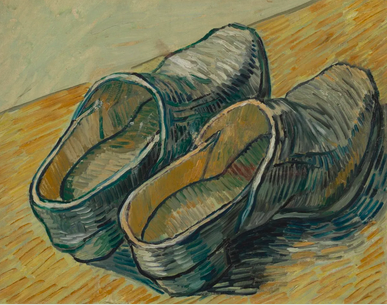
(‘A pair of leather clogs’ by Vincent Van Gogh 1853-1890)

“I am wearing a pair of shoes.

They are ugly shoes.

Uncomfortable Shoes.

I hate my shoes.

Each day I wear them, and each day I wish I had another pair.

Some days my shoes hurt so bad that I do not think I can take another step.

Yet, I continue to wear them.

I get funny looks wearing these shoes.

They are looks of sympathy.

I can tell in others eyes that they are glad they are my shoes and not theirs.

They never talk about my shoes.

To learn how awful my shoes are might make them uncomfortable.

To truly understand these shoes you must walk in them.

But, once you put them on, you can never take them off.

I now realize that I am not the only one who wears these shoes.

There are many pairs in the world.

Some women are like me and ache daily as they try and walk in them.

Some have learned how to walk in them so they don’t hurt quite as much.

Some have had to wear the shoes so long that days will go by before they think of how much they hurt.

No woman deserves to wear these shoes.

Yet, because of the shoes I am a stronger women.

These shoes have given me the strength to face anything.

They have made me who I am.

I will forever walk in the shoes of a woman who has lost a child.”

  • Author unknown.

One death by suicide is one too many. On World Suicide Prevention Day, today, let us start by

  1. believing that suicides are preventable.
  2. knowing that we all play a part, however small, by being aware, educated and resourceful.
  3. being kind and courageous enough to ask the ‘S’ question, listen and respond.

Same story

“Three weeks before that day he was at a bridge and he called his friend who called the police. They came out but just told him to call the GP. One week before that day he called another friend saying he had a panic attack. The friend picked him up. Four days before that day they told the GP what was happening. She gave him a prescription for anti-depressants and said it would take 3 weeks for a referral. 4 days later my brother was dead. At no point did anyone tell the family.”

That day was sixteen days ago.

I wonder if anyone sat down with him to listen to what was going on with him. Two friends, one GP and the Police – none of them could put him in touch with his life and keep him safe. Yes. Ultimately it is up to him but I wonder if he was told that it might be helpful to get in touch with his sister, his brother, his mother, his father – the people who had known him all his life. That he could choose someone who he had a deep connection with, someone he trusted, and let them know how fragile he was at present. Someone who truly cared.

I wonder if you’ve seen this recent advert from St John’s ambulance where a dad is desperately trying to save his son. It encourages lay people to learn First Aid, in case of a physical health crisis. It’s a good one.

Save the boy”

Let’s put this in the context of doctors not knowing how to give First Aid to someone in a Mental health crisis.

The police not knowing that this is life-threatening, that there are resources in addition to the GP, like A&E, Maytree, Papyrus, Samaritans, CALM, their community, their family.

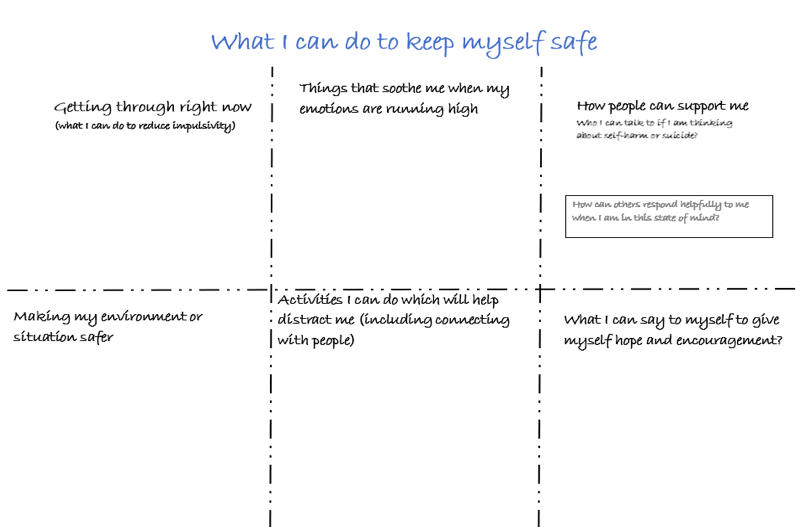
The GP not knowing that this is life-threatening, that there are things in addition to antidepressants that help, like having a proper conversation, exploring the suicidal ideation, informing them that it would be in their best interest if they included a family member or a friend of their choice in their care, giving them details of helpful Charities, giving them compassion and hope, drawing up a Safety Plan, getting in touch with the local Mental Health Crisis Team and  being aware that antidepressants can make things worse for young people in the short term.

Over-medicalisation of suicidal thoughts and behaviours in a setting where most medics are uneducated and unsupported in managing these crises.

Save the boys and girls by insisting on education for all professionals in medicine, nursing, law-enforcement, prison service, youth services, social work, for schools universities, hair-dressers, cab-drivers, students, parents, teachers, managers and everyone else is the only way to get it right – A multi-agency approach to Suicide Prevention.

In the USA, ‘legislation’ was recognised as essential to Suicide Prevention(SP) in 2012. At present, 10 states have legally mandated training for all health care professionals.

ASIST Training (Applied Suicide Intervention Skills Training):

The Office Guy

Once upon a time, trains in London used to be stuffed with people. Every now and then one found one’s head in some random person’s armpit. That Friday evening, my train was not too full.  Every other seat was taken and a few people stood by the door.

He boarded at London Bridge and sat opposite me. We sat facing each other at either end of the long rectangular window, looking out at the dusk, in the typical way Londoners show consideration and give space to one another. I was on my way home after work. The skies were moody. I was glad to be released from the hospital after a long windowless day.

As my gaze shifted from the sunset outside the window to the seat across from me, I saw the young office guy with his neat brown hair, parted on the left side. Crisp white shirt and well-pressed grey trousers. Tense jawline. Fixed steely eyes staring through glass panes. Two vertical frown lines just above the bridge of his nose on a smooth white forehead. He looked sharp, a tense energy encompassed him like a taut canvas. It was palpable. He was, as if a statue with serious internal whirings.

The train was on the move now. My station was six stops away. I had noticed something I couldn’t ignore.

I wasn’t sure if I should do something. If yes, what?

If I did nothing would I regret it? Yes.

Could I fully trust my instinct? I wasn’t sure but probably.

Did it matter if I made a fool of myself by saying something? No.

He could get off the train at any moment so I had to make up my mind pretty quick.

Two stops had now gone by and he was still there. This was my chance. I leant in, my head closer to his, caught his gaze in mine and softly said – ‘Whatever it is, it will pass. I promise. It will.’

I went back to admiring the sunset as if nothing happened.

I didn’t look for a response in anyone. Nothing.

I left it there, feeling like a crazy old woman on the train who talks to strangers, my heart beating in my ears.

One stop later, from the corner of my eye I saw him get up to leave. I brought my eyes back into the coach and chanced looking at him as he stood by the doors. He met my gaze and gave me an acknowledging nod, his frown lines gone. I could have cried. I think I smiled and nodded back.

I was finally learning to trust myself to do the right thing.

CHIME

132 billion pounds = money saved for the UK by unpaid carers.

6.5 million = number of carers in the UK.

6000 = number of people who become carers every day.

1 in 8 adults are unpaid carers for a family member or friend.

Carers UK call them ‘The Second NHS’.

Yet, do we or the Health Service truly value them? Listen to them? Include them? Give them a voice? Understand their concerns? Treat them as an ally? Respect their abilities and contributions? Answer their questions? Educate them? Empower them? Support them? Partner with them as well as we could? Sadly not.

In my experience and that of many other families of individuals with a mental illness, the power imbalance between the health care providers and the service users does not allow for an equitable relationship. Hence, denying the patient the best chances of recovery. There is national and local evidence that proves that carer engagement saves lives.

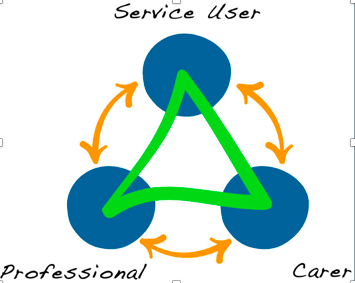
Triangulation of services is essential for best outcomes for patients and professionals. Risk averse practices may help reduce risk in the short term but may increase risk in the long term. A recovery approach to risk and development of a “life worth living” may have longer lasting benefits through rebuilding relationships, increasing service-users skills and confidence in collaboration with carers.

Norfolk and Suffolk Foundation Trust (NSFT) have developed a program called “Stepping Back Safely” up-skilling staff, carers and service-users. It is based on five main drivers of Recovery: CHIME

  • Connection
  • Hope
  • Identity
  • Meaning
  • Empowerment

NSFT are offering free training in Stepping back Safely in July 2021 on-line. Having heard many stories where a life could have been saved only if there was a meaningful and effective communication between the three parts of the Triangle of Care, I think this training is most relevant and essential. I shall be taking it as I am sure it will deepen my understanding of the subject. If you or anyone you know might like a point of contact, here it is: catherine.phillips@nsft.nhs.uk

Twenty-seven

Dear Saagar,

It was your 27th birthday, last Thursday. You would have been 27 years old. You were 27. You are 27. Which one is it? None of the above? All the above?

You were a Presence eons before you were born as Saagar and you will be one for ever more. You are Awareness, beyond form and name. I am the same. There is no separation between us – both ageless, placeless and traceless. Untouchable. Unknowable.

Didn’t take that day off work this year. Woke up and thanked the blessed day for you, your life. On the beautiful bike ride to work, the heart overflowed with love and gratitude. Had a full productive day at work and another lovely bike ride home. Sat on your bench in the evening under the circle of trees bathed in the slanting rays of the setting sun. Felt the love.

Thank you for bringing me the true experience of love.

Yours,

Mamma.

“When love beckons to you, follow him,

Though his ways are hard and steep.

And when his wings enfold you yield to him,

Though the sword hidden among his pinions may wound you.

And when he speaks to you believe in him,

Though his voice may shatter your dreams

as the north wind lays waste the garden.

For even as love crowns you so shall he crucify you. Even as he is for your growth so is he for your pruning.

… Like sheaves of corn he gathers you unto himself.

He threshes you to make you naked.

He sifts you to free you from your husks.

He grinds you to whiteness.

He kneads you until you are pliant;

And then he assigns you to his sacred fire, that you may become sacred bread for God’s sacred feast.”

  • Khalil Gibran

PS: Please like and retweet the link below if you can. That will give a media presence to this short documentary film, ‘1000 days’, which is based on this blog and has been made with the intention of bringing us all closer together in love, kindness and understanding so that no one reaches a point where they can’t find a way to live another day. You will be able to see the film in late summer, once it has done the rounds of a few film festivals across the globe. Thank you very much.