
An empty brown shoe-box
Under an unmade bed
In a dusty attic
Atop a townhouse
with no lights
at the edge of a city
stuffed with people
with no eyes.
Author: kidsaregifts20
Shushshsh…
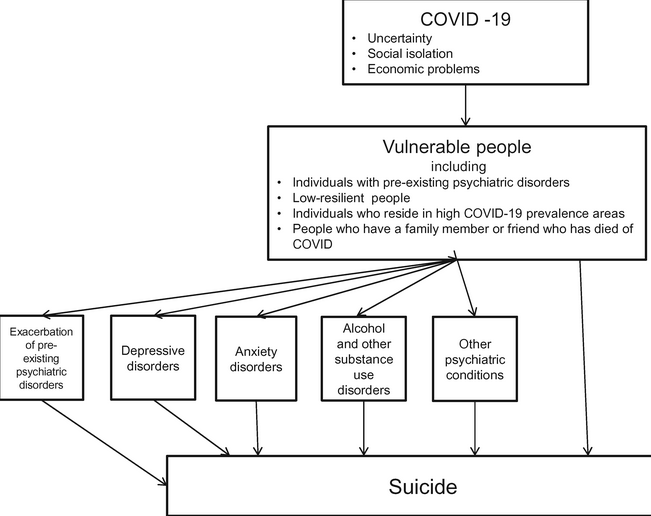
In June 2020 Sher et al said “Social isolation, anxiety, fear of contagion, uncertainty, chronic stress and economic difficulties may lead to the development or exacerbation of depressive, anxiety, substance use and other psychiatric disorders in vulnerable populations including individuals with pre-existing psychiatric disorders and people who reside in high COVID-19 prevalence areas … COVID-19 crisis may increase suicide rates during and after the pandemic.”
This possibility is slowly starting to unfold. The number of calls being made to crisis help-lines of all kinds is up by about 40%. Economic uncertainty, insomnia, stress and suicidality feed into each other. The previous financial crisis of 2008 had a tragic outfall in terms of the toll taken on human life, essentially due to job losses. Now we are heading into another one. Unless governments all over the world wake up now, lives lost by suicide over the coming months and years could be more than those lost to COVID-19. As per the ONS data from last year, the England and Wales suicide rate remains statistically significantly higher than the rates seen in recent years.
Active outreach is necessary. If you know friends or family who might be struggling or worried, please do reach out to them with your time and open up supportive conversations. Sending a text or WhatsApp message is not enough. Having a proper check-in by telephonic or video link, possibly meeting up for a cup of tea or a drink fosters proper connection. If you find yourself in a tight spot, please know – this too shall pass. It is a temporary problem. Life still holds promise and beauty. Do reach out to your friends and family for support. More than ever before, in the present times suicide prevention is everybody’s business. Take care of you and yours.
Denials.
Amongst the heap of books with colourful book-marks popping out at jaunty angles, amidst the papers printed and plain lounging about, inside a laptop open but its screen black, behind a glass of orange juice half-full, inside a bunch of blue and purple pens and underneath a lime-green I-pad. I looked everywhere. Could I find it? Nope.
After 2 years of carrying it with me all over the world at the bottom of my handbag, hidden inside a red polka-dotted Cath Kidston case. Never letting it out for fresh air. Squinting my eyes to the point of distortion. Cocking my neck to extremes. Adjusting the length of my arms till they wail. I pushed it as far into the future as possible. Avoiding reading as much as I could, especially the list of ingredients on a packet of food or drink in the supermarket. Enlarging the text-font on my phone so much that people whose eyes might fall on the screen would spontaneously burst into a loud laugh.
It had been long overdue. This change. It’s here now.
No glasses, no reading. No glasses, no writing. The pair had to be found.
Went upstairs to peer under my pillow, just in case … not there. Popped over to the dressing table and caught a flying glimpse of it … in the mirror … perched on top of my more-salt-less-pepper head of hair.
Now it was my turn to laugh out loud. I used to make fun of my dad when he went up and down demanding his glasses to appear – if it wasn’t this pair, it was that. And now it’s me. Si threatens to buy me a string of loosely put together baroque pearls to hold my reading glasses firmly around my neck. That would be too much of a declaration. It’s too early yet. I believe that was a one-off. Yes, what has happened cannot be undone but its highly unlikely to happen again. Isn’t it?
Blue Rose
She was the colour of almonds. Her smile so bright, it made the sun shine. Her hair waist-length, wavy and a very dark brown, like a heavy veil down her back. Her petite frame, shy, smelt of sandalwood. She was only 19.
Her friends had rebellious red, pink and green highlights in their hair. Some had happy multi-coloured beads and braids woven in. Others had playful ribbons platted in, like flower-girls at hippie weddings. She sat on her aquamarine blue sofa with her laptop, peering through colour-charts. She wanted her hair dip-dyed. She hadn’t picked a colour yet.
It was going to cost a bit but her mum had agreed to pay for it. She often did.
When alone in her room, unable to sleep at 2 am, Rose had looked up Helium and what it does. She didn’t know why. It was an involuntary act. It was nonsensical. Her body and mind were no longer of her.
Her hair appointment was in a couple of hours. She had to decide now. It was important she got this right. It was an expensive decision. The staid Royal blue or the scintillating Moroccan Turquoise? Silky peacock blue or the majestic sapphire? She wanted a straight horizontal line to run right across the dark sheet of her hair. The bottom one-third of the length a startling shade of blue, like a designer curtain.
She played classical music on the violin. Her ears didn’t particularly savour the Blues. They jarred her. She didn’t have a taste for blueberries. She preferred the ‘rasp’ variety with big dollops of double cream. Her wardrobe was a smattering of whites, pinks and reds. No blues there either, except the denim jeans and shorts. She was a proper girlie-girl. Blue skies made her spirits soar. But they left blue stains on her heart. She hid them like children hide pretty pebbles in corners of drawers. Her smile kept feeding the sun through the blueness.
She hand-wrote letters to the people she shared the house with, in blue ink. To her mother she said how wonderful a mum she was and she should take better care of herself. To her sister she expressed her appreciation for her companionship, friendship and laughter. Her little brother never left her side. She never turned down his invitation to play any kind of silly game with him. The dogs were all hers. They didn’t know they weighed as much as her. She had to sit down when they clambered all over her saying ‘we love you’.
The blue stains on her heart were expanding like drops of ink drip-dripping on a white blotting paper. She knew it was happening but didn’t know what it was. It’s creepiness had no name. It made her want to escape. It compelled her thoughts to convince her that her deepest desire was to implode. She had no say in the matter. It made her hands look up Helium on the internet. It kept her eyes wide open at night. It made her tummy churn, her legs restless and her head hurt. She now had 2 hearts and she moved between them. One blue. The other not. One wanting out. The other wanting blue hair.
“I am finding this difficult Mum.”
‘We need to leave in about 20 minutes for the hair-dressers my darling.’
“Yes. I am thinking about it … looking up the options on the internet.”
‘Good idea. We can take your laptop with us. I am sure the hair-dressers will have some ideas for you. Don’t worry.’
“I have some ideas but haven’t decided yet.”
‘Take your time. No rush.’
Midnight blue was the final choice. She was happy.
Over the next year that wretched blue embedded deeper into her heart and from there, leached into every cell of her body. Then it burst out, released itself and merged back into the midnight, the sky, the ocean.
That was 5 years ago. Till this day, her mother’s mind twists into painful knots when she remembers that day. How could her lovely Rose have wanted to live with blue hair and at the same time, to not live at all? At nineteen! How?
No one knows. Sometimes it’s like that.
———————————–
A video for every parent: https://www.youtube.com/watch?v=3BByqa7bhto
Logotherapy
It was late 1930s. He was a young man in love. She was a young woman who was delighted to be asked by him. They were married. Soon she was to be a mother. But the clan they belonged to were not allowed to procreate. She was made to abandon the baby even before it was born. They both were sent to different concentration/death camps. But their love story did not end there.
Despite shoveling snow with no shoes on, going for months without proper food, constant beatings and humiliation, not knowing which instant he would be walked to his death, he carried on loving her. He did not know if she was dead or alive but he loved her every second. He hoped to see her again. His longing kept him alive.
Four years later, he was freed and he found out that his sweetheart had passed away soon after their separation, at the age of 24. His father, mother and brother had met the same fate in that ugly assault of humanity on itself. His sister had survived and moved to a faraway land.
Viktor E. Frankl was a Psychiatrist. He took 9 days to pen down his learning and thoughts which became a book – ‘Man’s Search for Meaning’ that sold millions of copies all over the world as it helped them transform their suffering .
He pioneered a new way of counselling patients called Logotherapy or ‘meaning-based-therapy’. When asked of the difference between Psychoanalysis and Logotherapy, he said, “In Psychoanalysis the patient must lie on a couch and tell you things which sometimes are very disagreeable to tell. In Logotherapy the patient may remain sitting erect but he must hear things which sometimes are very disagreeable to hear.”
It is a future focussed approach through which the patient is reoriented toward his unique and specific attributes aligned to a purpose which can be fulfilled by him/her alone. It is based on the premise of freedom – the freedom to choose our response to our experiences, the freedom to choose the stance we take when faced with a difficult and unchangeable situation.
Over the last 5 years I have read Frankl’s book at least 5 times, each time deriving new inspiration. Last week I had the good fortune of being able to share some of those insights on-line with a community close to my heart. The Compassionate Friends helped me discover that Frankl’s love story will never end. It is interwoven into yours and mine and with the love-stories of those yet to come across it.
 kidsaregifts