Room 9 – A short story

One dank dark evening I walk towards my hospital thinking, ‘why me?’.

5th night-duty in a row – running around screaming babies, stressed out labouring mothers and their families. A place where temperatures and emotions run high. I love it and it kills me. My sleep cycle is mushed up into a ball and my head is scrambled. I want to turn right around, head home and dive straight into bed. But there is one more night of madness between that bed and me.

The master-board directs me to Room 9. I get changed into scrubs, one size bigger than usual, just for comfort. I get my hair out of my face and bind it in a scruffy pony tail. I sling my mid-wife ID lanyard around my neck. It’s heavy. I look in the mirror to check if the concealer has successfully hidden the semi-lunar hollows under my eyes. It hasn’t. Well. Do I really care? One more night and then I can get back to normal until the next time. Deep breath!

I am told to expect Mrs Natalie Cunningham, 33, in the next few minutes – first baby. Cunningham! Hmmm. Nice. I smile a feeble smile. I prepare the room and look up some of her records on the computer. She seems unchallenging.

A wheelchair is being pushed down the main corridor. She’s slight. She smiles politely in between contractions. All she has is a bump. He shoulders and ankles are slender, like a teenager. Her skin, clear and radiant. Her face, kind and content. She knows how to breathe in synchrony with her contractions. An ideal patient. She apologises before calling her husband. He’s visiting his mum who’s not well.

“Hi darling. I am in. Don’t panic. All is well. Come when you can. No rush. Plenty of time yet.”
“Can you pick up the i-pod from home on your way? I forgot to pack it.”
“Great. Thanks. See you my love.”
He’ll be here soon, she says. I check her in, get her changed into a hospital gown, put on some monitors and settle her down. She’s easy to work with. Thank God!!!  I leave the room to get a few things from the store.

I return with the drip stand and such after about 8 minutes. She’s not in her bed. The man bending down to plug the i-pod into the wall stands up. He’s Matt. Matthew Cunnigham. My Matt. I freeze. He looks up and clocks me. After 3 years and 4 months.

“I am 28. I want to travel and keep my career options open. I am not ready for a family” he had said.
“I am” I had said.

That was that.

The bathroom door clicks open and Natalie declares that her waters have broken. I want to snap back into work mode but I am paralysed. I need air. There is none in the room. I leave. Someone swaps into my place. I creep into a quiet, dark corner and sit. For as long as I can remember.
It’s a boy!

4th May 2018

It’s not a tranquil lake. It’s a torrential flash flood and it’s fast approaching. It’s coming towards me and I am putting up a big fight but not winning. I am being pushed towards it by the boulder of time. Another turn of the wheel. The approach is a rough zig-zag path with exhausting ups and 3G downs, jagged corners and innumerable pot-holes. It goes thud-thud-thud. My brain hits the hard inside of my skull multiple times as it comes closer and closer. Am I going to hold my breath when it happens?  Am I going to be submerged for longer than I can hold on? I don’t know how to swim and my limbs are pathetic. What am I going to do when it hits?

6th May 2018

It’s here – the 24th birthday of a man-child who didn’t reach his 21st. It’s a blessed day. A happy day. But it doesn’t feel that way. A painfully long weekend filled with his absence. A trip to the local park. An ice-lolly. Carrying his djembe around in the sun like a mad woman as if it’s my baby. Baking raspberry, pistachio and chocolate brownies. Holding back tears all day. Being with ‘it is like this’. A visitor. A long evening. A nice meal. An enormous hole. Massive nothingness – a vacuum that my love wants to get into but there is no way in or out. It’s sealed like a submarine.  Not a drop of water or a molecule of love can enter or leave. The void sits in the middle of my living room. My life. Starving my love of all expression. Suffocating me.

7th May 2018

It came and went. I lived. But I am not getting anywhere. I want to be someone I am not while accepting everything as it is. How can these two positions be compatible? It’s like being night and day at the same time. Not dusk or dawn – they are too serene. Do I have a realistic hope of ever getting there or am I delusional?

Does unconditional peace exist? Apparently, some folks have experienced it. I have too, for brief snatches of time. To have it as a native state of being – unblemished, pure and vast consciousness. It seems unachievable. But they say it’s possible. May be. Some day…

(Buddhist teachings by Ajahn Anando: ‘Knowing in the present’: https://www.amaravati.org/speakers/ajahn-anando/page/2/)


I love tree-tunnels.

IMG_6360

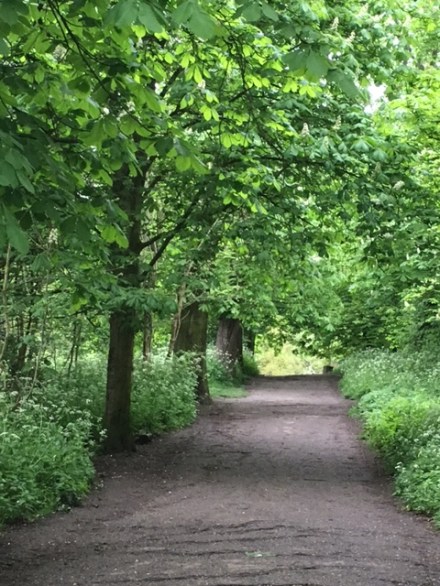
I love tree-tunnels and I know why. They are proof that in every separation, there is a meeting. A river separates its two shores but also links them. I once heard a story of 2 prisoners in solitary confinement. Their cells were separated by a thick wall. Over time they learnt to talk with one another by a particular pattern of tapping on this wall. The very thing that kept them apart, connected them.

Every year I seem to forget what this time of year looks like. Then I am surprised and delighted by the blossom and the fresh greenness on the trees. Even on a dull day like today, walking, looking and driving through tree-tunnels, channels light into my life. The trunks of these trees stand on either side of the road but the roots intertwine underground and the leaves meet up in the air and dance together. It feels like nature is not just giving me permission but actively encouraging me to enjoy life and look beyond what is visible. I need to give the same permission to myself. This light is mine.

Maybe this apparent separation from my darling Saagar is not at all real. Maybe this chasm is the link between me and my higher self. Maybe the greatest life lessons come to me through this gorge. Maybe this deep cleft of pain has been created for growth to take place. Maybe this fissure has appeared to make more space for love and kindness in our world. Maybe.


We all are Sakura.

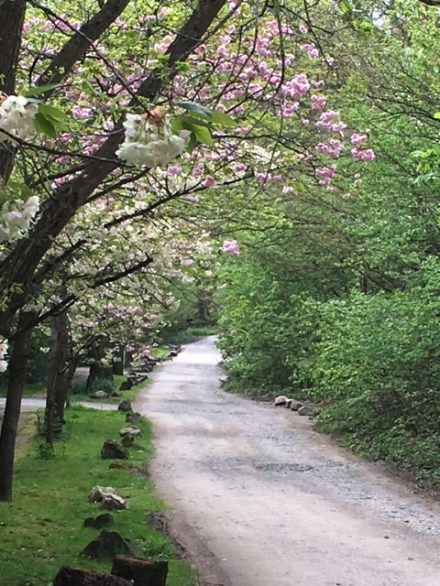
After a long, harsh and adamant winter, the hope and light of spring is here. The former is still lurking around the corner, waiting to jump back when it can. But for now, it’s hiding. Pink and white clouds of blossom hover a few feet above the ground.

IMG_6355

For centuries cherry-blossom or sakura has lived in the hearts of and ignited the spirit of the Japanese people. They wait for this time of year as the blossom signifies beauty and celebration. Its delicate pinkness stands for innocence and fragility. Families get together ceremoniously to marvel at this spring-time bloom. This occasion of watching and admiring of the blossom is called Hanami.

These feathery pink  flowers have inspired much of Japanese painting, poetry, film, music, food, textile design, ceramics and other art forms. In addition to being exquisite to look at, they carry a deep philosophical meaning. They are a timeless metaphor for human life. While this blooming season is intoxicatingly brilliant, it is tragically short. It  reminds us of the splendour and brevity of our own lives. It encourages us to appreciate our time on earth with the same joy and passion as we do the blossoms. It awakens our senses and forces us to pay attention – notice the present moment, welcome what’s to come, honour what has passed, acknowledge the transient nature of everything and hold ourselves in a stance of grace and gratitude.

The samurai embodied this combination of beauty and mortality. They appreciated the inevitability of death without fearing it. A fallen petal or blossom is said to symbolise the end of their short lives.

Sakura also indicates renewal. In Japan, this is the month in which the school, calendar and fiscal year start.  Aside from deep historical, religious and cultural significance, it also has connotations of agricultural optimism.

Beautiful, fragile and transient – that is us.


Project Eighty-four and more

180326102147-01-london-suicide-statues-restricted-exlarge-169

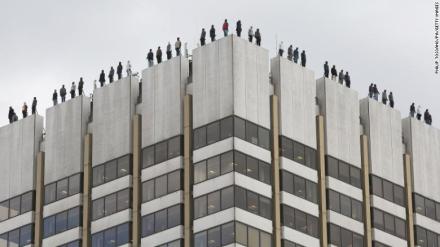
84 life-size statues of men were seen standing at the edge of tall buildings in central London in late March representing the same number of men lost to suicide every week in the UK – a hard hitting visual project aiming to bring this tragic loss out into the open from behind closed doors.

Common threads emerged from articles published in April:

“Students more likely to kill themselves” in the Times: Researchers from a Hong Kong University analysed the ONS figures and found that the number of university students in Britain increased by 5 per cent between 2012 and 2016. The total number of suicides among students increased by 32 per cent, from 139 to 183 deaths. A think tank said that a law banning universities from contacting the friends and family of students who are struggling should be revisited.

The number of first year university students reporting mental health problems in UK Universities has risen five fold in 10 years. A combination of increasing awareness of mental health issues, a lowering of the taboo previously attached to mental health services, mounting debts, homesickness, loneliness and a greater sense of anxiety about the future may be some of the reasons for it. Some vice-chancellors still think that mental well being is not the business of universities and it’s just about developing the mind. But developing minds means nothing unless students settle down well in their new environment and be ready to learn.

According to recent ONS statistics on loneliness, people between 16-24 are at the epicentre of the loneliness epidemic in the UK. More so than the elderly. Women were found to be lonelier than men. Other variables were renting a home rather than owning one, being single or widowed, having poor health and feeling disconnected from the local community.

In an article entitled “Doctors knew my son was suicidal. I should have been told before he died” in the Guardian, I raise this question yet again: Is confidentiality more important than helping someone at risk to stay alive? Is it correct for a father to be informed by doctors after the death of his son,”Now that he is dead I can tell you that this was not his first attempt”?

Is it?