Queer youth are five times more likely to die by suicide. I did not know that. I knew nothing about Andrea Gibson until after their death earlier this week from Ovarian Cancer. Every word they wrote throbbed with a cry against injustice. They were an activist for tenderness, a warrior for the human heart. I have spent most of today reading her poems and they sing to me. Gibson lived deeply and spoke candidly about moments when things got too much for them.
“When your heart is broken, you plant seeds in the cracks and pray for rain.”
“Just to be clear,” they wrote, “I don’t want to get out without a broken heart. I intend to leave this life so shattered there’s gonna have to be a thousand separate heavens for all of my flying parts.”
So many disappeared. I saw them on Day 1 and 2 and then nothing. Not even a text or a call. Luckily, the early days were a fog, a maze. Luckily, I have forgotten so much.
Some people, who were nothing more than work colleagues showed up big time. They could sit with my despair. They sent me little books of poems for difficult times in the post. They met with me for coffee in town. They called up and chatted on the phone. They made a note of Saagar’s birthday and death anniversary and sent me cards, saying, thinking of you today. Simple, small things that meant the world.
Some people spoke very little but their body language boomed loud and clear. They mirrored the contraction inside me. Their empathy shone through that. On the second day, Rajeev, an old friend sat with us for two hours in silence. Before leaving, he said, “If there is anything I can do, please let me know.” Over the next months and years, he followed my blog, commented on posts and casually dropped by when he could. He let me know he was there.
Some people possibly saw in me, the worst possible lashing of fate as a parent. Maybe they got frightened. The speed of their exit indicated their fear of catching it. Some people who were previously in the ‘life-long friends’ category, vanished. One of them was a Psychiatrist, a mother of two. One of her children, Rajat, was a close friend of Saagar when we were neighbours in Belfast. The two boys spent every evening together cycling, playing and talking. They often had their dinner and their bath in each other’s houses. I still have a picture of them at six-year-olds, with the alien they constructed together from their toys and balloons. We were the closest of friends for four years and then they moved to Birmingham and we, to London. We stayed in touch and visited each other but the boys grew apart as boys of that age do. After their visit on Day 2, our next contact was a wedding invitation to Rajat’s wedding by a WhatsApp message, eight years on.
Of course, people don’t understand. They can’t. It’s not their fault. I wouldn’t want them to because they would have to experience this. If this had happened to a friend of mine, I would like to think that I would’ve been there for her but I don’t know that for sure. The woman I was in the ‘Before’ might have been too busy or too afraid or too awkward. I don’t know.
Some of Saagar’s friends have been with us all along. We’ve attended every concert we could as Hugo and Azin have risen in their musical careers. We have met up for meals and walks as often as possible. We’ve met their partners, watched them buy houses and change jobs. Our connection with them seems to be made of the same silk as our love for Saagar, and his memory. We feel blessed to have these young people in our lives.
Yes. My address book has radically changed. Like me.
In Delhi, it was simple and sweet. In Belfast, it was a problem. It had to be spoken out slowly with exaggerated lip movements and spelt out clearly. Still, it was uttered in all kinds of ways – Segaar, Sega, Saaga, Sags, Sagsy-wagsy. “As long as you call him with love, you can say his name in any way.” I would say with a smile. But of course, it was his name. Not mine.
At the age of seven, one day he came home from school and said, “Can’t you change my name to Aran or something?” I felt for him but laughed. What else could I do? I asked him if something happened at school that day, if someone said something hurtful and he just picked up his soft stuffed grey elephant and cuddled it.
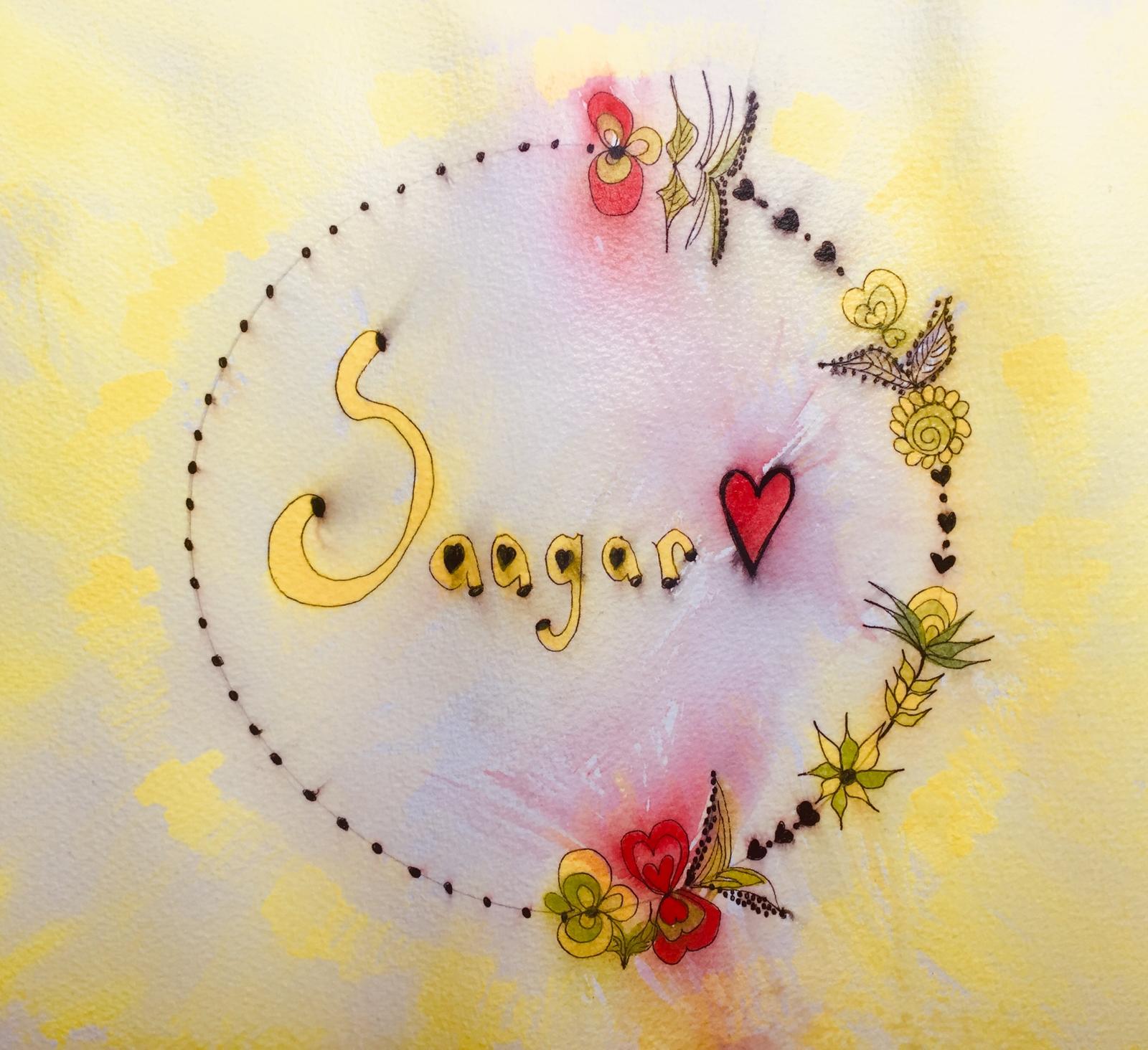
I told him the story of his name. I was 24 when I got married. My in-laws lived In Chennai. We visited them a few months after the wedding and one evening we all visited a place called Besant Nagar beach. That was the first time my eyes fell upon the expansive ocean. On the map this water body had the boring label, Bay of Bengal. The vision of a dark blue shimmer below meeting a pale blue glow above in a clean, delicate, straight line made everything else disappear. Its calm, its rhythm, its enormity, its subtle dance, its grace and openness pulled me in. All conversation faded away and there I was, completely soaked in the bliss of the ocean. My soul soothed. My body relaxed. My eyes quenched. My heart happy. I was in love. In that moment, I knew that if we ever had a son, he would be called, ‘Ocean’: Saagar. I reminded him that his name was Saagar because his heart was as expansive and as beautiful as the ocean. He smiled and wrapped his soft cuddly arms around my neck.
As he grew older, he came to own his name. He came to live it. The waters of this ocean ran deep. On the surface, it appeared playful but strong currents ran underneath. All I saw was the steady flow of gentle waves, rhythmically lapping against the shore, through all the seasons. It oscillated with the moon but the high tide was never too high and the low tide was never too low, until many years later it was.
In October 2000 we went shopping to the Abbey Centre, around Halloween. Saagar was six years old. He loved riding the miniature cars left dancing on thick metal springs atop short sturdy plinths, strategically placed outside women’s clothes stores. I planted him in a blue car, instructed him not to move and stepped into the shop for no more than a few seconds to take a closer look at a long black dress in the window. I felt the texture of the fabric between my right thumb and forefinger, looked at the label for the price and size and rushed back out of the store. He was not to be seen. Just like that, we lost each other. He must be so scared. I was petrified! Gosh. The stories you hear… No. No. He’s got to be nearby. ‘Saagar! Saagar!’, I called out, trying not to yell, desperately hiding my panic, my eyes hunting, hurting from the assault of his sudden disappearance from the blue mini-car. What felt like absolute eternity must’ve been no more than five minutes. An announcement sang out of the PA system. He was walking down the corridor accompanied by a big uniformed man. My son, in his blue jeans and dark blue jacket ran into my arms. Phew! I cried with relief. Thank God!!! I got down on my knees and held him tight. All colour had left his face. His eyes were wide and blank. “It’s okay beta. It’s okay. We’re fine.” Later that day we went out to collect pine cones from the thick green grass underneath the trees within the premises of Whiteabbey Hospital. I wanted to nest with my baby. I wanted to keep him close to me in small, cozy places where he wouldn’t get out of my sight and I, out of his. We collected forty pine cones in a basket. We talking. The cones half-filled a wide spherical glass jar which took a place of pride in all of our many homes. It followed us everywhere as a reminder of the day we made the promise to never ever lose each other again.
During Saagar’s illness, I was helpless. Also, I was rubbish at asking for help. A few weeks into Saagar’s unrelenting and forever changing moods, I was baffled. I realised I couldn’t do this alone, I needed to ask for help. Most of my family lived in India so I needed to hurry up.
Looking back, I asked somewhat hesitantly, by sending a group e-mail to my family members in India. Some tried to help and couldn’t. Others didn’t try. Yet others kept mum. Some advised me to send him to India. Some couldn’t even pick up the phone. I was so panicked that I couldn’t think straight. It didn’t cross my mind that I needed support too. The fact that I was a hot shot doctor at a hot shot hospital did not help. At that point, I was simply his desperate mother.
I texted a distant uncle on Tuesday night to say I was really worried about Saagar and we needed urgent help. He lived 20 minutes away. He texted back to say he could only help on weekends. By Thursday, it was all over. I suppose none of us had the slightest inkling of the disaster that was hurtling towards us.
Helplessness was the darkest cloud there ever was. It was a humiliating beast of a thing. It had completely obliterated the way I saw myself – capable, resourceful. It had made me a stranger to myself. Again and again, it invaded from the past to leave me without oxygen. I imagined I would limp through the rest of my life, trying to get to a point of relief, of grace. There was no way of getting that ghost of helplessness off my back.
A few years after his death, on a warm quiet afternoon on a beach in Goa, I invited Ms Helplessness to sit with me. We sat cross legged on the wooden floor of the beach hut. We looked into each other’s eyes for a few still moments. With tears streaming down my face, I extended both my hands toward her, and she took them in hers, gently squeezing them and then loosening her grip. I steeled myself and looked harder into her eyes.
I hate you. I forgive you for nearly killing me once. Thank you for showing me I can’t control what happens.
Maybe there’s a power beyond us both, that rules.
Promise me, you won’t be so cruel again. Will you? She had her gaze fixed on the ground in front of us. A tearful silence ensued. Then she stood up and walked away.



 kidsaregifts