Day 988

Transition is the cliff edge.

IMG_0591

Alas, poor Yorick…

Eighteenth birthday! Yay! No more a child. You are mentally, emotionally, socially, spiritually and physiologically an adult. That’s it. Over to Adult services now. Easy.  The number ‘18’ is completely arbitrary. It is designed for the convenience of the service providers, not in the best interest of children. There is a strong case being made now for raising the ‘transition’ age to 25 and rightly so. The recent publication “State of Child Health 2017” has recognised that the transition from Paediatric to Adult services is poorly organised and unsafe for mental and physical health conditions.

This is how one of the parents felt: “In my experience the teams did not work together. They each did their separate thing. When Rebecca left school, she was left with without regular support or advice. When she turned 18 we just stopped receiving information. Emails and phone calls didn’t get answered.”

Chronic conditions such as Epilepsy, Asthma, Diabetes, Juvenile Arthritis and Childhood Obesity are often associated with significant mental health problems. The budget for kids was 6% of the Adult MH services until recently. The government promised an increase and guess what! It has gone up to 7% now. Hurrah! Considering that mental illness most often begins in adolescence and early intervention is of paramount importance, the allocation of funds is highly disproportionate.

Piet Jansen, Director of International Relations, Yes We Can Youth Clinics, Netherlands, commented:

‘There was a lot of talk at the CAMHS congress about the Green Paper, but in my view the only green thing that matters here are dollar bills (in this case pounds). Without sound financial and genuine political commitment, structural changes are not to happen.’

DC2K3UbXUAAai4p


Day 985

download

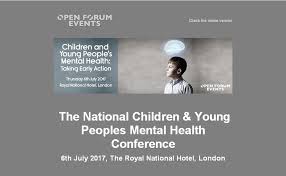
‘Children and Young People’s Mental Health – Taking Early Action’ : title of a conference I attended today.

The hall was packed with 350-400 people, working for the well-being of kids as teachers, social workers, decision makers and others. Two speakers mentioned suicide in the passing – Rt. Hon. Norman Lamb MP, who lost his sister through this tragedy 2 years ago and Richard Andrews, who set up the charity Healios after experiencing serious difficulties in accessing support for friends and family affected by serious mental illness.

One of the professors spoke about the reasons for early deaths of people with mental ill-health.  He attributed this mainly to physical problems such as hypertension, obesity and smoking related problems. Death by suicide wasn’t mentioned.

I learnt a lot, some of which I shall share in the next few days. A Green Paper is being drawn up to set out proposals for delivering better mental health support for children and young people. During one of the question times, I suggested that bearing in mind that suicide is the biggest killer of young people in this country, 2 things must be included in the Green Paper –

  1. Suicide Prevention Training for all medical and nursing staff and students, just like CPR training, to bring parity of esteem between physical and mental ill-health.
  2. Meaningful sharing of information about para-suicidal young people between medical teams, police, first-responders and families, in the best interest of the patient.

This remark was met with a stunned silence. The room froze. The chairperson mumbled something like ‘eloquent…’ and rapidly moved on to the next person.

Stigma lives here too. Inside the healthcare community.


Day 981

For Rene’

Somewhere in the sea
Are you waiting for me?
In that expansive blanket
Of blue
I am waiting for you
I’ve cried these tears
They’ve made this sea
And now I cannot find you
In this sorry mess of blue.

I’ve swam to the edge to reach This tip
Of nothingness where you left your shoes for a dip
From which you haven’t returned
And now I’m left tracing
Across this sparkling blue
Where has it taken you?

My love was pure
It held no bounds
And yet nowhere, anywhere
Can you be found
I try to search with frantic eyes
Where I can turn back the fate
Of your demise?

I hold your shoes pacing
these shores
Wont you be out soon, cold,
and need your soles?
I am here, a lifeguard
Supposed to protect you
Against these waves of blue.

I pray to the Gods and the earth and the creators I don’t know
That they can bring you back here to this spot where I bow
I’ll protect you better
Try harder
Swim faster
Against this tide that pulled you out.

If I can’t find you then what is my life about?

I’m so sorry, my angel
But I’ll never give up
I’ll wait here forever till this blue dries up
I’ll sit here searching until you come back.

-by Rene’s sister, Stephanie.

Day 979

“Helping others is the way we help ourselves”
-Oprah Winfrey

Simple ideas change the world. A Clinical Psychologist, Dr Charlie Howard was taking a walk around her area. Having recently had a child, she was looking for her next “thing”. She asked random people what would make a difference in their community. “A Problem-Solving Booth right here on my street” answered a young man in the queue in a sandwich shop.  “A place where people can go with the stresses in their head and where we can help each other”. The idea was genius and Charlie’s head built on it quickly. “Maybe we could try one here?” Charlie suggested, “we could do it together”. The young man smiled at Charlie and said “yeah maybe” and then his phone rang and he ran off down the street. No one knows his name and no one has seen him since. He probably has no idea just what his throwaway words have since inspired.

Problem-Solving Booths are a great way to bring members of the community together to have conversations that they might not otherwise have, by helping each other with their problems. One chair is for the “Helper”, the person listening to the problems. The other is for the “Helped”, the person describing their concerns. The aim of the Booth is that people swap roles regularly as we all have both the potential to have problems as well as to offer help.

Thrive London is a citywide movement for better mental health for Londoners supported by the Mayor of London and the London Health Board. Problem-Solving Booths have become the local arm of Thrive and we’re working out what they are, what they do and what they can do, with everyone we meet from street to street, borough to borough and organisation to organisation. It’s cool.

Watch this space!


Day 978

Primum non nocere- First do no harm.

Doctors could save lives by breaking rules on privacy.

Screen Shot 2017-06-29 at 22.23.06

This is a point worth making again and again and again and again and as many times as it takes. Few excerpts:

Hamish Elvidge, father of Mathew – “Before my son took his own life, he had only just been discharged as a low-risk patient, despite coming in as a high-risk patient that very same day after a suicide attempt. At no point were his family involved in any part of the process. There is a chance that, had the hospital decided to share information with his family, our son would still be here today.”

“Confidentiality is far too embedded within the medical profession. The default position has to be one where you have to explain why you haven’t involved the family.”

Prof. Appleby said: “Psychiatrists should feel able to use their clinical judgment on where the balance of patient safety and confidentiality lies. Families are devastated when they discover too late that their loved ones had been talking to professionals about suicide.”

Professor Sir Simon Wessely, president of the Royal College of Psychiatrists, said: “In my experience, if doctors make well- justified, well-recorded decisions to share information in the best interest of a patient who is in suicidal crisis, consistent with their professional codes of practice, this will be understood, respected and upheld in courts of law.”

 (Source: The Herald_Congress17_suicide story.pdf)