Varanasi

This ancient city of learning and burning sits on the banks of the river Ganga which is home to Saagar’s ashes. We were here twice, within a few months of Saagar’s passing for various ceremonies related with the sudden and tragic nature of his death. A year ago, my Irish medium who I have come to rely on, informed me that the elaborate prayer services that were held for him here had been greatly helpful in freeing his soul. I have no reason to not believe her as everything else she tells me makes sense.

Last month I was back in this iconic city for a long weekend, celebrating the writings of my favourite 15th century poet and philosopher, Saint Kabir.

“Scholars are never made 

from reading countless books.

You only need to understand ‘love’

to be a true scholar.”

Twenty three years ago I left India as a motivated young professional thirsty for knowledge, professional growth and ‘success’. I was a naive kid. I did not know who I was. Now it feels like I’ve taken a tortuous and torturous route to finally come back home, to myself.

Yes, I passed many exams. In the year 2000, I traveled to Dublin for the day, for my first post-graduate exam at the Royal College. As soon as I returned home, Saagar, who was six at that time asked me, “Mamma, did you win?” A huge smile descended on my face and my entire being. I forgot about the stress of that day and the preceding months and got lost in our cuddles and giggles.

I did grow in my work and was ‘successful’ but the most important lesson I am learning is to understand, experience and be love.

The only lesson that is worth learning.

Random stuff

After many years, things are being taken out of cup-boards and off shelves, turned inside out and properly looked at. Dusty books, clothes, folders, boxes and sachets. Some familiar fragrances are escaping and some old scenes are playing out on the screen of the mind. Bits of stuff slipping out of other stuff and falling to the ground with a clink. Some stuff that was believed to be misplaced is being placed. Some that was believed to be forgotten is being revisited.

Sample 1

A nappy pin. Special feature – A white safety cap to prevent accidental opening up while the baby has his cloth nappy on. Commonly used in India and other developing countries. Original owner: Baby Saagar.

Sample 2

A business card. Special feature – Simplicity. An invitation to music and joy. Original owner: Saagar.

Sample 3

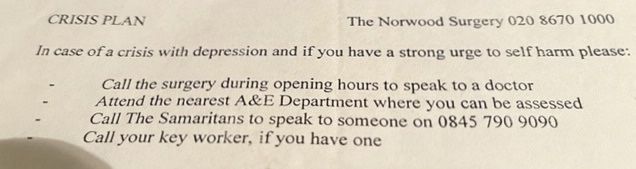
A Crisis Plan. Special features – Not worth two pennies. Highly ineffective. Not accompanied by a conversation. No detail. Not individualised. Not created in partnership with the patient. Not an alive document. Does not mention anything more than ‘self-harm’. Doesn’t tell us what ‘Crisis’ looks like. Doesn’t identify any helpful distractions, activities, friends or family. Doesn’t appear to know the patient, for example, a key fact – does this person have a key worker? Does not express any understanding or compassion.

Commonly used in developed countries.

Oops! The name of the GP surgery is visible. It doesn’t matter. It closed down years ago. We were it’s last few unlucky patients. Owner: Saagar Naresh (1994-2014).

(Resource: Safety Planning is essential to safety: https://stayingsafe.net/home)

Borrowed light

It sits on my shoulder like a monkey. Annoying. I’ve had a long day, I say. Go away.

It pulls my right ear and searches for lice scrambling all its fingertips over my scalp, irritating as hell. There are none. Get lost. I am not a child.

I’m losing it. The moon is winning.

Proud of its super-fullness. It is evil. The tides it excites, the fights it ignites, the way it bends minds, the resting foetuses it pulls into this cruel world, stealing sleep from the depths of the night. Milky and serene on the outside, within a serious trouble-maker resides. Hurricanes, tornados and earthquakes it invites.

You’re an imposter. I see you. A big black rough rock with nought to your name. No water. No gravity. No air. Certainly, no light. This thing you proclaim as your own is in fact not so. We all know. It belongs to the star called Sun. The one that gives life. Not you. That’s the real star. You, a mere appendage, borrowing importance, gloating in your pretend beauty, cycling and circling with poor intent.

You’re no good to me. Go away. You bad bad moon.

No words.

Two years back, it could not be screened as scheduled. After a long wait, last weekend it was, at Clapham Picture house where Saagar often went with his friends. People came from Leicester, Salford, Cornwall, Cardiff and Birmingham. Some, I had only ever seen on screen. Others, when they were school kids. They brought their sisters, spouses, friends and colleagues. They stayed for hours afterwards, talking about themselves in a way they never had. They fell in love with Saagar’s big brown eyes and mischievous smile. They saw what a treasure had been carelessly lost. Everyone felt something. Many had no words but there was a profusion of overdue hugs all around. Many felt they knew him even though they had never met him. Some introductions were made to link up the leaders from various sectors of society so they could form stronger and safer networks.

That woman in the film was not just me. She spoke for the fifteen families in the UK, who are plunged into this harsh reality every day. More than 6500 every year.

That young man in the film was not just Saagar, but everyone who has ever blamed themselves for their troubles and felt shame for things that have happened to them, hiding behind their beautiful smiles. Unseen. Unheard. Each one who lost their tribe and couldn’t find a way back.

These were not just Saagar’s friends, but all those who are left behind, trying to figure out how this could happen to someone they loved. Wondering what they could have done then and what they can do now.

This film laments a future lost. It mourns silent suffering. It also illuminates a path that appears out of darkness. It also celebrates love and smiles. It also gives us permission to soften, lighten, loosen. It breaks open our hearts so we can hear the unspoken pain that lies behind the mask of another face and our own. It makes us one.

This is what it means to be human. Here, on this beautiful Earth, there is no other. Only us. Not us and ‘them’. Just us.

PS: International film awards: Eight.

‘1000 days’ is made by Me and Thee films for educational purposes. Hence it is not yet freely available on social media. It was screened in the ‘Lived experience’ section at Middlesbrough, for the Hartlepool and Stockton Safeguarding children’s Partnership and South Tees Safeguarding Children’s Partnership Conference on the 12th of July. It made a profound impact on roughly 350 attendees, motivating them to make individual and collective change so as to protect young lives and their happiness. Will keep you posted on the opportunities to watch it. Thank you for your love and support. Please do share any constructive ideas/ thoughts you may have for the film in the comments section.

What do I do with this thing?

It churns inside me all the time. This thing does not settle. It does not sit still. It burns my tummy, wets my thirsty eyes, parches my tongue and pokes its elbow into the longing in my heart. It doesn’t rest and doesn’t allow me to rest. It kisses my forehead, only to kill me with its kindness. It stays with me, no matter where I go – to the park, to work, on a bike-ride, at my desk, in the kitchen. It seeps into my words. Into the movements of my hands. Into the mirror. Into the songs, I choose. Into tea and toast. There is no getting away from it. It pervades my silences and my sleep.

I wish it had never appeared but it has. It wish it wasn’t mine but it is. The problem is, it won’t leave me alone. Not for the briefest of moments. In a Stockholm Syndrome way, I hold on to it and defend it. How I wish it wouldn’t tear me up so mercilessly.

What do I do with this thing?

Once I heard a Therapeutic Writing Coach say: Name it. Claim it. Tame it. Re-frame it. Proclaim it.

‘Re-frame it’ stayed with me. It does not mean I tell myself false pacifying stories but encourages me to see it for what it is, beyond the drama. Grief, as love that has no place to go. Longing, as the other side of the coin of love.

If I don’t transform it, I will keep transmitting it and I don’t want to do that.

(Resource: Therapist and Writing for Well-being Coach

Nigel Gibbons : http://www.nigelgibbons.co.uk/About-Me.htm)