Every time we visited him in the Intensive Care Unit, he mouthed the line “Just take me home.”
We wanted the same. It was our prayer in every moment that we would be able to take him home. But how would we transport the things that were attached to him? The things on which his life depended – monitors, strong medications being infused through syringe pumps and the beeping robot that was supporting his lungs? Even if we transported those, who would man these gadgets and modulate them as required? The first step was to get him to breathe by himself. It was happening in bursts. Some days he looked so bright that it was easy to believe that it wouldn’t be too long before we could. Other times he seemed tired, simply from the effort of breathing. Of course, they were trying to help him come off the ventilator but sometimes it was too much for him. Despite their good intentions and gentle demeanour, it was too much for him.
One of the young residents encouragingly said, “Sir, we want to send you home soon. That’s why we’re making you work hard.” He pointed skywards with a wry smile, “That way?”
A few months after Day 0, at a SOBS (Survivors of Bereavement by Suicide) meeting at the All Saints near Euston, I met a father who said, “Eight years” when I asked him how long it had been since his son died. I looked at his face as if he was the most spectacular and wondrous impossibility of the world. Is it possible to live as long as that after the death of a child? He was proof. It was. I had never seen anyone who had been bereaved that long, standing and smiling and speaking sense.
Last Monday I joined the 3 dads on the last leg of their long walk to Westminster alongside many people who want the government to add suicide awareness and helpful resources to the school curriculum. We walked and talked in the rain. I said ‘Nearly eight years’ in response to how long has it been since my son passed. I got the same look from a young mum recently bereaved. She stopped and looked into my eyes through the thick rain drops. Past and future, face to face. “Gosh! Does it get any easier?” she asked. It does, I replied, holding her hands.
All these years I have tried to keep Saagar alive in every way I could – writing, public speaking, teaching Youth Mental Health First Aid courses, advocating for young people, working with various people, charities, NHS, Churchill Trust and other organisations, making films and so on.
I have read other people’s accounts of loss, hoping to lessen my pain and deepen my understanding. The latest book I read was ‘The Year of Magical Thinking’ by Joan Didion. She says:
“I know why we try to keep the dead alive: we try to keep them alive in order to keep them with us.
I also know that if we are to live ourselves there comes a point at which we must relinquish the dead, let them go, keep them dead.
Let them become the photograph on the table.
Let them become the name on the Trust accounts.
Let go of them in the water.
Knowing this does not make it easier to let go of him in the water.”
After many years, things are being taken out of cup-boards and off shelves, turned inside out and properly looked at. Dusty books, clothes, folders, boxes and sachets. Some familiar fragrances are escaping and some old scenes are playing out on the screen of the mind. Bits of stuff slipping out of other stuff and falling to the ground with a clink. Some stuff that was believed to be misplaced is being placed. Some that was believed to be forgotten is being revisited.
Sample 1
A nappy pin. Special feature – A white safety cap to prevent accidental opening up while the baby has his cloth nappy on. Commonly used in India and other developing countries. Original owner: Baby Saagar.
Sample 2
A business card. Special feature – Simplicity. An invitation to music and joy. Original owner: Saagar.
Sample 3
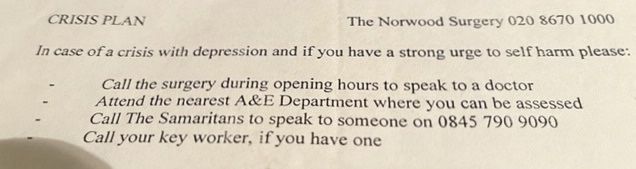
A Crisis Plan. Special features – Not worth two pennies. Highly ineffective. Not accompanied by a conversation. No detail. Not individualised. Not created in partnership with the patient. Not an alive document. Does not mention anything more than ‘self-harm’. Doesn’t tell us what ‘Crisis’ looks like. Doesn’t identify any helpful distractions, activities, friends or family. Doesn’t appear to know the patient, for example, a key fact – does this person have a key worker? Does not express any understanding or compassion.
Commonly used in developed countries.
Oops! The name of the GP surgery is visible. It doesn’t matter. It closed down years ago. We were it’s last few unlucky patients. Owner: Saagar Naresh (1994-2014).
She was listed for a minor surgical procedure on my list. I called out her name in the waiting area and escorted this pleasant, middle aged lady into a cubicle for her pre-anaesthetic check-up. We both sat down at right angles to each other. She had an unmissable racoon’s eye on the right side of her face. I looked again. Just to be sure. It was there in its fading pinky-blueness. She was in hospital for a totally unrelated reason but I ventured into asking, “What happened here?” pointing to the eye.
‘Oh. I had a run-in. Couple of weeks ago.’
“A run-in with what?”
‘You know … It’s okay. I don’t want to talk about it.’
“Have you spoken to anyone about it?”
‘Yes. I am okay. I really don’t wish to speak about it.’
“That’s fine. How are you doing today?”
We went ahead, staying focused on preparing her for the upcoming procedure.
I took a moment to call the Safeguarding department of the hospital. They said that it was normal for people suffering abuse, to not talk about it for a long time. They advised us to signpost her verbally. A written set of resources might make her more vulnerable, if discovered by the wrong set of hands.
Two women are killed by a partner or former partner every week in England and Wales.
One in five people suffering domestic violence will plan or attempt to take their own lives.
One in eight of all female suicides and attempts in the UK are due to domestic violence and abuse. This equates to 200 women taking their own lives and 10,000 attempting to do so due to domestic abuse every year in the UK. That’s nearly 30 women attempting to complete suicide every single day.
Men endure domestic abuse too. This can include physical violence, as well as emotional and psychological bullying, sexual violence or financial control and abuse.
It is living hell. An invisible prison. Isolating, with no one to confide in.
It takes great courage to speak. It’s often ignored. Many suffer in silence.
Survivors do come in contact with health and social services but disclosure is difficult.
If done right, it is life changing. Appropriate response is invaluable.
Front-line staff must recognise signs and highlight issues.
It is important to ask and act.
After her procedure, I went to see her in the Recovery room.
“Have a nice evening.” She said. “Thank you for noticing.”
It churns inside me all the time. This thing does not settle. It does not sit still. It burns my tummy, wets my thirsty eyes, parches my tongue and pokes its elbow into the longing in my heart. It doesn’t rest and doesn’t allow me to rest. It kisses my forehead, only to kill me with its kindness. It stays with me, no matter where I go – to the park, to work, on a bike-ride, at my desk, in the kitchen. It seeps into my words. Into the movements of my hands. Into the mirror. Into the songs, I choose. Into tea and toast. There is no getting away from it. It pervades my silences and my sleep.
I wish it had never appeared but it has. It wish it wasn’t mine but it is. The problem is, it won’t leave me alone. Not for the briefest of moments. In a Stockholm Syndrome way, I hold on to it and defend it. How I wish it wouldn’t tear me up so mercilessly.
What do I do with this thing?
Once I heard a Therapeutic Writing Coach say: Name it. Claim it. Tame it. Re-frame it. Proclaim it.
‘Re-frame it’ stayed with me. It does not mean I tell myself false pacifying stories but encourages me to see it for what it is, beyond the drama. Grief, as love that has no place to go. Longing, as the other side of the coin of love.
If I don’t transform it, I will keep transmitting it and I don’t want to do that.
(Resource: Therapist and Writing for Well-being Coach



 kidsaregifts