Day 867

Kooning
(The Attic, by William de Kooning)

In the 1920s, a Russian film director, Lev Kuleshov filmed a male matinee idol staring in turn at a bowl of soup, a young girl in a coffin and an elegant lady reclining on a couch. The actor got rave reviews from the audiences on his ability to effortlessly evoke hunger, grief and desire in the film. What they did not know was the fact that the director had used the same shot of the actor each time, just cut to each different object.

Humans have an innate need to impose order on the world. If we are presented with disparate images, we will try to assemble them into a meaningful order. It we are given a bunch of jumbled unrelated words, we will try to arrange them into a sentence that might mean something.

In the mid-twentieth century, Wiiliam de Kooning emerged as one of the pioneers of Abstract Expressionism. His art is known to put brains in a tizzy, desperately trying to order and make sense of the shapes within. Faces? Animals? Semi-clad human forms? Women? Doors?

ExcavationdeK
(The Excavation, by William de Kooning)

Maybe life is the same – unrelated images randomly juxtaposed, the human mind desperately struggling to make sense of them.

Ref:

William de Kooning: http://www.theartstory.org/artist-de-kooning-willem.htm
Kuleshov effect: https://www.youtube.com/watch?v=_gGl3LJ7vHc

Day 866

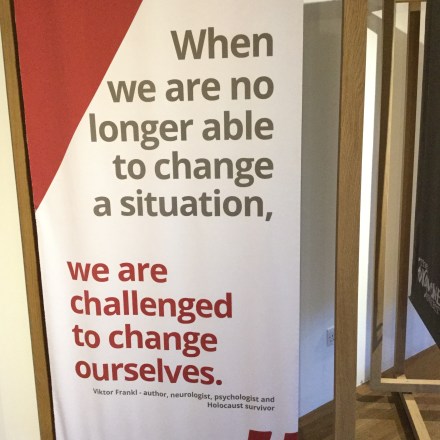
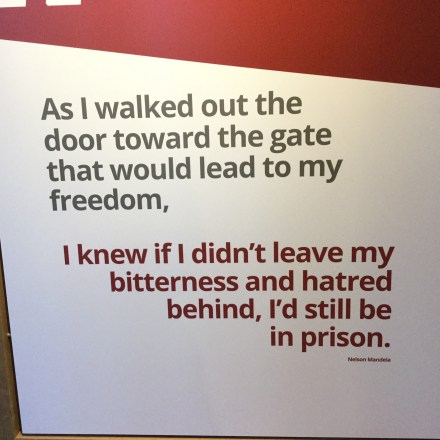
Having a couple of daylight hours still left after work is a luxury. This evening I was lucky. I walked aimlessly along the Southbank and ‘The F-word’ exhibition caught my eye. F for Forgiveness. Bold posters with simple, human messages from ordinary people from all over the world, telling stories that transform, offering a dynamic and challenging exploration of forgiveness through real life situations.

There is nothing ordinary about forgiveness. Forgiving others. Forgiving myself. I constantly struggle with it.

One mother said “When I was told that my son had been killed in action, the first words that came out of my mouth were ’Do not take revenge in the name of my son.’ It was a totally instinctive response.”

When Saagar passed away, one of the strongest feelings that came up for me was – no one should have to loose anyone they love to suicide. That was the driving force that kept me alive and goaded me on but forgiveness is a subtle and powerful thing that happens at another level. I am very conscious of the fact that it is something I really need to address but keep putting it off while it keeps gnawing away at me. Perhaps, it is not entirely by co-incidence that I chanced upon this exhibition.

IMG_0570IMG_0571IMG_0573IMG_0574

Ref: http://theforgivenessproject.com/


Day 865

IMG_0567

Work is good.
Ikebana is beautiful.
Friends are lovely.
The weather is not bad.
The volunteering is going well.
Meditations are peaceful.
Writing is fun.
Si is a blessing.
Family is great.
Smiles and laughter are coming back.
Music is returning.
Good things are happening.
Saagar’s friends are sweet.
Energetically, things feel positive.
All is well.

But I miss him.
I miss him to death. It kills me.
I miss his smile, his hugs, his smell, his voice, his jokes, his brilliance, his light.
I miss the way he made me feel.
I miss what we had and what we could have had.
I miss the cup of tea he would sometimes make for me.
I miss everything about him. I wonder if he knows how much. Our texts, our conversations, out silent communications, our shopping sprees, our travels… I miss them all. Even though he is always present, I miss him like hell. Nothing seems to lessen the missing. It is always there, like an unbearable part of me. The wretched missing and me are incurably, painfully one.

Day 864

This is a well-known story within medical circles. A few years ago, a patient was in the operating theatre to have his diseased kidney taken out. Everyone believed it to be the left kidney, except a medical student who said in a hesitant, soft and muffled voice that he thought it was the right kidney. No one paid him any attention and went right ahead to take the left kidney out. It turned out, that was the wrong kidney. The only person who was correct was the medical student. The person who suffered the damage was the patient.

Large organisations are hierarchical by nature. Decisions taken by those on top are rarely questioned by juniors. But true leadership means, the ability to challenge the status quo. The culture of an organization is shaped by the worst behavior the leader is willing to tolerate.

During their selection process, Google particularly look out for ‘courage’ in candidates. They prefer to hire people who ask the right questions and are not afraid to be open if they disagree with what is being said, irrespective of who says it.

The only way to improve is to be open. That is how we learn.

When was the last time I kept quiet when in fact I had something to say? When was the last time I didn’t have the patience to listen? What are the dynamics at my work place? Who pays the price for my silence or my inability to listen? Will I have the courage to speak-up the next time? Will I have the courage to listen?

“It is not because things are difficult that we do not dare, it is because we do not dare that they are difficult.” – Seneca

Ref: Just a Routine Operation (A short film about the importance of Human factors , one of them being assertiveness) : https://www.youtube.com/watch?v=JzlvgtPIof4

Day 863

IMG_0562

Jalebis are the most luscious of Indian sweets . They are made from plain flour, ghee, saffron and sugar – the best possible ingredients. They bring back the sweet memory of home. Lately they featured in a Holywood film, Lion, as a trigger for a deep longing for home for a young displaced man. This longing grows into a desperation and then becomes a source of great suffering. Even though the body moves from one place to another, the heart can stay in one place for lifetimes, clinging on to sights, smells and sounds that mean ‘home’ and ‘love’. The power of the mind to revisit, relive, reconfigure and re-create life from all these stray scraps is tremendous.

This big blockbuster addresses issues of adoption, childhood trauma, migration and much more. The most interesting questions it has raised for me are – What is your narrative? What is the story you tell yourself? Do you ever question it? Are you willing to see how your life might change if you did question it? Are you willing to be proven completely wrong? Would that set you free? Would that empower you to change your direction?

The things we tell ourselves have more power than we know. They make the difference between life and death.

Lion

Saagar as Lion 🙂