Day 822

the-drummer

Jack Samuel on Facebook:

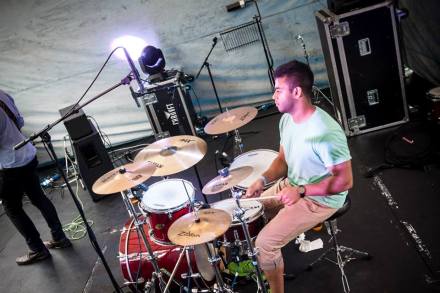
When I found out about the passing of Saagar Naresh, I had very little time to process my thoughts. Sitting on a train to Munich several days later, I was alone with my thoughts for the first time, and a memory of Saagar popped into my head. We were in the music room at Aidan’s, having one of our last-minute band rehearsals. At the end of a song, we realised that one of the porters had been standing outside the room, listening to us. He came in, and he said “I’m loving the music, but could you possibly play a little more quietly?” Assuming that he could hear us from his desk upstairs, we weren’t all that surprised that we were being a bit loud. What we hadn’t realised was that the porter had come from a conference in the Lindisfarne Centre at the other side of college. He had come to tell us that Saagar was drumming so loudly that everyone in the conference could hear him. By extension, Saagar was probably interrupting the whole of college. I wouldn’t be surprised if people in the other Hill colleges could hear him. Nobody drummed as loudly as Saagar.

This is a song I wrote for Saagar that day on the train. Even if Saagar and I sometimes had a different approach to life, he is such an important part of some of my best memories of Durham. He had a joke for every situation, a great awareness of the world, and the most powerful drumming style I have ever seen on a man.

RIP Saagar, this one’s for you.

Here is a song for someone who will bang the drums so loudly that we’ll always be able to hear him, no matter where he is. R.I.P. big man.

https://soundcloud.com/dontstealoursun/bang-the-drum

Day 821

Suicides are grossly under-reported. Here are a few reasons for that:

  1. Criminal standard of proof, “beyond reasonable doubt”, is required when determining the cause of death as suicide. Many suicides are recorded as ‘undetermined deaths’ because of that. The Chief Coroner is supportive of the change which would reduce the standard of proof for suicide to the civil standard and has expressed his view to the Ministry of Justice but the MoJ has steadfastly refused to change the way that coroners reach a suicide verdict despite persistent requests from Suicide Prevention charities such as PAPYRUS. This leads those of us campaigning on this issue to conclude that they deliberately want to suppress the figures around the number of people who take their own lives each year.
  1. MoJ argues that a change to the law would offend certain faith groups. We, at PAPYRUS believe that determining a cause of death should be about establishing facts, not about appeasing any particular sector of the community.
  1. Many families who have lost loved ones to suicide, particularly when the deceased are their children, do not want to hear that they ended their own life. Coroners are understandably sensitive and hence, reluctant to reach a verdict of suicide and conclude that the death occurred because of an accident or misadventure. An open or narrative verdict is often returned even when the evidence clearly shows that the person took his or her own life.
  1. Death is taboo and suicide is a deeper layer of taboo underneath. Mental illness is taboo and suicide is a darker layer of taboo underneath. The stigma attached to it stops everyone from being open about it.

Research by Professor Colin Pritchard at Bournemouth University suggests that if coroners used the civil standard of proof – “on the balance of probabilities” – we would see a 30-50% increase in recorded suicides. His research validates the view held by Papyrus that the current arrangements mask the true number of suicides in the UK.

Unless we can face the enemy, how can we ever hope to vanquish it?

Sources:

https://www.theguardian.com/commentisfree/2017/jan/09/suicide-crisis-law-uk-cause-of-death-young-people

http://www.inquest.org.uk/help/handbook/section-4-3-verdicts

http://www.thetimes.co.uk/article/thousands-of-suicides-hidden-to-comfort-grief-stricken-families-5fhkspfbx


Day 820

One of the French companies worst affected by suicides has been the telecommunications giant, France Télécom/Orange, where 12 employees took their own life in 2008, nineteen in 2009, 27 in 2010 and 11 in 2011. Despite a new agreement on workplace conditions negotiated with the trade unions, there has been a renewal of suicides in recent years with eleven cases in 2013 and ten suicides in 2014.

Suicides took place at a time when the company was restructuring, including a plan to cut 22,000 jobs in three years. Suicidal individuals shared a similar profile: these were typically skilled male engineers or technicians in their fifties who had been forcibly redeployed into low-skilled roles, often in call-centres.

On 17 January 2014, a 42-year old employee dealing with business customers at a France Télécom/Orange office in Paris, threw himself under a suburban train on his way to work. His sister, who is pursuing a claim against the company, contends that her brother had repeatedly complained to his bosses that he was a victim of bullying by his manager. Occupational doctors had also reported a deterioration of working conditions at the agency where he worked, with a rise of workplace stress as a result of company restructuring. Prior to his suicide, the victim had sent e-mails to family members complaining of an unmanageable workload and of constant surveillance and he referred to “humiliation”, “intimidation” and “bullying”. He held several meetings with senior management where he complained of harassment by his manager. Five days before his suicide, he sent an e-mail to his head of service in which he reiterated his request to change teams. These e-mail exchanges are being used as evidence in the investigation by the public authorities into his suicide.

Whilst in France work place suicides are an urgent public health phenomenon, in the UK, despite severe deterioration in working conditions, workplace suicide is not recognised in legislation and there are no specific official mechanisms for data collection. Even when it takes place in the workplace, suicide is presumed to be an individual and voluntary act and according to Health and Safety Executive (2016) legislation: “All deaths to workers and non-workers, with the exception of suicides, must be reported if they arise from a work-related accident.”

(Source: When work kills : http://www.emeraldinsight.com/doi/abs/10.1108/JPMH-06-2016-0026?mobileUi=0&journalCode=jpmh)

Day 819

scan-3

The night temperatures are below freezing. The weather forecasts are sending out warnings of frost and black ice. I thought a hot water bottle for the night would be a good idea for uninterrupted sleep. I placed it against my lower back as I drifted off in fetal position. It was comforting and sleep-inducing, resting perfectly still against my lumbar spine. I was wrapped up in my duvet and the bottle, in a thick white cotton towel under the duvet.

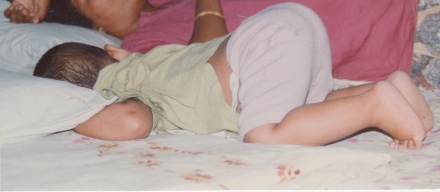
Sometime during the night, I surfaced to a semi-awake state and felt a small bundle next to me. It was warm and cuddly. Still half submerged in slumber, my mind floated away into the past. My hands brought the bundle up to my chest and held it close. It didn’t move. I hugged it and kissed it. The pain of the love and the longing came back. The absolute joy of cuddling my baby came back. The memory of how he slept with his bum in the air came back. The sense of the way he moved round in his sleep came back. The tears came back. The pillow got soaked but the eyes stayed closed and the attention went to the sobs, the sadness and the breath and then slowly…the sleep came back.

Day 818

dry-791774_960_720

The Tale of the Reed Flute by Rumi

Listen to the reed flute and its tale.

Complaining of separation:

Since they cut me off from the bed of reeds

Men and women lament the sound of my cry.

Due to separation, I want chests torn to shreds

To describe the pain of desire

Anyone distant from his origins

Will seek to return to them.

Lamenting at every gathering,

I am the friend of both

The happy and the unhappy

Each believes himself to be my friend,

Yet none searches for my secrets.

My secret is not far from my lamentation,

Yet my eyes and ears do not have that light.