Day 711

photo-7

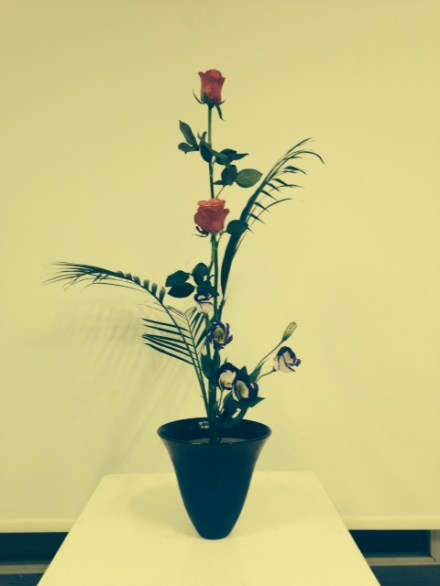
“This study is ok for the bed-room” said my teacher scrutinizing my floral arrangement, “not for the living room.”

Resuming Ikebana lessons has reminded me how much pleasure I derive from touching, feeling, smelling and putting different types of flowers and foliage together. After a long day of practicing anaesthesia, it is a refreshing change to be in a position where the big decisions to be made are – which colour do I want the flowers to be, how long should this stem be, which leaves should I keep and which ones should be trimmed away and other such important considerations.

I belong to the Ikenobo school of Ikebana, an ancient art of Japanese flower arranging. It endeavours to bring nature indoors and establish a perfect balance between the beauty outside and inside homes. It is a classical art form based on deeply philosophical principles.

The study I am presently working on is called Shoka Shofutai. In this composition 3 types of materials are used and arranged in 3 groups named Shin, Soe and Tai.

Looking over my notes I found that the Tai group has 3 stems right in the front of the arrangement, representing the present, the past and the future. The one representing the present should stand tall and should have some buds. The one representing the future should be bending forward and should have buds. The one representing the past should be in between the two and should be the smallest in size.

I wonder if there is a message in that.
 

Day 710

Can someone press the ‘Refresh’ button for me please?
Hello! Anyone there?
Nope.
Just me.
I’ve got to do it myself.

Many people ready and willing to hold my hand while I do it. Many waiting patiently for it to happen.
‘Re-fresh’.
Re-invent. Re-define. Re-create. Re-invigorate.
Re-enthuse. Re-affirm. Re-generate. Re-vive. Re-vitalise.
Re-make. Re-vamp. Re-novate. Re-build.
Re-model. Re-store. Re-new. Re-instate.
Re-live. Re-smile. Re-settle.

It’s coming up to two years!
Is that a measure of anything though?
Time means nothing.
The absolute finality of death brings Time to a halt.
The suddenness of it puts emergency breaks on Time and forces it to come to a dead stop.

The question I ask myself – how much of this being ‘stuck’ is natural and how much is generated by my ‘ego’? I am sure Eckhard Tolle would ascribe a lot of it to my ‘pain-body’.

“It is not so much that you cannot stop your train of negative thoughts, but that you don’t want to. This is because the pain-body is living through you, pretending to be you. And to the pain-body, pain is pleasure. It eagerly devours every negative thought. In fact, the usual voice in your head has now become the voice of the pain-body. It has taken over the internal dialogue. A vicious circle becomes established between the pain-body and your thinking. Every thought feeds the pain-body and in turn the pain-body generates more thoughts. At some point, after a few hours or even a few days, it has replenished itself and returns to its dormant stage, leaving behind a depleted organism and a body that is much more susceptible to illness. If that sounds to you like a psychic parasite, you are right. That’s exactly what it is.

The beginning of freedom from the pain-body lies first of all in the realization that you have a pain-body. Then, more important, in your ability to stay present enough, alert enough, to notice the pain-body in yourself as a heavy influx of negative emotion when it becomes active. When it is recognized, it can no longer pretend to be you and live and renew itself through you.

It is your conscious Presence that breaks the identification with the pain-body. When you don’t identify with it, the pain-body can no longer control your thinking and so cannot renew itself anymore by feeding on your thoughts. The pain-body in most cases does not dissolve immediately, but once you have severed the link between it and your thinking, the pain-body begins to lose energy. Your thinking ceases to be clouded by emotion; your present perceptions are no longer distorted by the past. The energy that was trapped in the pain-body then changes its vibrational frequency and is transmuted into Presence.”

Conscious Presence.
Awareness of the ‘self’ which is infinitely more expansive than thoughts and feelings.

Day 709

Often I feel like I am hanging in between life and death. Neither fully alive nor fully dead. Will this plague stay within me forever or set me free one way, or another?

Andrew Sullivan, who suffered with AIDS and its accomplices writes :

“ And for a precious short time, like so many other (HIV) positive people, I also sensed that the key to living was not a concentration on fighting the mechanics of the disease (although that was essential) or fighting the mechanics of life (although that is inevitable), but an indifference to both of their imponderables. In order to survive mentally, I had to find a place within myself where plague couldn’t get me, where success or failure in such a battle was of equal consequence. This was not an easy task. It required resisting the emotional satisfaction of being cured and the emotional closure of death itself. But in that, of course, it resembled merely what we all go through every day. Living, I discovered for the second, but really the first time, is not about resolution; it is about the place where plague can’t get you.”

The grief of loosing Saagar is not the plague. It is unbearably sad but the plague is that voice in my head that screams – “You didn’t love him enough to save him. You could have done more. Love is in actions, not words. Love is not just an emotion. All this campaigning and writing is a cover-up. You will be found out. You didn’t care enough for your own child.”

That is the plague.
Living is, to find a place where the plague can’t get me.
To find a place where it can’t get me.
Cannot get me.

Day 708

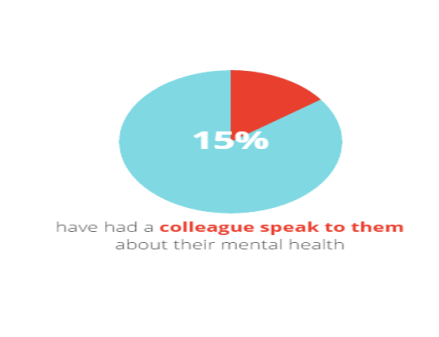
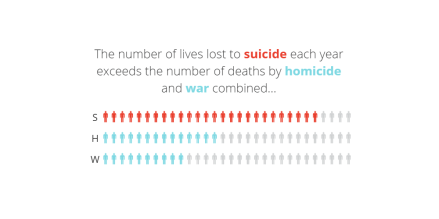
suicide_homicide_warA survey of 500 people revealed that a third of people didn’t feel comfortable at all talking to someone at work about mental health related issues and only 15% have had a colleague speak to them about their mental health.
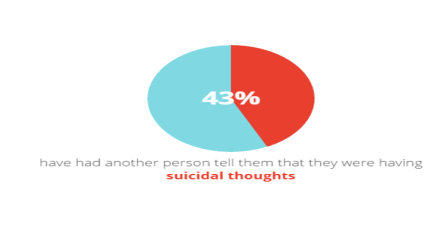
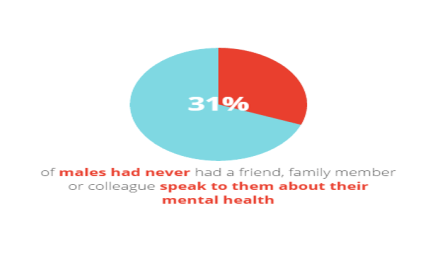
The survey also uncovered an interesting trend: nearly a third of all male respondents have never had a friend, family member or colleague speak to them about their mental health. Worryingly, this statistic rises to 42% for males aged 45 and over and increases yet again to 60% for males aged 54 and over.
( Source:  www.team24.co.uk/suicide-prevention-day )

43_per_cent_suicidal_thoughts

33_per_cent_dont_feel_comfortable_talking

31_per_cent_males_never_speak_mental_health

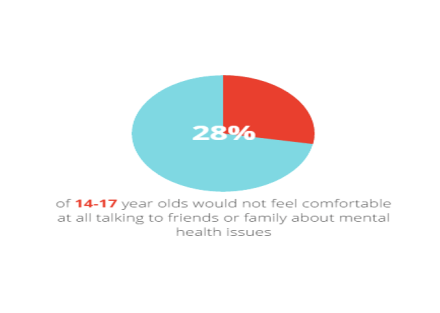
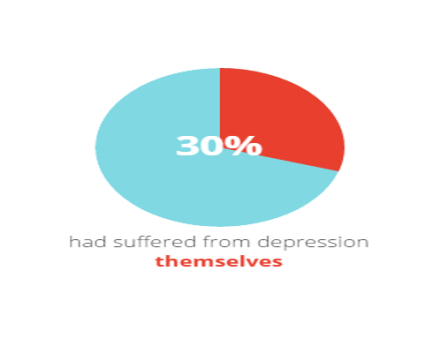
30_per_cent_suffered_depression28_per_cent_14_17_dont_feel_comfortable


15_per_cent_colleague_mental_health

“I would say that the vast majority of people who die by suicide, don’t necessarily want to be dead—they want to end their suffering and don’t know what else to do. We know from our clinical treatment research that suicidal suffering can be effectively treated. There is hope; suicidal states can be effectively treated and people can and do recover from suicidal suffering.”

David A. Jobes, Ph.D., ABPP. Professor of Psychology. Author of Managing Suicidal Risk

Prevention starts with a conversation.

Let’s start the conversation.

Day 707

While the government in England aims to reduce the rate of suicide by 10% in 5 years, an independent charity ‘Contact’ (http://www.contactni.com/) in Northern Ireland (NI) holds the vision of creating a society free of suicide. Its mission statement is – ‘Getting you through the most difficult times.’

Here are the salient features of its manifesto for this year:

  1. Zero Suicide is the only target to aim for, the ultimate expression of our commitment to patient safety. Driving suicide to zero must commence with health and justice care systems, affirming the conviction that, ‘no one should die alone, in despair, by suicide’.
  2. All learning achieved from saving lives in our care must be urgently applied to community and family settings. Continuity of care at crisis point must ensure critical real-time information sharing agreed by memorandum of understanding, investing in robust multi-agency relationships, applying 24/7 ‘air traffic control’, gold standard patient safety quality assurance for everyone in our care.
  3. No wrong door – every patient at risk of suicide must receive comprehensive clinical assessment and safety plan at first point of contact (including family/ loved ones, GP and crisis clinical support), testing safety plan relevance on every subsequent contact.
  4. No wrong door at times of crisis. Perfect crisis care requires 100% commitment to a ‘no blame’ culture, championed by accessible, visible and competent corporate leadership accountability – with immediate learning from honest mistakes celebrated as opportunities to achieve continuous service improvement excellence.
  5. Civic leadership must invest in competent, courageous suicide prevention championship, encouraging compassionate understanding while promoting courageous lived experience voices of hope and recovery.
  6. A regional Suicide Prevention Standing Conference to celebrate what works and drive the zero suicide challenge. If suicide is preventable, then NI health and justice systems have a unique opportunity and compelling obligation to provide world-class suicide prevention integrated care, from crisis-point, to stabilisation and recovery, with a renewed, ambitious, relentless resolve to drive the NI suicide death rate down, establishing NI as the safest-from-suicide region in the UK and Ireland within the next five years. Every suicide is preventable until the last moment of life.

Belfast was home for 7 years. Saagar was there from the ages of 5 to 12. He did a fantastic ‘norn-irish’ accent! I never thought I would be going back there to participate in a Suicide Prevention Conference but in November I am.