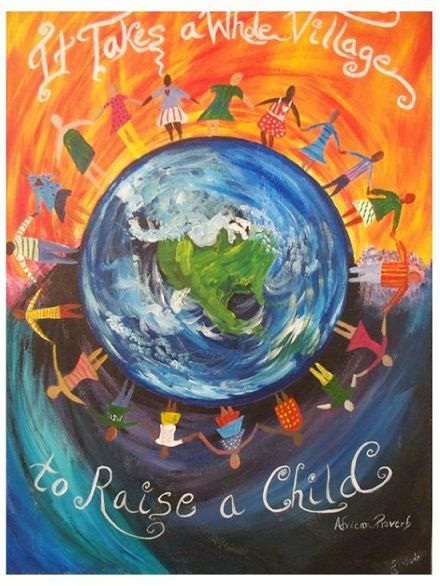
It takes a whole village to raise a child.

f73ced10f5b52382b2b8e1d461fa04aa

When I was 9, a music teacher came home every Tuesday evening to teach me singing and Kathak dance. That was my favourite time of the week. One week I waited and waited for what seemed like a very long time but he did not come. That evening I had a very high fever and had to be taken to the doctor.  Last week I have been having a high temperature, a cough and a cold. Withdrawal?

Growing up in the UK’, a report published by the BMA in 2013 found that we fail many children and young people every year. 2.6 million children in the UK live in absolute poverty. Children are at higher risk of living in both relative and absolute low income than the overall UK population. 14% of the most severely materially deprived kids from 30 EU countries live in the UK – same percentage as Romania. The severe economic hardship from the 2008 financial crisis in the UK and consequent spending cuts have been disproportionately detrimental to children, young people and low income families, particularly those who were already at a disadvantage such as migrant children and lone parent families.

‘We like to think of ourselves as a child-friendly society, but the facts do not support that comfortable, complacent assumption’  – James Appleyard, treasurer of the BMA.

Nelson Mandela said: ‘There can be no keener revelation of a society’s soul than the way in which it treats its children.’

According to the World Happiness Report 2013, Dutch kids are some of the happiest in the world. Here are a few possible reasons. Dutch parents are the happiest people. Dutch Mums have found the perfect work-life balance with 68% of them working part time, 25 hours per week or less. They don’t care so much about being charming or about how they look. Dutch dads are more hands on and play a large role in child care. Many of them also work part time. Dutch kids feel no pressure to excel at school. They have no homework before the age of 10. There is no competitive university application process. They can simply attend school for learning rather than competing in academic performance.

The Dutch breakfast mostly consists of a slice of white bread with butter and chocolate sprinkles on top. The United Nations called it healthy. What makes it ‘healthy’ is that breakfast is taken as a family every morning. The kids have a right to express their opinions as they are meant to not just be seen but also heard. Grandmothers have an active role in bringing up the grandkids and that has a huge positive impact on the kid’s self-esteem. The Dutch government gives money to families to help with expenses. People, including kids safely cycle everywhere. A huge emphasis is placed on ‘gezellighied’, a concept of pleasant togetherness that is more bracing than coziness and more exciting than contentment. ‘Gezellighied’ is an untranslatable Dutch word. Its closest meanings are convivial, sociable, fun, nice atmosphere resulting from general togetherness of people giving rise to a strong sense of belonging and a warm feeling. People work hard to bring this into their everyday family lives.

Why do we fail so many kids in our country?

Politicians make blunders because they surround themselves with like-minded people who are completely disconnected from the general populace. There is a failure in advocacy for children. As a society we need to examine and change our attitudes towards the importance of children. Mentally and socially some people manifest a bunker and silo attitude leading to isolation and exclusion. We need to create nurturing communities locally which could be based around the arts, music, exercise, spirituality, sports, play groups and after-school clubs.

Families, government and education policies and practices need to emphasise the importance of creating nurturing environments for kids.
 

Day 996


Tying the knot

IMG_0814

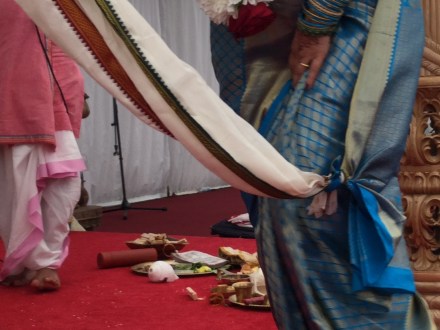
Today my friend and her fiancé tied the knot. 2 individuals and families came together and entwined their love and destinies forever. The sun and the flowers smiled as they poured out blessings. The fragrance of jasmine flooded the air as the pretty little white flowers adorned the hair of most women present. Chanting of Sanskrit verses in a rhythmic baritone meter sanctified the atmosphere. The fire at the centre of the auspicious ceremony bore witness.

The sights, sounds and smells conjured up images from the past. The food and music. The silk and gold. The gifts and festivities. The smiles and promises. The coconuts and beetle-nuts. The salutations and offerings to deities. The hopes and dreams of lifelong friendship, companionship, health, happiness and prosperity. Mischievous traditions of the bride’s friends hiding the bride-groom’s shoes and little competitions between the bride and groom. A reminder of times and people gone by.

In the last 2 years and 9 months I have turned down three wedding invitations. Couldn’t face the thought. Today was the first. It was good.

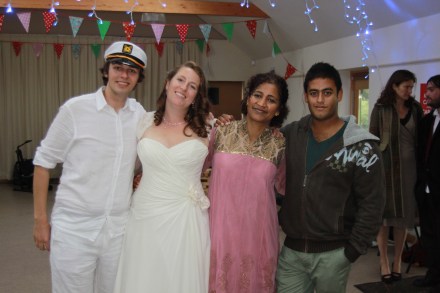
The last wedding Saagar and I attended was in September 2012. We drove to a small village near Brighton on a very wet day. Our Tom-tom took us to the middle of a field and declared, ‘You have reached your destination’ . We had to laugh. We drove up to the nearest set of houses, knocking on doors of complete strangers to find out more. We finally got there. It was great!

IMG_6808


Day 992

images

Strawberry Hill

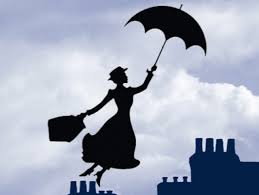
“If you had a carpet bag and an umbrella you could be mistaken for Mary Poppins” one of my colleagues commented as he stopped his car right next to me at a red signal while I waited there on my bike. I often wear a tunic dress with leather shoes to work. I enjoy watching other cyclists in their multi-coloured and multi-logoed breathable jerseys, elasticated and padded cycling shorts, grippy mitts, electric yellow socks, clickity-clop shoes, snazzy sporty eye-wear and fancy headgear. Most of them are very serious.

My cycle belongs to the category of ‘hybrid’. It’s black and silver. It’s heavy compared to some of the feather-weights on the road. The special thing about it is that it is wholly unremarkable. Saagar used to call it ‘old lady bike’. Its first name is Strawberry and second name, Hill.

Space on roads is negotiated between cyclists, motorists and pedestrians. Cyclists move in packs and sometimes have disagreements amongst themselves. It’s clear from the behaviour of a cyclist if he/she has ever been behind a wheel. Likewise, it is easy to say if a driver is cyclist-aware. Pedestrians are a law unto themselves.

Within 3 turns of my wheels as I start off from a red signal, at least 10 bikes go past me. It’s another matter that a hundred yards hence we find ourselves waiting at the next set of lights. Some attempt to squeeze through the narrowest crevice in the traffic. Being stuck behind a bus is a special treat in terms of the quality of air. Smoking is mandatory.

The morning ride to work is a dream – fresh air, fresh me, very few people out and about, the wind behind me and the way mostly flat or downhill. In the evening – smoky air, tired me, lots and lots of people, riding into the breeze on a steady uphill road. Both, leisure times. Excuses to be a child again. As my quads toil hard to get me home inch by inch, I visualise the tub of Green and Black’s Dark Chocolate ice-cream waiting for me in the freezer. It helps with the speed and puts a song in my heart.


Day 980

Japanese Floral Art

In ancient Japan it was believed that God lived in the evergreens. That is why they used it as the tallest and the main component of their flower arrangements. God was the invisible line that passes vertically through the centre of the arrangements. So said a senior faculty of Ikebana, Prof. Kurata at his lecture/demonstration this morning.

GodTraditional Ike

Three hours of his talk equalled a year’s worth of learning. He went on to show how nature outdoors is depicted through flowers, leaves and stems indoors. This bamboo vase represents a cliff side and the alcove within it denotes a cave from where plants are emerging towards light, the spectator. Pictures don’t do any justice to the space and the movement created by the study.

Cliffhanger

IMG_0738

He spoke of beauty. When hidden, it carries intrigue. When hidden, it allows for imagination to flow. When hidden, it can be the most beautiful thing in the world. This is an example.

The Veil

IMG_0741

The shape of the container and the simplicity of the materials combine to create elegance.

Who? Me?

IMG_0745

Rikka is a form that captures a landscape. Each part of it signifies something, like receiving, flowing, supporting and carrying. It has mountains and rivers within it. Find them if you can.

Tatiana

IMG_0747

Clever use of angular shapes and bright contrasting colours to create an uplifting happy slanting mood.

I swear diagonally, Bro.

IMG_0748

The world is sort of round and so is this. Rounds within rounds. Wheels within wheels. Keeping to the theme. Cheerful asymmetry.

Must be Spring

IMG_0750

This last one was for the youngest member of the audience, a 3 year old girl. Playful bobbles and wires hanging out happily with an orchid in a blue bottle of gel balls.

Smile!

IMG_0749

Wonderful to see a true genius at work! It’s calming working with flowers, stems, branches, leaves, berries and grasses. Being with nature. Breathing. Learning. Smelling in the subtleness. Letting the imagination flow. Allowing the Self to heal. Letting go. Dissolving.

Day 979

“Helping others is the way we help ourselves”
-Oprah Winfrey

Simple ideas change the world. A Clinical Psychologist, Dr Charlie Howard was taking a walk around her area. Having recently had a child, she was looking for her next “thing”. She asked random people what would make a difference in their community. “A Problem-Solving Booth right here on my street” answered a young man in the queue in a sandwich shop.  “A place where people can go with the stresses in their head and where we can help each other”. The idea was genius and Charlie’s head built on it quickly. “Maybe we could try one here?” Charlie suggested, “we could do it together”. The young man smiled at Charlie and said “yeah maybe” and then his phone rang and he ran off down the street. No one knows his name and no one has seen him since. He probably has no idea just what his throwaway words have since inspired.

Problem-Solving Booths are a great way to bring members of the community together to have conversations that they might not otherwise have, by helping each other with their problems. One chair is for the “Helper”, the person listening to the problems. The other is for the “Helped”, the person describing their concerns. The aim of the Booth is that people swap roles regularly as we all have both the potential to have problems as well as to offer help.

Thrive London is a citywide movement for better mental health for Londoners supported by the Mayor of London and the London Health Board. Problem-Solving Booths have become the local arm of Thrive and we’re working out what they are, what they do and what they can do, with everyone we meet from street to street, borough to borough and organisation to organisation. It’s cool.

Watch this space!