A report and a film.

A report published last month by National Child Mortality Database (NCMD) identifies common characteristics of children and young people who die by suicide between 1st April 2019 and 31st March 2020. It investigates factors associated with these deaths and makes recommendations for policy makers.

Every child or young person who dies by suicide is precious. These deaths are a devastating loss for families and can impact future generations and the wider community. There is a strong need to understand what happened and why, in every case. We must ensure that we learn the lessons we need to, to stop future suicides.

Key Findings:

-Services should be aware that child suicide is not limited to certain groups; rates of suicide were similar across all areas, and regions in England, including urban and rural environments, and across deprived and affluent neighbourhoods.

(No one is immune.)

-62% of children or young people reviewed had suffered a significant personal loss in their life prior to their death, this includes bereavement and “living losses” such as loss of friendships and routine due to moving home or school or other close relationship breakdown.

(Saagar was unable to return to his life at University due to a new diagnosis of a mental illness.)

-Over one third of the children and young people reviewed had never been in contact with mental health services. This suggests that mental health needs or risks were not identified prior to the child or young person’s death.

(Saagar had been in contact with Mental Health Services but they discharged him as soon as he showed signs of improvement. They did not follow him up. His GP was unable to identify his high risk of suicide despite his Depression scores being the worse they could be for at least 4 weeks.)

-16% of children or young people reviewed had a confirmed diagnosis of a neurodevelopmental condition at the time of their death. For example, autism spectrum disorder or attention deficit hyperactivity disorder. This appears higher than found in the general population.

(Saagar did not.)

-Almost a quarter of children and young people reviewed had experienced bullying either face to face or cyber bullying. The majority of reported bullying occurred in school, highlighting the need for clear anti-bullying policies in schools.

(At his Primary school in Belfast, his peers called him ‘Catholic’. He didn’t know what it meant but he knew it was not right. This went on for more than a year before I found out. When I spoke to his class teacher about it, she denied any problem.)

The film ‘1000 days’ tells us about Saagar and what we have learnt from his life and death. I am not sure what or how much the policy makers and service providers have learnt or changed but we have learnt and changed a lot and here we talk about that. The film is presently available on-line at the Waterford Film Festival (Short Programe 6), till the 15th of November at the link below. Please take 20 minutes to watch it if you can. You will learn something too. Each one of us can make a difference.

https://waterfordfilmfestivalonline.com/programs/collection-jlvwfxb8ctq

Ordinary people

Once upon a time there was an ordinary person. Making a living, being honest, spending time with the family, having a few friends and simple pleasures. Nothing special. Just ordinary.

Then they lost their child to the monster of unbearable pain. They carried on breathing and giving and receiving love. There was nothing ordinary about that. They couldn’t bear the thought of the same thing happening to anyone else. So, they went out to tell the stories of their angels to everyone. To exhibit the smithereens of their bleeding hearts. That was not easy or normal but they did it anyway. To say that there were other options that they wish their kids had been encouraged to explore. To give out the phone numbers of the good people out there who can help. To remind everyone that there was hope. There is hope.

These 3 dads were ordinary people. Now they are walking together for 300 miles over 2 weeks, making waves all over the country, connecting with people, smashing the stigma and sharing the stories of their lovely girls. Ordinary and beautiful. Just like you.

Please listen and take a look at what’s possible when love speaks and acts.

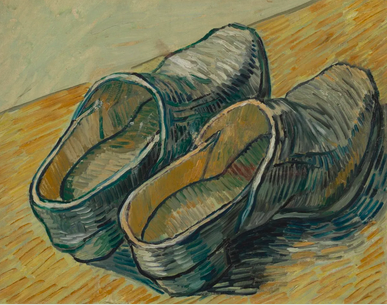
I hate my shoes.

(‘A pair of leather clogs’ by Vincent Van Gogh 1853-1890)

“I am wearing a pair of shoes.

They are ugly shoes.

Uncomfortable Shoes.

I hate my shoes.

Each day I wear them, and each day I wish I had another pair.

Some days my shoes hurt so bad that I do not think I can take another step.

Yet, I continue to wear them.

I get funny looks wearing these shoes.

They are looks of sympathy.

I can tell in others eyes that they are glad they are my shoes and not theirs.

They never talk about my shoes.

To learn how awful my shoes are might make them uncomfortable.

To truly understand these shoes you must walk in them.

But, once you put them on, you can never take them off.

I now realize that I am not the only one who wears these shoes.

There are many pairs in the world.

Some women are like me and ache daily as they try and walk in them.

Some have learned how to walk in them so they don’t hurt quite as much.

Some have had to wear the shoes so long that days will go by before they think of how much they hurt.

No woman deserves to wear these shoes.

Yet, because of the shoes I am a stronger women.

These shoes have given me the strength to face anything.

They have made me who I am.

I will forever walk in the shoes of a woman who has lost a child.”

  • Author unknown.

One death by suicide is one too many. On World Suicide Prevention Day, today, let us start by

  1. believing that suicides are preventable.
  2. knowing that we all play a part, however small, by being aware, educated and resourceful.
  3. being kind and courageous enough to ask the ‘S’ question, listen and respond.

One moment on a Friday morning.

Time is a scaffolding. Not the real thing. A construct. A transactional entity. An illusion. A convenience. A cage.

The Time is always Now.

Right now I hear Si pottering in the kitchen downstairs.

Michael, his friend is waiting in his car outside the front door. The engine is whirring, parked slightly to the left of the middle of the road with just enough space for passing cars to slide past.

My second cup of tea is waiting. Steaming.

The sunshine had penetrated many curtains to reach the park across the road.

The wind is gently encouraging the trees to wake up and dance.

The indoor plants watered this morning are feeling fresh. A large green Poinsettia (from last Christmas) on my left and a pink orchid on my right.

The ‘to-do’ list is staring at me from the far side of my table, feeling left-out. My Mind is pulling hard at me, trying to get me out of writing, into ‘doing stuff’. I am watching it. It looks like a toddler yanking at her Mum’s dupatta pleading for attention.

Black and green bins are lined up in tidy rows on the pavement along both sides of our street, waiting to be emptied. Five years ago, when the bin-collection day changed from Tuesday to Friday, I immediately thought I must tell Saagar. Then I remembered. Now, I think of him when I see the bins. I recall us putting the bins out together. In the Now. I feel that memory become a twinge in my chest. Sometimes, it becomes a cloud in both my eyes.

Now, I hold him in my heart on Fridays and every other day. He lives in me. Speaks through me. Sees the world and keeps me calm.

The neighbour’s son’s school bus stops at the same spot every day. He boards it wearing his yellow anorak every day. He sits at the same seat every day – by the window on the left, second row from behind.

The world goes on and I go on with it, carrying you in me. Loving you. Keeping you alive.

Same story

“Three weeks before that day he was at a bridge and he called his friend who called the police. They came out but just told him to call the GP. One week before that day he called another friend saying he had a panic attack. The friend picked him up. Four days before that day they told the GP what was happening. She gave him a prescription for anti-depressants and said it would take 3 weeks for a referral. 4 days later my brother was dead. At no point did anyone tell the family.”

That day was sixteen days ago.

I wonder if anyone sat down with him to listen to what was going on with him. Two friends, one GP and the Police – none of them could put him in touch with his life and keep him safe. Yes. Ultimately it is up to him but I wonder if he was told that it might be helpful to get in touch with his sister, his brother, his mother, his father – the people who had known him all his life. That he could choose someone who he had a deep connection with, someone he trusted, and let them know how fragile he was at present. Someone who truly cared.

I wonder if you’ve seen this recent advert from St John’s ambulance where a dad is desperately trying to save his son. It encourages lay people to learn First Aid, in case of a physical health crisis. It’s a good one.

Save the boy”

Let’s put this in the context of doctors not knowing how to give First Aid to someone in a Mental health crisis.

The police not knowing that this is life-threatening, that there are resources in addition to the GP, like A&E, Maytree, Papyrus, Samaritans, CALM, their community, their family.

The GP not knowing that this is life-threatening, that there are things in addition to antidepressants that help, like having a proper conversation, exploring the suicidal ideation, informing them that it would be in their best interest if they included a family member or a friend of their choice in their care, giving them details of helpful Charities, giving them compassion and hope, drawing up a Safety Plan, getting in touch with the local Mental Health Crisis Team and  being aware that antidepressants can make things worse for young people in the short term.

Over-medicalisation of suicidal thoughts and behaviours in a setting where most medics are uneducated and unsupported in managing these crises.

Save the boys and girls by insisting on education for all professionals in medicine, nursing, law-enforcement, prison service, youth services, social work, for schools universities, hair-dressers, cab-drivers, students, parents, teachers, managers and everyone else is the only way to get it right – A multi-agency approach to Suicide Prevention.

In the USA, ‘legislation’ was recognised as essential to Suicide Prevention(SP) in 2012. At present, 10 states have legally mandated training for all health care professionals.

ASIST Training (Applied Suicide Intervention Skills Training):