The day is the day.

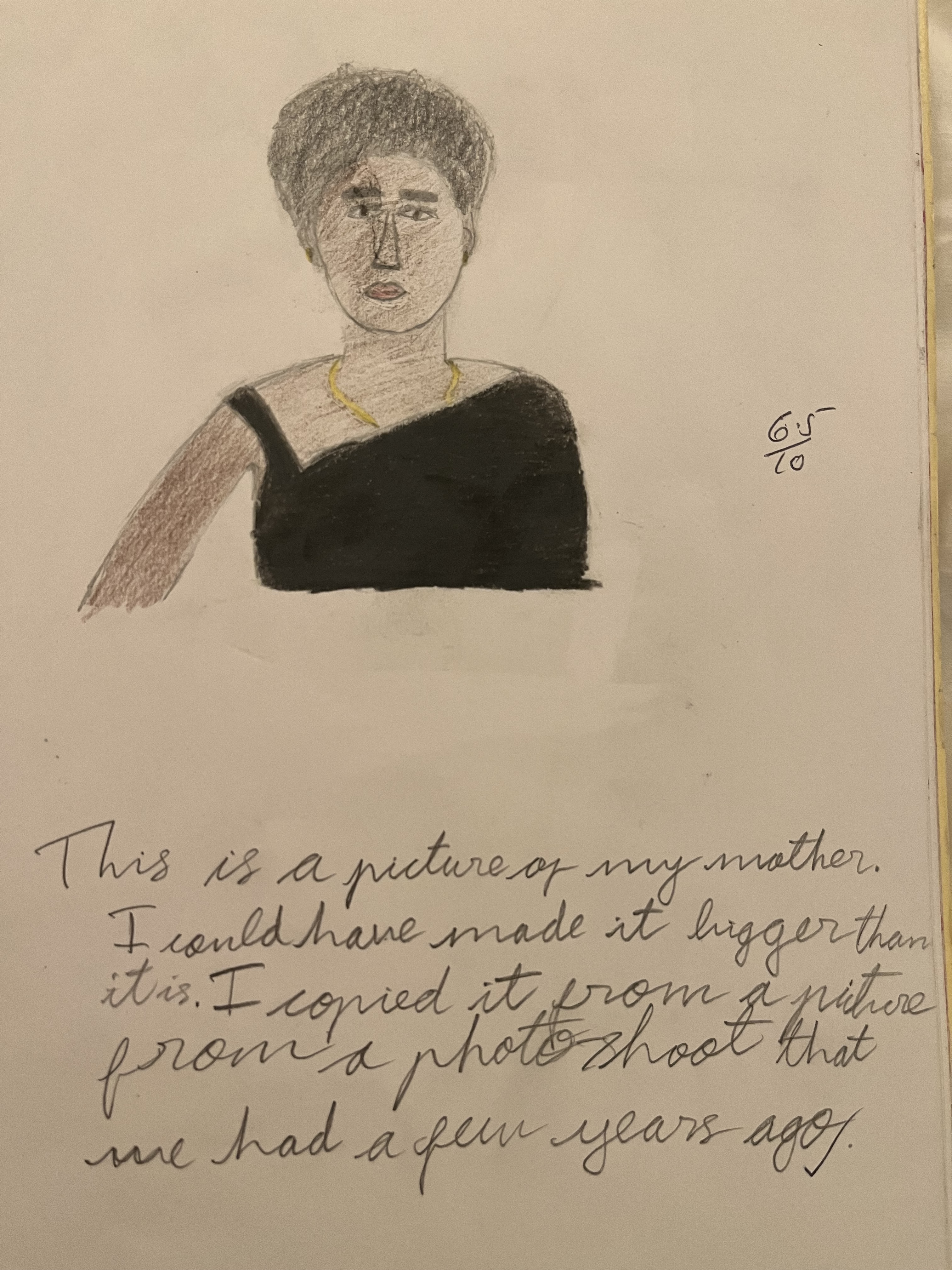
(Credit:: Saagar Naresh. Age 12. Art Homework.)

It’s an ordinary day that starts as the sun peeps from somewhere behind the horizon and ends as it vanishes somewhere behind another at different times for different people on the globe scattered all over these continents everywhere. It is not a singular day as it claims to be.

It’s not my enemy and yet it circles around each year as a reminder of what happened as if I need reminding. It’s not my enemy even though it feels like one. It’s just another day, innocent and ignorant, asking me to sit down. Have another cup of tea.

It was nameless and inconspicuous until it arrived hiding a deep darkness within its light wearing the face of a sacred place and a robe of expansion and growth and holding a promise of transformation before I knew what that meant, unlocking the path to an invisible destination.

This endless path covered in thorns and nettles with no alternative or detour must be trodden with bare feet. It is essential they bleed.

To my desperate open eyes the destination remains invisible. When I let them close I glean a faint ray of hope.

Bad mother.

She had been admitted to a separate room in the Birth Center because of her special circumstances. The thing was written all over her notes.

“Congratulations Vicky! You have a beautiful baby boy. Do you have other kids?” the doctor’s voice boomed from behind the drapes covering Vicky’s legs. She was grieving her first born, Oliver. Only six weeks prior, his brain tumour had ended his sweet little life. He was three. The doctor should’ve known but he didn’t. Did he not read her notes? Did no one tell him?

She kept quiet and so did her midwife, who knew. She let go of Vicky’s hand and walked south to whisper something in the doctor’s ear. His question remained suspended on top of her head like a heavy cold fog.

Vicky lay there, admonishing herself for the time Oliver had asked her for a cuddle. She was so tired, she was unable to stand up. The last few weeks of her second pregnancy and the last few weeks of Oliver’s life had mercilessly clashed and she was trapped in the middle. She wished for more strength. She wished Oliver had been home to receive his little brother. His sweet round face with blue google eyes danced in front of her eyes. The new baby had been cleaned and weighed. He lay in the cot while she danced with Oliver in her dreams.

Back in her room, the midwife fished out a smiley portrait of Oliver and set it on Vicky’s bedside table so she could see his face. Susan, her friend from the Lamaze classes came with a bunch of red roses. In those days that was allowed. “You have the perfect replacement.” she leaned down to kiss Vicky on the cheek, holding her own belly with her right hand.

Forty-five years later, Vicky still says “Bad mother” to herself for not having given Oliver more cuddles, especially the one he had asked for. She has not forgotten his smile or his suffering. She still believes her doctor was callous. She wishes Susan had not said what she said.

The kindness of that nameless midwife still brings a smile to her face and a tear to her eye.

*** *** ***

(On Unresolved parental grief , research says that parents who have not worked through their grief are at increased risk of long-term mental and physical illnesses. Core helps parents grieve and grow together.)

Cats

The Intensive Care Unit (ICU) at City Hospital, Belfast was a circus. Every day of the week a different clown (read Consultant) took charge of the ICU. What was right on a Monday was completely wrong on a Tuesday. The same action would be pronounced ‘perfect’ by one clown and ‘abhorrent’ by another. To make things even better, they didn’t talk to each other. The flunkies (read Junior doctors) were the in-betweeners that got lammed from both sides as their shifts crossed over time-territories. They were the pawns on the frontline that took over the running of the unit from one clown at the beginning of a shift and handed over to the other at the end of it. The flunkies dodged the arrows of conflict between the clowns – on the phones, in hospital corridors and at handovers. They were the ones that ran around all night looking after the sickest patients in the hospital, only to be lambasted the next morning. They were the buckets in which the bile of bitterness was collected, the one that the clowns didn’t have the gall to throw at each other.

In 2004, I was one of those flunkies. After about 8 months of this non-sense, I was done. I was loosing my sense of self, my confidence in making decisions and most importantly, the pride in my job. It was time to stop and take stock. After a nasty night shift, I was handing over the patients to the day team. At one point the Consultant said to me ‘you need your head examined’. That did it. I couldn’t bear to go home only to return to this hell-hole ten hours later. I walked into the Psychiatry Outpatient Department which was on the way to the car-park. There were two empty seats in the waiting area. I planted myself on one.
“Do you have an appointment?” one of the receptionists asked me.
“No. I don’t. I can wait for as long as it takes. I work here. If I am not seen today I may not come back tomorrow.” I didn’t fully comprehend what I was saying but it was my truth.

Dr Ingram was a handsome young psychiatrist with kind eyes and a small beer belly, well couched in his grey suit. He understood. He gave me 6 weeks off on grounds of ‘work-related-stress’ and started me on Fluoxetine. I was also seen five or six times by a therapist. She was a kind elderly lady who listened. She suggested getting a cat.

At the Antrim Animal rescue home an adorable black and white feline peered at Saagar’s dad and me from her cage. It was her eyes that got me – curious and twinkling, like a child. They said this little girl had been there for a month. Before that she’d had a rough life on the streets for a few months. Her right ear had a wedge missing from its edge. We decided to call her Bella. We were advised to keep her strictly indoors for at least 6 weeks, till she got familiarised with the smells of the house. She found her way to the tops of kitchen cabinets and radiator covers, squeezed behind sofas and underneath beds, inside shoes and suitcases. The only place she didn’t like was her brand new soft bed.

On our trip to the vet for a basic check-up, we were told that the she-cat was in fact a he-cat. After much discussion, Saagar’s dad’s choice of name came up tops. ‘Mr Bronx’, the old faithful. He soon became a source of great joy, comfort and hilarity for us. We had him playing with balls of wool, soft toys with bells and chasing the beam of a laser pen. He was pure joy but kept his distance. Slowly he let us stroke and cuddle him. His purring beneath the palms of my hand soothed my soul and made me feel deeply connected with this four-legged being. Within a month we were having full-fledged conversations.

The Fluoxetine made me feel like a zombie. No joy. No pain. No love.
It was dehumanising. At times it made me terribly restless but I stuck with it. It was proof that pills can’t make you happy. May be they take the edge off, but at a price. The best thing about that time was that I could rest. I was left alone. I had some control on my days and nights, which I had not had for years.

After 6 weeks, it was time to go back to work. I did. My schedule was reshuffled to ensure I didn’t spend much time working in ICU. It worked. I got back on my feet. Later I discovered that other junior doctors before me, had had similar unpleasant experiences, complaints had been made about the sad state of affairs at that hospital but nothing had changed on ground. It was an open secret, not spoken about while the abuse persisted and continued to break innocent young doctors down.

Nine years later, Saagar was home from University and I got a phone call from him at work. “Mamma, can we get a cat? I found one on Gumtree.”
That evening we went over to a tiny flat in Sydenham occupied by a black family of four – mum and three kids. On a window sill lounged another family of four, a grey mother-cat with her three grey kittens. Six weeks old. The kittens were being carried around the flat like rags by the kids. They didn’t care if they lifted them by their ears or tails or bellies.They released the sweet little things from various heights above the floor, cornered them and held them tight. They told us about what the cats ate. We picked the littlest one, a grey and white mini-punk. We got a bell, a bowl and some toys for him from the pet shop and brought him home in a cardboard box. He was christened ‘Milkshake’ by Saagar, who became his loving mum that summer.

The sedate Mr Bronx was too old and too calm for the punchy young Milkshake who developed an attitude very quickly, but they found a way to co-exist, keeping a safe distance from each other.

Not once did it occur to me that there might be a connection between the circumstances in which we got the first cat and then, the second.

Five times more likely.

Queer youth are five times more likely to die by suicide. I did not know that. I knew nothing about Andrea Gibson until after their death earlier this week from Ovarian Cancer. Every word they wrote throbbed with a cry against injustice. They were an activist for tenderness, a warrior for the human heart. I have spent most of today reading her poems and they sing to me. Gibson lived deeply and spoke candidly about moments when things got too much for them.

“When your heart is broken, you plant seeds in the cracks and pray for rain.”

“Just to be clear,” they wrote, “I don’t want to get out without a broken heart. I intend to leave this life so shattered there’s gonna have to be a thousand separate heavens for all of my flying parts.”

Respect!

Ms Helplessness

During Saagar’s illness, I was helpless. Also, I was rubbish at asking for help. A few weeks into Saagar’s unrelenting and forever changing moods, I was baffled. I realised I couldn’t do this alone, I needed to ask for help. Most of my family lived in India so I needed to hurry up.

Looking back, I asked somewhat hesitantly, by sending a group e-mail to my family members in India. Some tried to help and couldn’t. Others didn’t try. Yet others kept mum. Some advised me to send him to India. Some couldn’t even pick up the phone. I was so panicked that I couldn’t think straight. It didn’t cross my mind that I needed support too. The fact that I was a hot shot doctor at a hot shot hospital did not help. At that point, I was simply his desperate mother.

I texted a distant uncle on Tuesday night to say I was really worried about Saagar and we needed urgent help. He lived 20 minutes away. He texted back to say he could only help on weekends. By Thursday, it was all over. I suppose none of us had the slightest inkling of the disaster that was hurtling towards us.

Helplessness was the darkest cloud there ever was. It was a humiliating beast of a thing. It had completely obliterated the way I saw myself – capable, resourceful. It had made me a stranger to myself. Again and again, it invaded from the past to leave me without oxygen. I imagined I would limp through the rest of my life, trying to get to a point of relief, of grace. There was no way of getting that ghost of helplessness off my back.

A few years after his death, on a warm quiet afternoon on a beach in Goa, I invited Ms Helplessness to sit with me. We sat cross legged on the wooden floor of the beach hut. We looked into each other’s eyes for a few still moments. With tears streaming down my face, I extended both my hands toward her, and she took them in hers, gently squeezing them and then loosening her grip. I steeled myself and looked harder into her eyes.

I hate you. I forgive you for nearly killing me once. Thank you for showing me I can’t control what happens.

Maybe there’s a power beyond us both, that rules.

Promise me, you won’t be so cruel again. Will you? She had her gaze fixed on the ground in front of us. A tearful silence ensued.  Then she stood up and walked away.