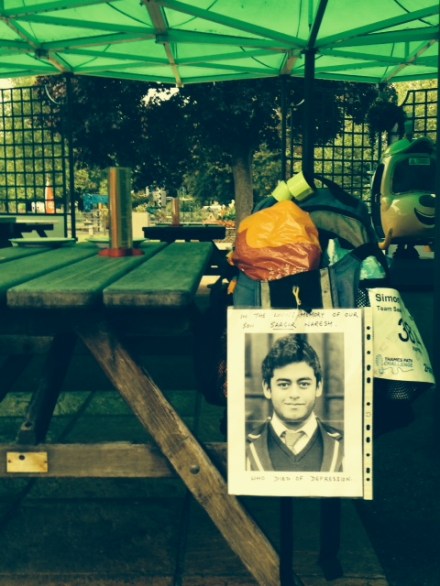
Day 695

photo

Wow! That was something.

50 K without much practice and with a few pre-existing issues in the right ankle and lower back for me and healing blisters from the last walk for Si.

It drizzled most of the day with no sunny spells and a few heavy showers. But around 5.30 pm it completely cleared up and we had a blissful walk in the twilight. The river and the life in and around it were making their sweet sounds, often unheard in London. More than half the moon was shining on us and soothing our aching legs. The last 5 kilometers were excruciating! Breathe in-2-3-4. Out-2-3-4. In through the nose. Out through the mouth. Paracetamol. Electrolyte water. Massage. Stretch. Sit. We had the best jacket potato with cheese for lunch. Met some lovely people. Shared stories. Reminded myself – one foot in front of the other. Si walked beside me holding my hand. At times bearing some of my weight through that hand! 

Feeling the legs a lot! Exhausted!
Hobbling but happy!

Ps: Thank you!!!

Day 693

This morning I spent an hour and a half at the Parliament Square with other enthusiastic, proactive, dedicated , men and women of all age groups who are passionate about talking about suicide and bringing it into everyone’s awareness so that it stops being a taboo subject.

A new YouGov survey commissioned by national charity PAPYRUS Prevention of Young Suicide reveals 78% of those surveyed did not know that suicide is the leading killer of our young people. The nation needs to wake up to the reality before more young lives are lost.

People do not realise how major this issue is. We need to raise this level of awareness and enable people to be more comfortable with the idea that they too can help to prevent suicide.

When asked what stops people from asking a distressed friend or relative about their suicidal thoughts, the main reason given was the fear of putting the idea of suicide into a person’s head.

“All the evidence shows that naming suicide is a relief for the person at risk and that we cannot create the idea by talking about suicide”, stresses Ged Flynn. “I cannot emphasise more strongly that asking about destructive feelings, talking about suicide, does not make it more likely to happen. It can, and often does, reduce the risk of suicide. Talking about suicide can seem scary but silence and stigma are killing young people. Many young people feel isolated with thoughts of suicide. People can start today by supporting our #TalkThroughTheTaboo campaign – it could save a young life.”

What would stop someone from speaking out about their destructive thoughts? That they would not wish to worry anyone (31%) or felt they would be letting people down (26%). Stigma is a barrier to seeking help.

Andy’s Man club is an inspiring new movement started by Luke. His main message is – “It’s ok to talk.” (http://www.totalrl.com/feature-andys-man-club-incredible-concept-telling-men-itsokaytotalk/). I felt strong standing there with these people, knowing that through the pain and tears, I make a difference.

When great trees fall

When great trees fall,
rocks on distant hills shudder,
lions hunker down
in tall grasses,
and even elephants
lumber after safety.

When great trees fall
in forests,
small things recoil into silence,
their senses
eroded beyond fear.

When great souls die,
the air around us becomes
light, rare, sterile.
We breathe, briefly.
Our eyes, briefly,
see with
a hurtful clarity.
Our memory, suddenly sharpened,
examines,
gnaws on kind words
unsaid,
promised walks
never taken.

Great souls die and
our reality, bound to
them, takes leave of us.
Our souls,
dependent upon their
nurture,
now shrink, wizened.
Our minds, formed
and informed by their
radiance,
fall away.
We are not so much maddened
as reduced to the unutterable ignorance
of
dark, cold
caves.

And when great souls die,
after a period peace blooms,
slowly and always
irregularly. Spaces fill
with a kind of
soothing electric vibration.
Our senses, restored, never
to be the same, whisper to us.
They existed. They existed.
We can be. Be and be
better. For they existed.

-Maya Angelou

Day 691

screen-shot-2016-09-06-at-17-51-30

A snippet from life of a Helpline call centre:

11.51: Bullies at school are telling the next female caller to take her own life. She’s upset and agitated and feels anxious about talking to her parents or GP. After talking through the issues, she says she’s not in immediate danger and will try to talk to her parents and seek support from her GP or the charity if she feels it necessary.

13.49: A mother calls about her son who is struggling at university and has told her he may as well not be alive. She is worried he might be suicidal.

The adviser talks to her for half an hour about asking her son directly about suicide and discusses what other support he may need, including talking to his GP and giving him the HOPELineUK details. Afterwards, the mum says she is more confident about speaking to her son.

18.32: With the suicide prevention advisers on calls, a voicemail is left by a young man. He calls back eight minutes later and starts apologising for calling the helpline.

He’s made plans to take his own life today and despite calling his mental health team and telling them he’s suicidal, he’s still waiting for his case worker to call back.

After 42 minutes on the phone with the helpline suicide prevention adviser, he’s much calmer and says he won’t take his own life today.

18.53: A young transitioning transgender person calls, admitting she’s feeling suicidal today. She spends 23 minutes talking through her issues with a suicide prevention adviser who works with her on a plan to stay safe over the coming hours and signposts her to support networks she may find helpful.

19.38: A text comes in from a young father who says he’s feeling suicidal. He suffered domestic abuse as a child and, as a result of alcohol and drug addiction, has lost contact rights with his own children. He says he has his suicide method in front of him and is intending to end his life.

Let’s break the silence. Hopeline number: 0800 068 4141

Source: https://www.thesun.co.uk/living/1732567/a-caller-wants-to-die-until-he-talks-about-his-cat-suicide-prevention-helpline-hopelineuk-works-to-prevent-hundreds-of-suicides-every-day/


Day 690

“Everything starts and ends in your Brain-Soul connection.
How your brain and soul work together determines how happy you feel, how successful you become, and how well you connect with others. The brain-soul connection is vastly more powerful than your conscious will. Will power falters when the physical functioning of the brain and the health of your soul fail to support your desires, as seen by illogical behaviours like overeating, smoking, drug and alcohol abuse, and compulsive spending.

It is the aim of The Amen Clinics to provide instructional programs and materials, evaluations and medical treatment where necessary to help you to understand and direct your mind to enhance your relationships, your work, and your health!”

Dr Daniel Amen is a psychiatrist in America who is a strong proponent of SPECT (Single Photon Emission Computerised Tomography) imaging of the brain. It bothers him that psychiatrists are the only medical specialists that never look at the organ they treat. Cardiologists, orthopaedic surgeons, neurologists look, whereas psychiatrists guess. As a result of which diagnoses are still made in the same way they were in the 1840s, based on symptom clusters. It’s like shooting in the dark especially when most psychiatric medications come with black box warnings that they might make the situation worse.

Screen Shot 2016-09-05 at 13.06.53

Simply put, the images tell us 3 things about the brain – areas of good activity, too much and too little activity. In his TED talk he shows some very convincing pictures of brains ‘before’ and ‘after’ interventions. He also shows scans of 2 patients with clinical depression but very different scans, one showing gross under-activity and the other significant over-activity.

Screen Shot 2016-09-05 at 13.16.56

He expresses great concern about the homeless people, criminals and soldiers returning from war zones who are not getting appropriate care as no one is looking at their brains and tailoring the care of their mental state.

He claims to have helped many people over the years using this technology but his work has been much criticised, firstly for not having enough evidence in its favour and secondly for the potentially harmful effect of the radio-nucleotide dye that needs to be injected in every patient. He has also amassed a great amount of wealth doing this work that insurers will not pay for. This  fact further discredits him within the medical community.

Would I have paid 3500 dollars for Saagar’s first assessment and scans at one of ‘The Amen Clinics’? Probably not. But it would have been good to have a more scientific approach to the diagnosis and management of his illness. It was like throwing darts in the dark. 


Day 686

“If your daughter is clever enough to get into this school and keep up with the curriculum, then she will be happy.” – this is what the parent of a 4 year old was told at an open day of a particular pre-school. They had 14 subjects on the curriculum for 4 year olds. On seeing the surprise on her face, the mum was reminded by one of the teachers that this was a school and not a nursery.

For those terribly serious about education, it is important to know that the reverse of the above is true. So, if she is happy enough, she will be able to keep up with the curriculum. A relaxed and light environment enhances the quality of learning for all age groups.

In New Zealand, a few key studies compared children who started formal literacy lessons at age 5 with those who started age 7. They showed that early formal learning doesn’t improve reading development, and may even be damaging. By the age of 11, there was no difference in reading ability level between the two groups. However, those who started aged 5 developed less positive attitudes to reading and showed poorer text comprehension than those who had started later.

Over the past half century, in many developed nations, children’s free play with other children has declined sharply. Over the same period, anxiety, depression, suicide, feelings of helplessness, and narcissism have increased sharply in children, adolescents, and young adults. The decline in play has contributed to the rise in the psychopathology of young people. Play functions as the major means by which children

(1) develop intrinsic interests and competencies
(2) learn how to make decisions, solve problems, exert self-control, and follow rules
(3) learn to regulate their emotions
(4) make friends and learn to get along with others as equals
(5) experience joy.

Through all of these effects, play promotes mental health.

It is no surprise that in Finland, Denmark and Sweden the age when formal education begins is 7.

(Ref: https://www.newscientist.com/article/mg22029435-000-too-much-too-young-should-schooling-start-at-age-7/)