Day 650

A brain surgeon, Paul Kalanithi got diagnosed with terminal lung cancer at the age of 36. Suddenly he found himself on the other side of the table. He wrote a ‘rattling, heartbreaking, beautiful’ book about his life as a doctor and then as a patient before he died. It is called “When breath becomes air’. In it he tactfully dissects the walls that exist between doctors and patients. Having found myself on either side of the table – first as a physician and then as the mother of a severely ill child, I can completely relate with this excerpt below.

“The reason doctors don’t give patients specific prognoses is not merely because they cannot. Certainly, if a patient’s expectations are way out of the bounds of probability – someone expecting to live to 130, say, or someone thinking his benign skin spots are signs of imminent death – doctors are entrusted to bring that person’s expectations into the realm of reasonable possibility. What patients seek is not scientific knowledge that doctors hide but existential authenticity each person must find his or her own. Getting too deeply into statistics is like trying to quench a thirst with salty water. The angst of facing mortality has no remedy in probability.”

“I had to face my mortality and try to understand what made my life worth living and I needed Emma’s (my doctor’s) help to do so. Torn between being a doctor and being a patient, delving into medical science and turning back to literature for answers, I struggled, while facing my own death to rebuild my own life – or perhaps find a new one.”

I cannot imagine what one’s options would be when diagnosed with a severe/ terminal mental illness. Saagar was unable to access his own life as he knew it and perhaps chose to find a new one.

Day 647

”No history of self harm” said the discharge summary from the Home treatment team to the GP. This sentence was one amongst many on the four page long letter.

Saagar was seen by at least 3 psychiatrists – 2 senior trainees and one Consultant and they all missed it. Did they ask him and he didn’t tell them the truth or was it an omission? The scars could easily be seen on his left forearm. They were clearly visible. Did they find the scars and questioned him about them? Did he make up a convincing story for them as he did for me? Or were they missed altogether? No one asked me about his history of self harm. He was mentally ill at the time and I don’t think I was.

At the Coroner’s inquest when this question came up, the psychiatric team said that the remark was made because Saagar never presented to the Emergency department with self-inflicted injuries. Is that a valid criterion?

Self harm is a personal and often a very private act. Given it is an important clue to the extent of a person’s emotional suffering, we as carers and professionals cannot afford to miss it.

“The only antidote to mental suffering is physical pain.”
– Karl Marx

Day 644

Impulsivity has been variously defined as behaviour without adequate thought, the tendency to act with less forethought than do most individuals of equal ability and knowledge, or a predisposition toward rapid, unplanned reactions to internal or external stimuli without regard to the negative consequences of these reactions.

Impulsivity is implicated in a number of psychiatric disorders including Mania, Personality Disorders, and Substance Use Disorders. Yet, there is significant disagreement among researchers and clinicians regarding the exact definition of impulsivity and how it should be measured.

2014 Publications Graphs

The Houston study interviewed 153 survivors of nearly-lethal suicide attempts, ages 13-34. Survivors of nearly-lethal attempts were thought to be more like suicide completers due to the medical severity of their injuries or the lethality of the methods used. They were asked: “How much time passed between the time you decided to complete suicide and when you actually attempted suicide?”

One in four deliberated for less than 5 minutes!
Nine out of ten deliberated less than a day.

1 in 4 said 5-19 minutes
1 in 4 said 20 minutes to 1 hour
1 in 6 said 2-8 hours
1 in 8 said 1 or more days

While this personality trait brings to question the predictability of some suicides, it most certainly makes a strong case for removal of means.

It appears that impulsivity does play an important but small role in suicidal behaviour. Research has demonstrated that impulsive individuals are more likely to engage in painful and provocative experiences and that these experiences appear to make them less fearful about death. Given their greater acquired capability for suicide, if these individuals go on to experience perceived burdensomeness and thwarted belongingness, they will be at high risk for death by suicide.

Day 637

South London and Maudsley (SLaM) NHS Foundation Trust is where Saagar was treated. This morning I visited their website and looked at a few videos and one titled “Insulin Coma Dreams: The Gloriously Psychotic version” captured my attention. It shows glimpses of healing through sharing stories, art, singing, playing the drums and guitar, poetry and rapping. It is full of hope. One young lady spoke the wisest words coming from her own experience of mental illness (most probably Bipolar Disorder):

“You need to stop focusing on lack
If you wish to reclaim your power back
You are a glorious co-creator
You have the power to design a will
So what you are experiencing
You have the key to change it still
If at times it feels as though
You are not the one in control
This is just a reflection of
Disconnection from the soul
Your inner being is pure love
And it speaks and thinks as such
So when your thoughts are not of love
It just means you need to get in touch
The love that you are
That at times you forget
It is that simple love
That’s your biggest asset
So when things are scary
You feel pain or angst or stress
Just remember who you really are
And know that you are the best.”

Day 634

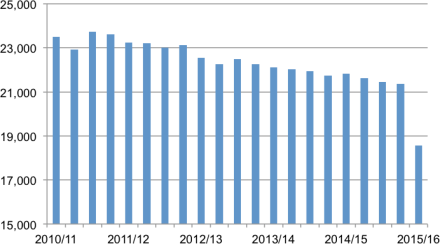
beds

Total beds available for Mental Illness in England

The total number of beds available for mental patients has steadily declined in recent years in response to acute funding pressures in the NHS and a latent preference for physical illness over psychosis. This is creating intolerable pressure on families and care in the community resources and frequently results in young people being sent for treatment hundreds of miles from where they live. This is unacceptable.

iapt

Access to Psychological Therapy (IAPT) in the NHS

The demand for psychological treatment has escalated dramatically in recent years. Whilst Improving Access to Psychological Therapy (IAPT) treatments has risen, it has not kept pace with demand and increasing numbers of referrals are being refused. The net effect is that treatment thresholds are rising – sufferers have to be in ever deeper crisis before they can access care. Those accepted for treatment are then faced with weak pathways and absurd waiting lists, leaving sufferers, families and communities in despair and anguish. This is unacceptable.

(Source: The MindEd Trust)