Do we really need another one?

No one reads books anymore they say.

Publishing is a dying industry they say and I love books. I know hundreds of people who do.

Presently I am in the world of trying to get a book published. I am witnessing an interesting phenomenon of humane, helpless and kind rejections such as this: “We think you are an emotive writer and your story is very moving. It would undoubtedly provide comfort to those who have lost children, whether by suicide or otherwise. But there is so much work that goes into publishing a book and we have to believe that it can work commercially to a certain degree. I worry that it would be very difficult to get media attention/reviews and therefore retailer traction in this case.”

These letters leave me strangely encouraged to persist and keep refining the manuscript, keep working on the craft of writing and keep remembering what this is about. I write in singular first person but denote the third person plural. I am They, Them, We.

It’s about kissing the ground that supports my weight. It is where my son, all my ancestors and circumstances stand in me through all the seasons and storms. In every moment, it is and has been my home whether I like it or not. It tells me who I am and how, from my very foundations I can hold a conversation with life even when it seems terribly treacherous. Strangely, it is also a place of grace that surprises me by its ability to humble and elevate me, even after being dragged through the mud. It enables me to step off onto a softer ground of gentle understanding where grief finds expression as what it truly is, pure love, often known by safer names such as compassion and connection. I kiss this wise ground that has taught me what it means to be free, be love and be human.

One way or another, I am sure my words will find their way to those with whom they will resonate. If you have any helpful ideas around publishing, please do write a comment. Thank you for reading. This blog is the birthplace of the book.

I fold.

My latest love is folding. The act of arranging a piece of paper or cloth in a way that it occupies less space and looks neat. Layering one part of it on top of another to make it compact. Apparently, molecules, tents, parachutes, rocks and beds fold too. But I am more inclined towards an un-stitched piece of material. Bed sheets and towels are my favourites but I don’t mind table-covers, handkerchiefs and face-towels.

Firstly, it’s the subtle fragrance of moist lavender fabric conditioner, still fresh from the wash. When I open my arms out wide to hold the margins, the top edge rises right up to my nose and the aroma gets right inside my head. Exhilarated by that, my fingertips follow the margins to find the corners. Sometimes the rim curls up on itself and needs to be straightened, patted back repeatedly on a flat surface. The corner often falls to the floor and it takes a deep forward bend to lift it up. These are the in-built stretching advantages for the upper and lower body.

The corresponding corners are brought together and the first large fold created which gets progressively smaller with every corner alignment, until I have a beautiful stack-able rectangle in my hands, ready to land on its shelf in the airing cup-board along with and on top of its contemporaries in white, blue, orange and green. If dried on a clothes-line, it doesn’t need ironing. That’s the energy saving advantage.

Folding a sari is an art-form. I learnt it from my mother. Here, the mouth and teeth assume an active role. The sari is an un-tailored stretch, at least six yards long and about forty-two inches wide. Before anything I need to ensure that I have a bed nearby so that I can lay the length of the material there while I work on the edges and corners. After figuring out which horizontal edge is up and which surface goes on the outside, I start from the top left corner. The rest of the routine has to be witnessed to be believed but it’s the middle point on the top edge of the sari that has been folded twice over that is held between the incisors for a short time. The silk ones have a habit of going all askew if not held and laid perfectly and lovingly flat. A real treat for the hands and arms.

Oh. The satisfaction. I wish all the ruffles and crinkles of the world could be folded neatly away and patted out with warm hands.

Yesterday I found myself putting away a pashmina that I had used once since it was dry-cleaned. In default mode, I was making the folds along the same lines, in the same direction as the dry-cleaner had done. It was strangely pleasurable and worrying.

Wonder where this new love of mine will take me.

Random stuff

After many years, things are being taken out of cup-boards and off shelves, turned inside out and properly looked at. Dusty books, clothes, folders, boxes and sachets. Some familiar fragrances are escaping and some old scenes are playing out on the screen of the mind. Bits of stuff slipping out of other stuff and falling to the ground with a clink. Some stuff that was believed to be misplaced is being placed. Some that was believed to be forgotten is being revisited.

Sample 1

A nappy pin. Special feature – A white safety cap to prevent accidental opening up while the baby has his cloth nappy on. Commonly used in India and other developing countries. Original owner: Baby Saagar.

Sample 2

A business card. Special feature – Simplicity. An invitation to music and joy. Original owner: Saagar.

Sample 3

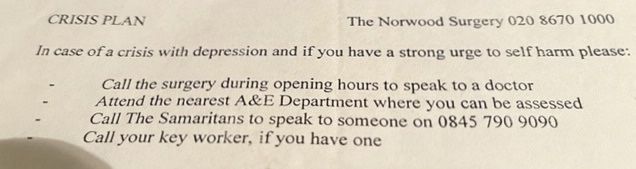
A Crisis Plan. Special features – Not worth two pennies. Highly ineffective. Not accompanied by a conversation. No detail. Not individualised. Not created in partnership with the patient. Not an alive document. Does not mention anything more than ‘self-harm’. Doesn’t tell us what ‘Crisis’ looks like. Doesn’t identify any helpful distractions, activities, friends or family. Doesn’t appear to know the patient, for example, a key fact – does this person have a key worker? Does not express any understanding or compassion.

Commonly used in developed countries.

Oops! The name of the GP surgery is visible. It doesn’t matter. It closed down years ago. We were it’s last few unlucky patients. Owner: Saagar Naresh (1994-2014).

(Resource: Safety Planning is essential to safety: https://stayingsafe.net/home)

Borrowed light

It sits on my shoulder like a monkey. Annoying. I’ve had a long day, I say. Go away.

It pulls my right ear and searches for lice scrambling all its fingertips over my scalp, irritating as hell. There are none. Get lost. I am not a child.

I’m losing it. The moon is winning.

Proud of its super-fullness. It is evil. The tides it excites, the fights it ignites, the way it bends minds, the resting foetuses it pulls into this cruel world, stealing sleep from the depths of the night. Milky and serene on the outside, within a serious trouble-maker resides. Hurricanes, tornados and earthquakes it invites.

You’re an imposter. I see you. A big black rough rock with nought to your name. No water. No gravity. No air. Certainly, no light. This thing you proclaim as your own is in fact not so. We all know. It belongs to the star called Sun. The one that gives life. Not you. That’s the real star. You, a mere appendage, borrowing importance, gloating in your pretend beauty, cycling and circling with poor intent.

You’re no good to me. Go away. You bad bad moon.

Thank you for noticing.

She was listed for a minor surgical procedure on my list. I called out her name in the waiting area and escorted this pleasant, middle aged lady into a cubicle for her pre-anaesthetic check-up. We both sat down at right angles to each other. She had an unmissable racoon’s eye on the right side of her face. I looked again. Just to be sure. It was there in its fading pinky-blueness. She was in hospital for a totally unrelated reason but I ventured into asking, “What happened here?” pointing to the eye.

‘Oh. I had a run-in. Couple of weeks ago.’

“A run-in with what?”

‘You know … It’s okay. I don’t want to talk about it.’

“Have you spoken to anyone about it?”

‘Yes. I am okay. I really don’t wish to speak about it.’

“That’s fine. How are you doing today?”

We went ahead, staying focused on preparing her for the upcoming procedure.

I took a moment to call the Safeguarding department of the hospital. They said that it was normal for people suffering abuse, to not talk about it for a long time. They advised us to signpost her verbally. A written set of resources might make her more vulnerable, if discovered by the wrong set of hands.

Two women are killed by a partner or former partner every week in England and Wales.

One in five people suffering domestic violence will plan or attempt to take their own lives.

One in eight of all female suicides and attempts in the UK are due to domestic violence and abuse. This equates to 200 women taking their own lives and 10,000 attempting to do so due to domestic abuse every year in the UK. That’s nearly 30 women attempting to complete suicide every single day. 

Men endure domestic abuse too. This can include physical violence, as well as emotional and psychological bullying, sexual violence or financial control and abuse. 

It is living hell. An invisible prison. Isolating, with no one to confide in.

It takes great courage to speak. It’s often ignored. Many suffer in silence.

Survivors do come in contact with health and social services but disclosure is difficult.

If done right, it is life changing. Appropriate response is invaluable.

Front-line staff must recognise signs and highlight issues.

It is important to ask and act.

After her procedure, I went to see her in the Recovery room.

“Have a nice evening.” She said. “Thank you for noticing.”

Resources:

https://www.rcn.org.uk/clinical-topics/domestic-violence-and-abuse/general-resources-and-support