People

So many disappeared.
I saw them on Day 1 and 2 and then nothing. Not even a text or a call.
Luckily, the early days were a fog, a maze. Luckily, I have forgotten so much.

Some people, who were nothing more than work colleagues showed up big time. They could sit with my despair. They sent me little books of poems for difficult times in the post. They met with me for coffee in town. They called up and chatted on the phone. They made a note of Saagar’s birthday and death anniversary and sent me cards, saying, thinking of you today. Simple, small things that meant the world.

Some people spoke very little but their body language boomed loud and clear. They mirrored the contraction inside me. Their empathy shone through that. On the second day, Rajeev, an old friend sat with us for two hours in silence. Before leaving, he said, “If there is anything I can do, please let me know.” Over the next months and years, he followed my blog, commented on posts and casually dropped by when he could. He let me know he was there.

Some people possibly saw in me, the worst possible lashing of fate as a parent. Maybe they got frightened. The speed of their exit indicated their fear of catching it. Some people who were previously in the ‘life-long friends’ category, vanished. One of them was a Psychiatrist, a mother of two. One of her children, Rajat, was a close friend of Saagar when we were neighbours in Belfast. The two boys spent every evening together cycling, playing and talking. They often had their dinner and their bath in each other’s houses. I still have a picture of them at six-year-olds, with the alien they constructed together from their toys and balloons. We were the closest of friends for four years and then they moved to Birmingham and we, to London. We stayed in touch and visited each other but the boys grew apart as boys of that age do. After their visit on Day 2, our next contact was a wedding invitation to Rajat’s wedding by a WhatsApp message, eight years on.

Of course, people don’t understand. They can’t. It’s not their fault. I wouldn’t want them to because they would have to experience this. If this had happened to a friend of mine, I would like to think that I would’ve been there for her but I don’t know that for sure. The woman I was in the ‘Before’ might have been too busy or too afraid or too awkward. I don’t know.

Some of Saagar’s friends have been with us all along. We’ve attended every concert we could as Hugo and Azin have risen in their musical careers. We have met up for meals and walks as often as possible. We’ve met their partners, watched them buy houses and change jobs. Our connection with them seems to be made of the same silk as our love for Saagar, and his memory. We feel blessed to have these young people in our lives.

Yes. My address book has radically changed. Like me.

Resource: How to be with someone who is grieving:

https://outlive.in/suicide-loss

PDA

(Awakening Needs Cards Created by Linda Nolan and Karen Plumbe)

It was natural, spontaneous and normal in London. Now, we must look around to ensure no one’s watching us.

Holding hands in public? At our age? Oh my God! At any age. Strange.

A hug. Inappropriately bold.

A peck on the cheek? Unthinkable.

A quick kiss on the lips to say hello or bye. Absolutely scandalous.

“Your husband even holds the umbrella for you in the market”, an acquaintance remarked.

I had not given it a thought. “Yes. He’s very good”, I said. I was tempted to defend his actions by making statements like, it’s easier for him as he’s taller than me or it helps me use both hands to select the fruit and veg but I stopped myself. He needs no defending. I was learning about what is normal here.

Affection isn’t a thing here. Public Display of Affection (PDA) is prohibited.

Food. Yes. Gifts. Yes. Laughter. Yes. Folded hands as greeting. Yes.

Hugs. No.

A young man of seventeen studies Biology with me for an hour, twice a week. He wants to be a doctor. He showed me an MCQ that he did not understand. It was about Barrier contraception. I asked him if he had covered the chapter on Sexual Health in School. He said the teacher had completely omitted it. She had asked the students to read and learn that chapter on their own.

The next day I found myself retrieving a little square white and blue packet from the small cupboard outside the door of the local Health Centre. It was labelled Nirodh (the Government sponsored condom). I had not signed up for this, but I turned out to be the one to explain Sexual health to him.

In a society where men and women pretend, they never touch each other and it is somehow wrong to do that, how can the adolescents learn affection, let alone intimacy?

“Affection is responsible for nine-tenths of whatever solid and durable happiness there is in our lives.”

– CS Lewis.

Who’s the boss?

Did you know there’s an organisation that brings science and spirituality together? Its mission is to create a kinder, heart-centered world where we care for one another and live harmoniously. It’s called the HeartMath Institute and offers many free resources.

They have found that the heart is not just a mechanical pump. It contains thousands of nerve cells. That is probably the reason our memories and trauma are stored in various parts of our body, mainly the brain and heart.

We were taught in school that the brain is a master-organ but it’s the heart that tells it what to do. The intelligence of creativity, innovation and intuition resides in the cells of the heart. Brain neurons are the antennae that follow the heart’s desires. For example, I want to speak and understand Spanish says the heart. The brain follows.

We humans have a stunning ability to self-regulate. Our biology is engineered as a soft technology. Our fundamental physiology is made up of ion-potentials across membranes. We’re the only form of life that can harmonise its two major neural organs through Heart-Brain Coherence. We can alter the chemistry in our bodies. Once this coherence occurs, we can heal and be healthy. The immune system is strengthened, longevity enzymes rise and stress is reduced at a molecular level. Three minutes of this shift can produce beneficial effects for 6 hours.

3 steps:

  1. Shift in focus – into the heart
  2. Shift in breath – slow it so the exhalation is longer than the inhalation
  3. Shift in feeling – a positive feeling – initiate Gratitude on demand.

We are powerful self-regulators. It is a God-like ability that we have, to heal ourselves. We’re conditioned to feel helpless and think we need external help. Sometimes we do need interventions, but we can honour the gift of this body to heal ourselves.

Mum’s the problem.

Recently I have met a Professor of Psychotherapy, a Consultant Psychiatrist and a GP – all parents of children lost to mental illnesses. Here’s what one mum says:

“Whenever I have seen a therapist, they have gone straight to my childhood, my up-bringing, my parents and their parents. All my behaviours and feelings seem to be explained and understood based on their behaviours, however ‘normal’, for their times. I am encouraged to think of all the ways in which they could have directly or indirectly damaged me.

By that principle, all of my child’s behaviours and feelings should be explained and understood based on the behaviours of his parents. Half of them is me. I agree. I must be part of the problem. My profession is perceived as a bigger problem. ‘High achieving Asian’ parents are assumed to put a lot of pressure on their children. So much so, the medics looking after him didn’t even need to meet me or know the quality of our relationship to be certain that my job makes me a bigger problem than most other mums. They could squarely put the blame on me and actively keep me out of the picture. I asked too many questions. I was the biggest problem. They wrote it in their notes.

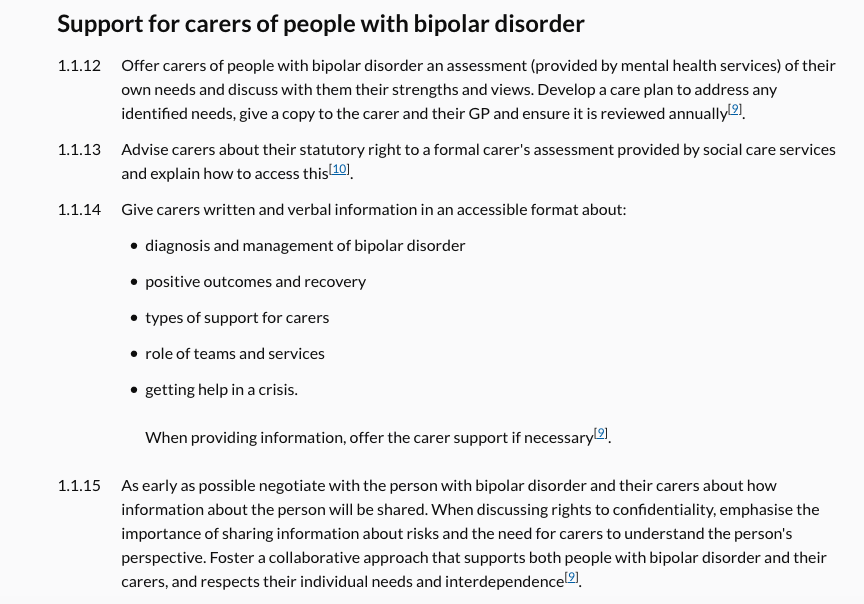
However, that does not mean that I cannot be part of the solution. NICE guidelines lay out my role beautifully but do the people on ground read any of these guidelines? In my experience, not. If half of all that is written in Policies and guidelines was implemented, families could engage meaningfully in helping their kids recover.”

Screen Shot 2019-04-23 at 23.01.58

Ref: https://www.nice.org.uk/guidance/cg185/chapter/1-Recommendations#recognising-diagnosing-and-managing-bipolar-disorder-in-children-and-young-people-2

Visiting my adolescence

Innkeeper's wife

(The mean, very mean wife of the inn-keeper. Nativity play 1983. CMC Ludhiana. India.)

Once upon a time I used to be a kid. A bright and happy kid. I nearly forgot that girl. She used to be fun. She loved singing, dancing and play-acting. She had thick black, unusually curly, short hair. She laughed easily and played harmless pranks. She listened to music on the radio with such ardour that her day was planned around the timings of her favourite programmes on the Urdu service of All India Radio. The last few pages of all her notebooks were filled with scribbled lyrics of songs written at speed to keep pace with them as they played on the old Murphy which was a part of her mother’s dowry. Then she neatly transcribed the messy song-words from the back pages of her notebooks onto a special red diary which was her treasure.

A few months back I accepted an invitation from my alma mater, Christian Medical College, Ludhiana, India.  This is where I trained to be a doctor and an anaesthetist, nearly 30 years ago. They requested me to run a Mental Health workshop for about 70 medical students and make a Keynote address at the World Junior Medical Congress they were hosting in early April.

While preparing my lecture, I dug up a few old pictures. They flew me back in time. I saw what I looked like when I was Saagar’s age. It was a strange juxtaposition. So much had changed. Oh, that heart-breaking innocence! The stars in my eyes shone so bright, they nearly blinded me. Who was this lovely girl? Where is she now? She has walked a long way and formed a big circle. She is back where she started, working with what she has – her Love, her Grief and her Self.

MH Workshop

The workshop was four and a half hours long. The sharing was powerful, the enthusiasm infectious. The learning for all of us was invaluable. It was fun! We sang and we danced. We worked and we played. It was just like the old times. Saagar was there. He was smiling his crooked smile.

“There is nothing in the world, I venture to say, that would so effectively help one to survive even the worst conditions as the knowledge that there is a meaning in one’s life.” – Victor Frankl.